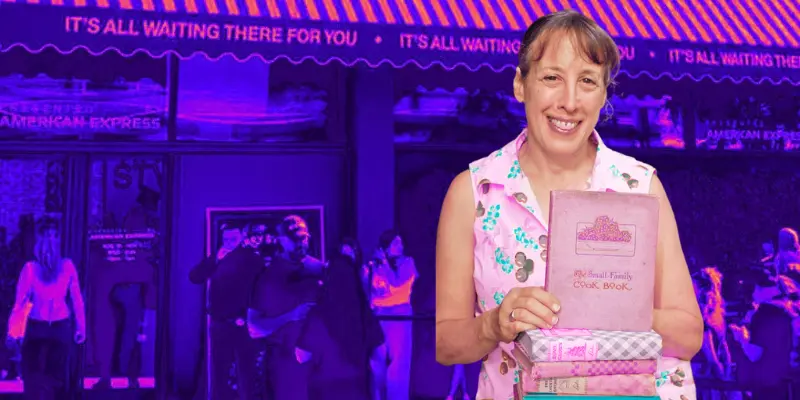
When global pop sensation Harry Styles wrapped up a landmark 30-day concert residency at Madison Square Garden, most New Yorkers assumed the singer’s local footprint would quiet down. Instead, a lingering retail phenomenon has managed to pit the Grammy-winning superstar’s sprawling commercial apparatus against one of downtown Manhattan’s most cherished and fiercely independent literary institutions. The resulting clash did not involve paparazzi or stadium gatecrashers; rather, it culminated in a bizarre neighborhood altercation that left a 30-year bookstore veteran spending a night behind bars.
Meet Bonnie Slotnick, a beloved figure in the New York City literary community and the sole proprietor of Bonnie Slotnick Cookbooks, a narrow haven of culinary history tucked away in the East Village. According to local neighborhood documentation by the urban blog EV Grieve, Slotnick was arrested on a Friday following a heated confrontation with a private security guard stationed outside a temporary merchandise shop tied to the "As It Was" singer.
The strange collision of these two vastly different worlds began back in August. Representatives for Styles erected a temporary pop-up merchandise shop on the same quiet, residential downtown block that has housed Slotnick’s specialized bookstore for three decades. While the singer’s massive fan base—often referred to affectionately by supporters as Harries—routinely generates economic activity wherever the artist goes, the reality on the ground for local merchants has proven far more complicated.
Since the pop-up opened its doors, it has drawn relentless waves of superfans who clog the narrow East Village sidewalks for hours, waiting patiently for a chance to purchase exclusive tour merchandise and memorabilia. While the phenomenon of massive street lines has become an increasingly common, if contentious, facet of contemporary New York City culture, the reality of managing thousands of eager consumers in a historic residential neighborhood requires heavy intervention. To maintain order, a dedicated line-management team featuring several private security guards was deployed to patrol the perimeter and keep the peace. However, those guards were not necessarily deployed to protect the peace of the long-time residents and independent business owners who anchor the neighborhood’s daily rhythm.
The Boiling Point on a Quiet Downtown Block
For Slotnick, the arrival of the pop-up shop brought an unwelcome disruption to her daily routine and mental well-being. Independent bookstores operate on razor-thin margins, relying on a tranquil browsing environment and steady, reliable foot traffic. The sudden influx of barricades, security personnel, and screaming fans fundamentally altered the character of the street.
As Slotnick explained in an email statement provided to the local news outlet Gothamist, the pop-up has been uniquely irksome for the block’s small-business ecosystem. She noted that the people standing in line, who predominantly travel from outside the immediate neighborhood, likely have little awareness of the logistical chaos and cumulative disruption they impose on the people who live and work there year-round.
Before the physical altercation on Friday, friction had been quietly building between Slotnick and one specific security guard for several weeks. As detailed in reports by EV Grieve, the flashpoint arrived on a routine workday when the Styles supporter was standing directly in front of the precise spot where Slotnick regularly locks up her bicycle.
What began as a verbal exchange quickly escalated. Frustrated by the obstruction and the weeks of mounting pressure, Slotnick approached the guard with her bicycle lock in hand. A physical tussle ensued on the sidewalk. During the scuffle, both individuals sustained bruised wrists, and eventually, the word "assault" was shouted across the crowded street.
The confrontation brought an immediate police response, and Slotnick was taken into custody. She subsequently spent twelve grueling hours behind bars. While neither Slotnick nor the security guard sustained serious physical injuries requiring hospitalization, the legal fallout for the veteran bookseller was severe. Slotnick walked away facing four distinct criminal counts, including charges of harassment and the possession of a weapon—the latter referring to the heavy bicycle lock she was holding during the altercation.
Navigating Public Image and Neighborhood Realities
Speaking candidly with Gothamist in the wake of her release, Slotnick did not attempt to mount a full defense of her actions, acknowledging that the unique pressures of the situation had thoroughly compromised her patience. The daily stress had taken a significant toll. She admitted that the line had wreaked absolute havoc on her mental state, adding that she felt a mounting sense of dread every time she had to commute to work for the pop-up’s five-day-a-week operating schedule.
At the same time, Slotnick expressed deep concern over how the dramatic incident might affect her professional reputation and her livelihood. She noted to EV Grieve that she was acutely aware of how easily the narrative could be framed by outside observers. She worried about becoming pigeonholed as a crabby, intolerant older resident lashing out at enthusiastic young people—an image she strongly rejects.
Preserving the integrity of her business is paramount to her. She voiced a clear desire to ensure that the details emerging from the arrest would not frighten her loyal customer base or brand her unfairly as irrational.
Beyond the personal ordeal of its proprietor, the incident has ignited a broader conversation among independent booksellers and urban advocates regarding the proliferation of corporate pop-up shops in quiet residential neighborhoods. The phenomenon of sudden, high-traffic commercial activations on side streets has increasingly drawn criticism from small business advocates across the city.
Weighing in on the wider trend, an employee at Left Hand Books pointed out the growing friction caused by pop-up lines on quiet streets. In a public statement shared on social media, the bookstore representative argued that these lines—which are frequently tied to corporate entities and private-equity-backed business ventures—severely impede pedestrian traffic flows, obstruct small businesses, and disrupt local residents. Furthermore, they noted that these manufactured crowds rarely arise as an organic expression of a given neighborhood’s distinct culture or street life.
As the legal process moves forward, representatives and public relations teams for Harry Styles have yet to issue a public comment regarding the altercation or the ongoing neighborhood tensions surrounding the downtown merchandise shop. Meanwhile, Bonnie Slotnick continues to navigate the aftermath of an unforgettable encounter that turned a quiet corner of the East Village into a flashpoint for the growing friction between modern pop culture juggernauts and traditional urban mainstays.