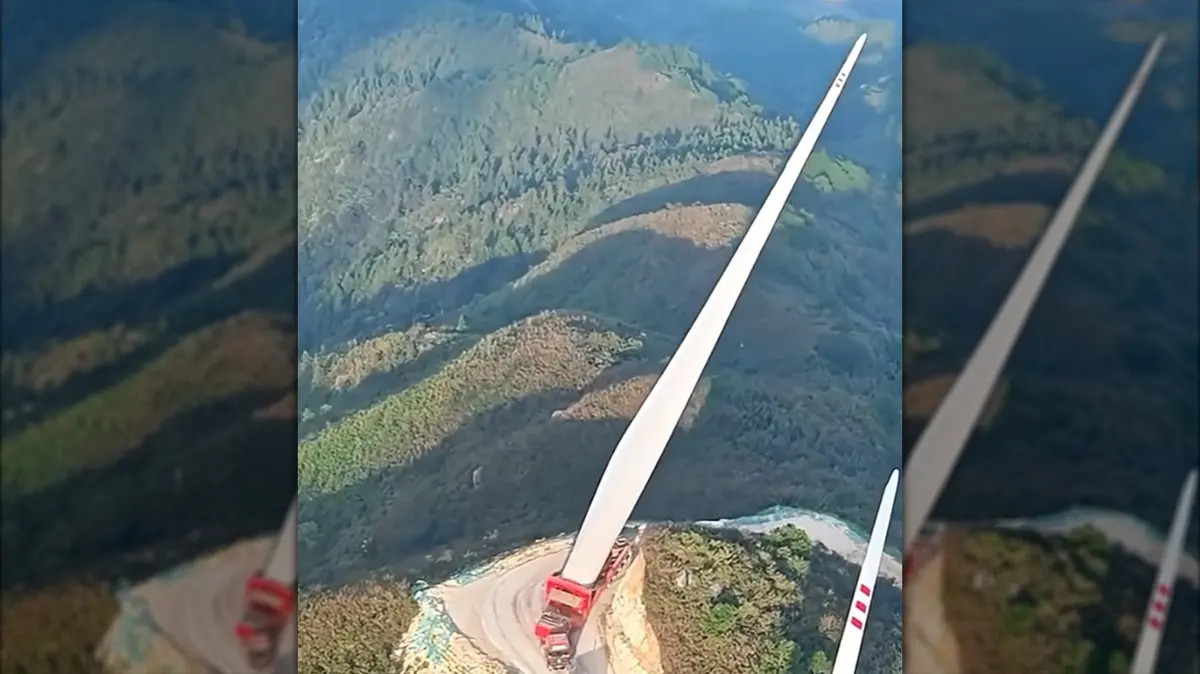
Driving for a living is inherently demanding, requiring constant vigilance against the combined hazards of high speeds, human error, and massive machinery. But for the specialized drivers tasked with transporting colossal wind turbine blades up winding, narrow mountain roads, a single day at work can feel like it ages a person by years. The pressure is immense, the stakes are high, and the margin for error is virtually nonexistent.
A video released by CGTN Europe highlights the extraordinary lengths—and heights—that truckers in China are willing to go to in order to supply the infrastructure for renewable energy. This treacherous drive through the rugged Nanling Mountain Range in Hunan, China, resembles threading a needle in the middle of a windstorm. In the footage, a skilled trucker is seen deftly maneuvering an 80-tonne, 172-foot-long windmill blade up the soaring, 1,312-foot-high Baoding Mountain.
Operating in such environments requires a rare level of concentration and extraordinary skill to navigate some of the world’s most remote, precipitous, and constrained mountain routes. A momentary lapse in focus can lead to catastrophic consequences, potentially sending a vehicle plunging over a severe drop beyond the edges where guardrails are entirely absent. This particular truck driver is unquestionably a contender for having one of the most stressful and dangerous jobs in the entire world. Yet, for many observers, the initial reaction is one of sheer perplexity: how can a conventional truck or specialized carrier even manage to transport an object of such immense proportions through terrain that seems practically impassable?
Slow, tall and steady
To successfully transport an object as massive and unwieldy as a modern wind turbine blade, standard commercial vehicles are entirely inadequate. Instead, highly specialized trucks and heavy-duty trailers are custom-built to the exact engineering specifications of the cargo. According to insights from Trucker Culture, these specialized trailers and haulers are equipped with an ingenious blade lifter system designed to tackle obstacles that would otherwise halt transport completely.
The root of the massive blade is securely mounted to a specialized frame on the carrier, which is outfitted with powerful hydraulic lifters. These hydraulic systems are the crucial mechanism that enables the heavy-duty rig to navigate narrow, twisting mountain paths, while clearing local obstacles such as residential homes, dense forests, intricate power lines, overhead bridges, and virtually any other obstruction that might block the path.
The hydraulic lifter is capable of raising the towering blade upwards of 60 degrees, and in certain specialized operational videos, some systems can push even closer to a vertical 90-degree angle. This capability becomes profoundly advantageous when the convoy encounters tight turns and hairpin switchbacks on steep mountain ascents. By elevating the blade into the air, the overall physical footprint of the truck is significantly reduced, helping to prevent the dangerous scenario where the rear of the truck and the trailing end of the blade hang precariously over the edge of a sheer mountain drop.
The vehicles seen traveling alongside the main semi-truck in the footage serve a vital operational purpose beyond simple escort duties. These support teams are tasked with surveying the route ahead, actively removing unexpected obstacles, and directly guiding the truck driver through exceptionally precarious situations. In many instances, this coordination is executed via continuous radio communication, particularly when slight, highly precise movements are mandatory and the massive blade or the truck itself has mere feet of clearance from the jagged rock face or the open abyss below.
Weather conditions can also instantly elevate the threat level of an already perilous transport operation. Wind turbine blades are aerodynamically engineered to catch and harness the wind, a design feature that unfortunately remains true even when the blade is lashed to the back of a moving heavy-duty truck. Encountering a sudden, powerful gust of wind at the exposed summit of a mountain, such as the peak featured in the footage, creates an intensely hazardous scenario for everyone involved in the transport convoy.
When severe weather strikes at high elevations, Mother Nature often forces the entire operation to a complete standstill until environmental conditions stabilize and clear. Attempting to push forward against severe mountain winds risks bringing down the entire caravan, potentially resulting in an unintentional and dangerously rapid descent back down the mountain face. For the drivers and crew members managing these colossal components of green energy infrastructure, patience and meticulous calculation remain just as vital as the heavy machinery they operate.