For decades, the high-energy sky has been defined by the blink-and-you-miss-it nature of short gamma-ray bursts. These violent, fleeting signals, which typically vanish in less than two seconds, have served as the primary beacons for astronomers tracking the catastrophic collisions of neutron stars—the ultra-dense, city-sized remnants of exploded massive stars. However, a groundbreaking discovery by an international team of researchers suggests that these cosmic cataclysms are far more complex than previously understood. New evidence indicates that some neutron star mergers may produce intense X-ray flashes that persist for minutes, offering a new window into the extreme physics of the universe.
A study recently published in the journal Science Bulletin presents compelling evidence for this phenomenon. The findings provide a potential solution to a long-standing mystery in astrophysics: the origin of enigmatic, bright X-ray transients that have baffled researchers since the launch of the Einstein Probe satellite in January 2024. By linking these long-lasting X-ray signals to neutron star mergers, astronomers are opening a new frontier in the study of stellar evolution and the birth of exotic celestial objects.
The Mystery of Fast X-Ray Transients
Since it began its mission, the Einstein Probe satellite has detected hundreds of bright X-ray flashes emanating from distant galaxies. These events, known as "fast X-ray transients," have presented a significant challenge for the scientific community. While some of these flashes have been definitively traced to the terminal explosions of massive stars, many others have remained shrouded in mystery.
The difficulty in categorizing these events stems from the inherent limitations of deep-space observation. Astronomers often struggle to determine the exact distance to these sources, which in turn makes it nearly impossible to calculate the total energy released during the flash. Without these critical data points, classifying the transient as a routine stellar death or a more exotic phenomenon has remained a matter of speculation.
The Birth of a Magnetar
The breakthrough came through the efforts of a research group led by Professor Eleonora Troja, with support from a European Research Council (ERC) Consolidator grant. The team’s focus was on a specific, intriguing X-ray transient that triggered an immediate, coordinated response. Upon receiving an alert from the Einstein Probe, the researchers mobilized a global network of instruments, including the European Southern Observatory’s Very Large Telescope (VLT) in Chile and the Very Large Array.
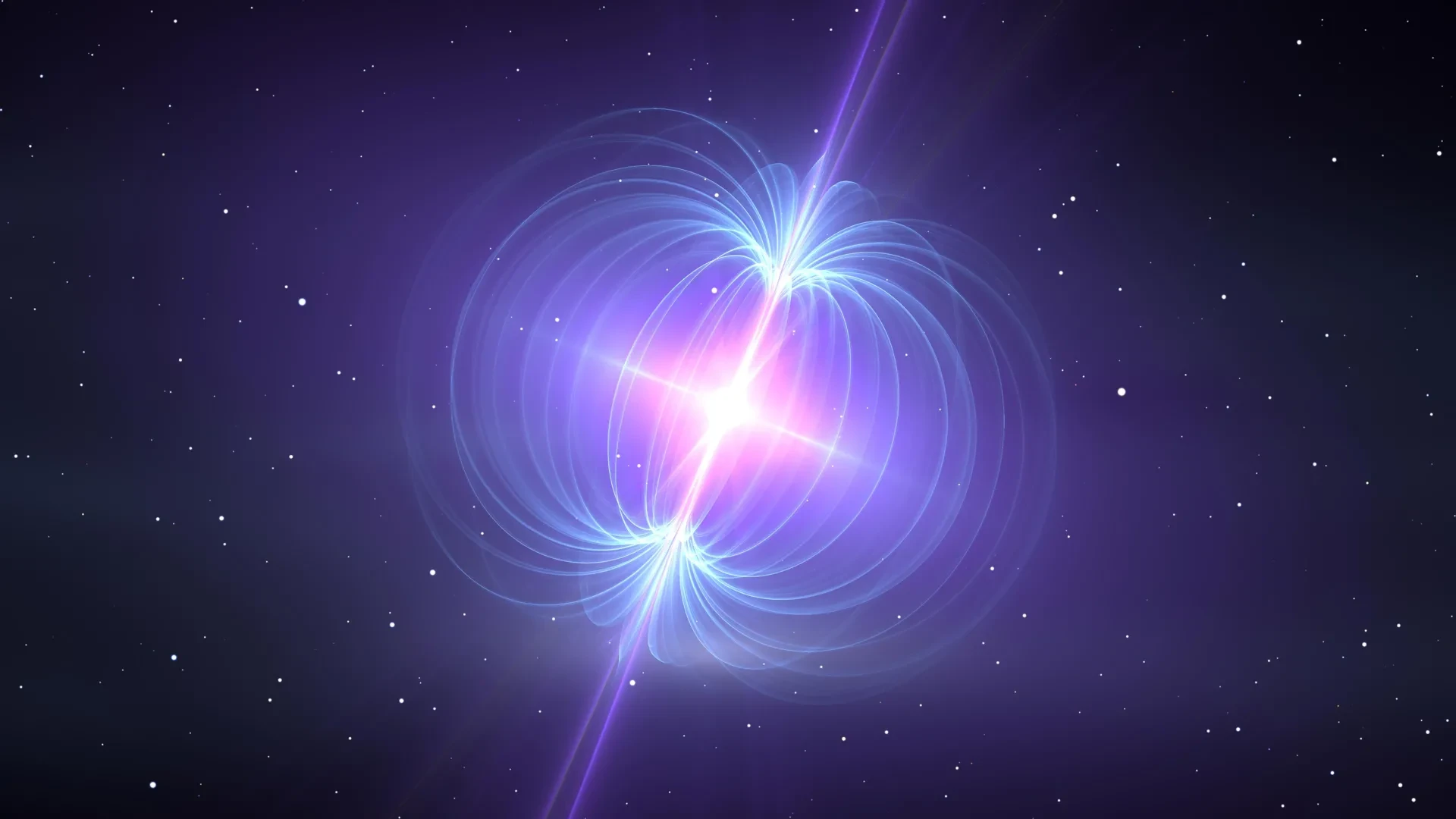
By analyzing the "afterglow"—the fading light left behind in the wake of the initial explosion—the team reached a startling conclusion: they had likely witnessed the creation of a magnetar. A magnetar is a rare, highly specialized type of neutron star characterized by an incredibly powerful magnetic field. When two neutron stars collide, they generate ripples in spacetime known as gravitational waves. While short gamma-ray bursts have traditionally been the hallmark of these events, the team’s findings suggest that if the remnant left behind is a magnetar, the physics of the aftermath changes dramatically.
"If the remnant of the collision is a magnetar, it could keep bursting for longer," explains Professor Troja, a member of the Einstein Probe European collaboration and co-corresponding author of the study. "Magnetars are rapidly spinning neutron stars with huge magnetic fields. When they damp their magnetic power into the surroundings, they can make any explosion brighter and longer-lasting. When I saw the X-ray data from this new event, I realized something was up."
A Record-Breaking Observation
The event, cataloged as EP250704a/GRB 250704B, was first detected on July 4, 2025, by a suite of advanced observatories, including the SVOM mission, the Insight-HXMT, and the Einstein Probe. The initial gamma-ray burst followed the traditional pattern, lasting for only half a second. However, the X-ray signature told a very different story: the Einstein Probe recorded bright X-ray emissions that persisted for nearly ten minutes.
This duration is unprecedented in the context of neutron star mergers. "This is the longest-lasting prompt X-ray flash ever observed from a neutron star merger," says Niccolò Passaleva, a graduate student who spearheaded the follow-up observations using the VLT. "It is an opportunity to have a front-row seat to the most extreme forces of the universe and discover more of its secrets."
For Passaleva, the discovery was a high-stakes race against time. The team had spent years searching for a smoking gun that would connect these fast X-ray transients to neutron star mergers, but previous candidates had faded too rapidly to allow for detailed analysis. When EP250704a occurred, Passaleva managed to trigger observations while the light was still bright enough to be studied.
"I was traveling home by train," Passaleva recalls, "and all of a sudden I was rushing against time to commandeer one of the largest telescopes in the world from my laptop."
Measuring Light Across Six Billion Years
To confirm the nature of the event, the team used the VLT’s X-Shooter instrument to break the light into its spectral components. By identifying specific absorption patterns, the researchers calculated the event’s redshift—a measure of how much the light has been stretched by the expansion of the universe as it traveled toward Earth.
The result was a redshift of z=0.6610, indicating that the light had traveled for more than six billion years to reach our sensors. This means the event occurred long before the formation of our solar system. To solidify their hypothesis that this was a neutron star merger rather than a massive star collapse, the team conducted deep observations with the VLT’s FORS2 instrument to search for a supernova.
In the case of a massive star dying, a bright supernova explosion is expected. The team found no such signature. The combination of the event’s vast distance, the absence of a supernova, and the unique, long-lasting nature of the X-ray flash provided robust evidence that they had observed the aftermath of two neutron stars merging into a magnetar.
A New Era of Discovery
This discovery provides astronomers with a vital new tool. If more of these long-duration X-ray flashes are identified, researchers will be able to statistically determine how often neutron star mergers result in the formation of magnetars. This, in turn, helps refine models of how matter behaves under the most extreme densities and magnetic pressures in the known universe.
"Finding more of these X-ray flashes could help reveal how often neutron star mergers create magnetars," Passaleva concludes. "I am really excited for the next run of gravitational wave observations, when we could finally pair one of these X-ray flashes with a burst of gravitational waves from the same source."
The research represents a triumph of international cooperation, involving an extensive collaboration of astronomers from institutions including Beijing Normal University, the Chinese Academy of Sciences, the University of Rome Tor Vergata, Nanjing University, and The University of Hong Kong. The VLT observations were conducted under the large research program "QUEENB: a QUEst for Elusive Neutron star and Black hole mergers," led by Professor Troja.
As technology improves and the sensitivity of satellite observatories like the Einstein Probe continues to yield data, the sky is becoming increasingly transparent to the violent, hidden history of the cosmos. Every long-lasting flash detected brings scientists one step closer to understanding the ultimate fate of the densest objects in the universe.