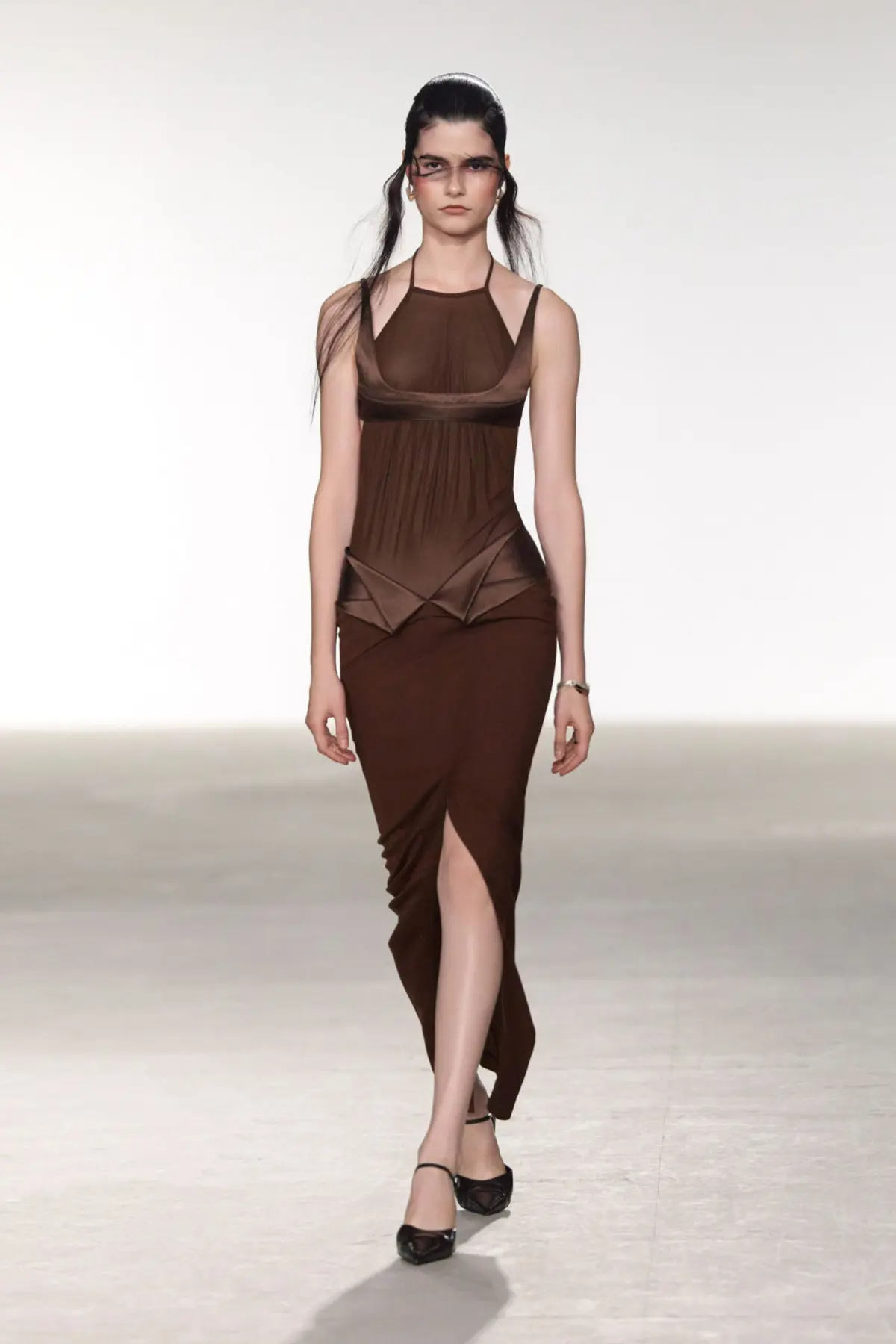
The conceptual framework could easily have tipped into solemnity in lesser hands, risking a heavy-handed theatricality that often plagues collections born from sorrow. However, Yin’s vision proved remarkably persuasive precisely because opposing impulses were allowed to play off each other naturally, without ever being forced into a neat or artificial reconciliation. The runway presentation unfolded as a visual meditation on vulnerability and resilience, capturing the reality that human healing is rarely linear and often messy, contradictory, and incomplete.
Throughout the collection, sharp tailoring and neat, architectural contours met liquid draping, floating chiffon, and washed, timeworn surfaces. This deliberate juxtaposition of structure and fluidity lent the garments a distinct sensuality that became all the more intriguing whenever precise construction gave the softer elements substance and allure. It was a masterclass in balance, reflecting a thoughtful and sophisticated design sensibility that has been steadily cultivated throughout Yin’s career.
Before launching his own distinctive voice at Oude Waag, Yin previously worked closely with Haider Ackermann, an experience from which he absorbed invaluable lessons regarding the rigorous geometry of tailoring and the poetic possibilities of draping. Reflecting on this background, the designer explained his ongoing fascination with the interplay of garment construction techniques.
"I see a connection between draping and the flat-cutting techniques of Eastern and Japanese design, and I try to bring these approaches together in a modern way," Yin explained backstage, discussing the technical foundation of his work. "Draping is a form of drawing, even sculpture, requiring the eye, mind, and hands to work as one."
That elaborate yet fluid hands-on approach came through vividly in the physical construction of the garments, where fabrics were frequently knotted, twisted, and organically gathered around the body. Rather than relying on standard seams to define the silhouette, the textiles seemed to react to the human form in real-time, echoing the unpredictable movements of everyday life.
To further complicate and enrich the visual narrative, ink-splash prints—inspired by the pomo technique of traditional Chinese ink painting—introduced a vital element of chance and spontaneity into an otherwise rigorously calibrated composition. The ink motifs bled across surfaces in unexpected ways, mirroring the uncontrollable nature of emotional upheaval. The color palette itself served as a narrative arc: earthy browns and muted grays dominated the initial looks, grounding the collection in a subdued, protective atmosphere. Eventually, these somber tones gave way to a sudden, striking slash of crimson, suggesting a renewed appetite for life rather than making a grand, theatrical declaration of recovery.
The emotional resonance of the collection lay precisely in its refusal to offer easy answers. The concept was compelling not because it promised a miraculous healing, but because it honestly acknowledged that life rarely proceeds in a straight, predictable line. The clothes were at their most convincing when they gave physical form to that complex psychological idea, allowing for internal contradictions and unexpected narrative turns without ever feeling obliged to spell everything out for the audience.
In an industry often obsessed with immediate perfection and loud statements, Yin’s understated approach felt refreshingly mature. Summing up the overarching ethos that guides his creative process and his deep fascination with the wearers of his clothes, Jingwei Yin offered a simple yet revealing perspective.
"I love women’s complexities," the designer said. "But above all, I’m drawn to their mystery."