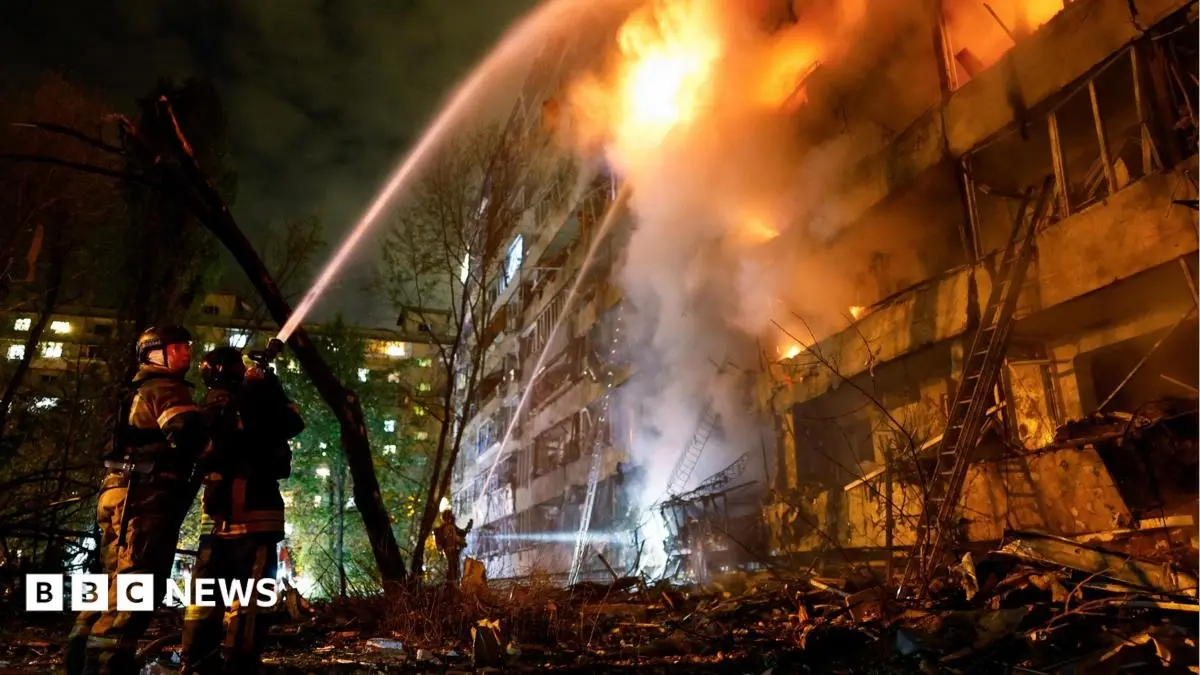
A critical energy facility supplying heating and electricity to the Ukrainian capital has been struck by a Russian ballistic missile, marking a significant escalation in hostilities just days after high-level diplomatic efforts were announced to secure an energy ceasefire. Ukrainian President Volodymyr Zelensky confirmed the strike on Darnytska CHP-4 (CHPP-4), an essential node in Kyiv’s infrastructure, and lamented that the attack occurred without any early warning from international partners.
The assault, which struck both the power plant and a residential building, has left the city reeling. Kyiv Mayor Vitali Klitschko reported that the missile strike on the apartment block, which occurred late on Tuesday, resulted in two confirmed fatalities and left at least 21 individuals injured. Mayor Klitschko further indicated that "several energy facilities" across the city had been targeted in the barrage, though specific details regarding the full extent of the damage remain under assessment.
The atmosphere in Kyiv remains tense as local officials have issued a red alert due to an ongoing "missile threat." Residents have been urgently advised to seek safety in shelters as the city navigates the aftermath of consecutive nights of bombardment. By the early hours of Wednesday, Mayor Klitschko confirmed that the scale of the "massive missile attacks" had successfully knocked out power across various sectors of the capital.
A Fragile Ceasefire Under Strain
The renewed bombardment of Kyiv’s energy grid comes against a backdrop of diplomatic uncertainty. Only two days prior, US President Donald Trump announced that a tentative energy ceasefire had been agreed upon by both Russia and Ukraine. However, the events of the past 48 hours have cast significant doubt on the viability of that agreement.
President Zelensky expressed deep frustration following the latest strikes, highlighting the stark disconnect between the diplomatic rhetoric and the reality on the ground. "Ukraine supported an energy ceasefire. Russia is targeting yet another power plant and the lives of our people," Zelensky stated. He emphasized the gravity of the intelligence gap, adding, "This is absolutely unjust: when they are destroying our energy infrastructure, and Ukraine is not even receiving early warnings about ballistic missile launches."
Zelensky’s comments were underscored by a direct appeal to the international community. "It is important that the world does not stay silent about this," the President said. "And it is important that the United States really see what is happening and who is responsible for this war continuing."
The intensity of these strikes—the second consecutive night of attacks on Kyiv—coincides with a pivotal moment in international diplomacy. President Zelensky is currently preparing to travel to London to meet with UK Prime Minister Andy Burnham at Downing Street on Wednesday. The primary focus of their discussions is expected to be the urgent acceleration of air defense supplies to Ukraine, a request that has taken on new criticality following the apparent failure of the energy truce.
Intelligence Disputes and Diplomatic Deadlocks
The lack of early warnings reported by the Ukrainian government has fueled intense speculation regarding the status of intelligence sharing between Kyiv and Washington. Following strikes on Monday night, rumors circulated that the United States had restricted Ukraine’s access to key intelligence data, which is vital for tracking and intercepting incoming Russian threats.
Earlier on Tuesday, President Trump firmly denied those allegations. "We are helping them and we are sharing intel," Trump stated. Addressing the broader context of the conflict, he reiterated a desire for a resolution: "We want the war to end. So we’re working with them and with Russia on getting the war to end."
When questioned specifically about the Russian strikes on Ukrainian energy infrastructure—which would appear to be a direct violation of the spirit of the reported ceasefire—Trump was more circumspect. He deflected the suggestion that Russia had breached an agreement, noting that "Ukraine hit many sites the day before." While he acknowledged that both nations ostensibly want the conflict to "come to an end," he admitted that there remains a significant impasse, stating, "we just don’t know how to get there."
The geopolitical maneuvering follows comments made by President Zelensky on Sunday, where he proposed a 60-day ceasefire. The Ukrainian leader suggested such a pause would provide the necessary stability to hold national presidential elections, a move that followed public remarks from President Trump suggesting that "it’s time for Ukraine to get a new president."
The Russian response to the proposal was immediate and dismissive. Russian Foreign Minister Sergey Lavrov argued that Ukraine did not merit the "respite" that a ceasefire would afford. Lavrov further articulated Moscow’s strategic skepticism, suggesting that any pause in hostilities would merely allow European nations to "pump [Ukraine] with new weapons," thereby enabling the continuation of the conflict.
The Vulnerability of Kyiv’s Power Grid
The focus of the most recent strike, Darnytska CHP-4, remains a symbol of the immense pressure on Ukraine’s civilian infrastructure. The plant is a vital utility provider, supplying heat and electricity to the Dniprovskyi district and significant portions of the Darnytskyi district. Because of its critical role in maintaining the city’s habitability, the facility has been targeted multiple times throughout the duration of the war.
The plant suffered catastrophic damage in a Russian missile attack in February of this year, an event that forced its complete shutdown. The humanitarian impact of that earlier strike was severe; according to reports from the time, the damage left more than 1,000 residential buildings without heat or hot water. The disruption also paralyzed essential public services, affecting 47 schools, 72 kindergartens, and 18 medical institutions.
As Kyiv residents face the prospect of another prolonged period without electricity, the vulnerability of such sites remains a primary concern for the Ukrainian government. The targeting of these facilities is viewed by Kyiv as an attempt to degrade the morale of the population and create a humanitarian crisis as winter approaches.
As Wednesday progresses, the focus of the global community will shift toward London, where the meeting between Zelensky and Prime Minister Burnham is expected to provide more clarity on the future of Western military support. With the ceasefire effectively in tatters and the energy grid under renewed assault, the pressure on Kyiv to secure advanced defensive systems has never been higher. For the people of Kyiv, however, the immediate concern remains the restoration of power and the safety of those living under the constant threat of ballistic fire. The events of this week have served as a stark reminder that the path to a sustainable peace remains fraught with technical, military, and diplomatic obstacles that have yet to be overcome.