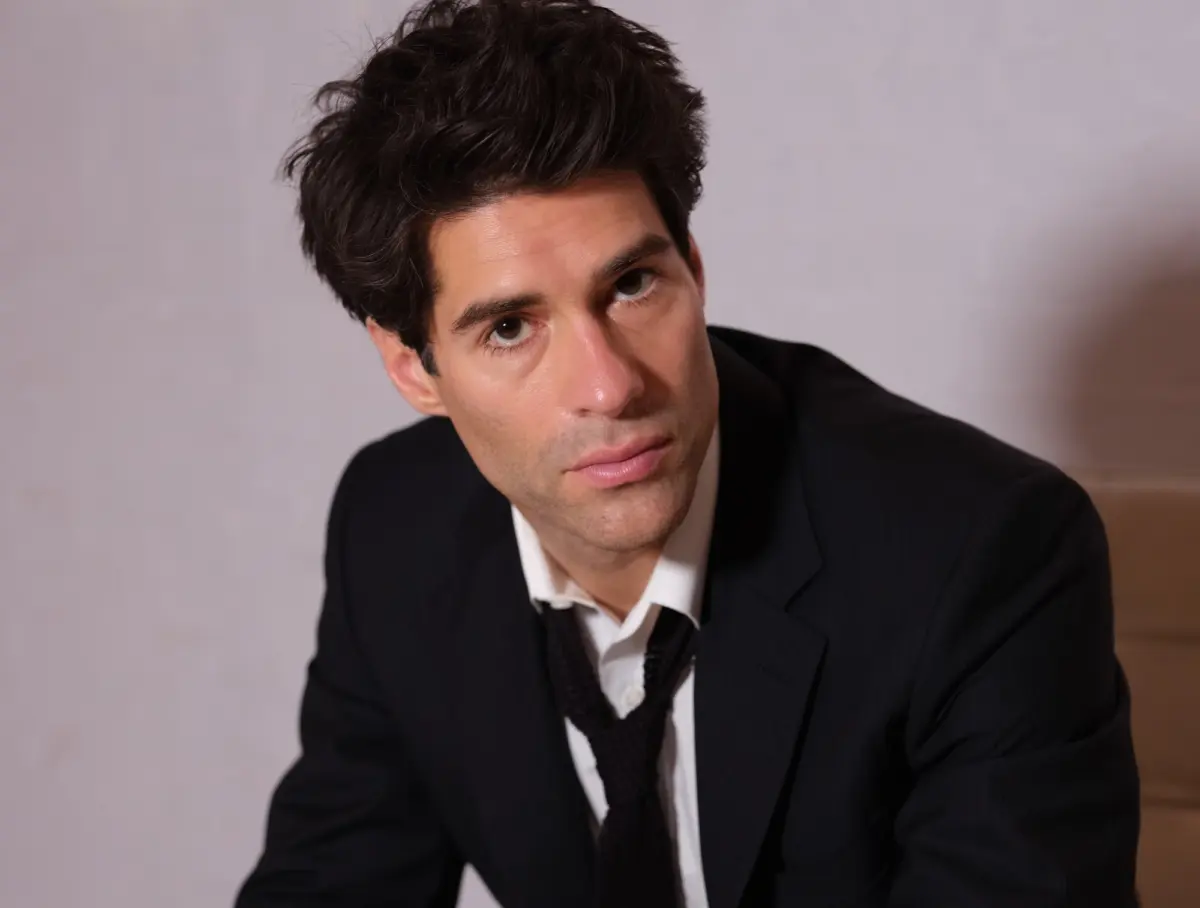
I have sat down with countless successful entrepreneurs, entertainers, and innovators throughout my career, but Asher Grodman holds a distinction that is perhaps singular in the history of television: he has achieved breakout fame largely while wearing no pants. As the scene-stealing Trevor on the hit CBS comedy Ghosts, Grodman portrays a deceased finance bro whose afterlife is defined by his permanent state of undress—a result of the unfortunate circumstances surrounding his death. It is a bold, commitment-heavy performance that has catapulted him into the spotlight, but behind the comedic premise lies a story of grit, artistic philosophy, and a refusal to take oneself too seriously.
On the eve of the show’s highly anticipated Halloween special, I caught up with Grodman via a video call from his trailer on the set of Ghosts. As we settled into the conversation, the reality of his role became immediately apparent. When asked the inevitable question—whether he was currently wearing trousers during our interview—he offered a laugh. "I am at this moment wearing pants," he admitted, "but I’ve got about two hours left of pantness in my life."
It is easy to assume that a character defined by such a specific, recurring gag might eventually wear thin, or that an actor would grow weary of the lack of wardrobe. However, Grodman’s approach to the character of Trevor is rooted in a profound acceptance of the absurd. When asked if there are days he wishes the writers would shift the character’s direction or allow him to "suit up," he is quick to clarify that he fully embraces the pantlessness.
"There are never days that I wish they wrote it differently, but there are certainly days where you’re just like, ‘pants would be so lovely,’" Grodman said. "When I get to do something else and I get to wear pants, it feels like such a power move."
For Grodman, the lack of pants functioned as more than just a character quirk; it served as a creative safety net during the show’s nascent stages. As someone who had never worked in the comedy genre before landing the role, the inherent humor of his situation provided a comfortable baseline. "The idea of me not wearing pants was kind of like a safety net," he explained. "I was like, ‘Well, if I don’t hit a joke, they’ll just switch up the angle and reveal my thighs, and that should get a chuckle at least.’"
The transition from traditional acting to the fast-paced, high-stakes world of network sitcom comedy is notoriously difficult, often triggering the familiar specter of imposter syndrome. Many performers struggle when faced with a pivotal career moment, questioning their right to occupy a space they have not previously navigated. When Grodman auditioned, he recalled a pointed inquiry from showrunner Joe Port: "Who are you? You’ve never done a comedy."
Grodman’s response, which he notes came from an intuitive place, crystallized his entire philosophy on the craft. "I remember saying—I don’t know where this came from—that comedy is just drama but more serious," he recalled. "You’re just committed to being an idiot, to some degree, or whatever the thing asks you to be."
He points to the very first line Trevor speaks in the series—a brash, entitled declaration about scooping a helicopter to bypass traffic for a trip to the Hamptons—as the key to unlocking the character. It was a moment of extreme specificity. Rather than trying to "be funny," Grodman focused on the internal logic of a man who possessed such a singular, unwavering point of view. "I was like, ‘I know who this is,’" Grodman said. "A lot of my job is going to be to get out of the way of the comedy, because that’s working, and just make sure that there is a heart to this guy. I approached it as an actor. I didn’t approach it with the intention of, ‘I have to make this funny.’"
This commitment to character, rather than caricature, is a theme that extends beyond the screen and into the environment he and his castmates have fostered in Montreal. While many might imagine the lifestyle of a television star to be defined by the isolation of high-end, private trailers, Grodman insists that the reality is much more communal.
"This is going to be really disappointing, because we really haven’t been in those trailers since season two," he noted. The crew on Ghosts constructed a "cast village," a series of intimate rooms and offices where the ensemble spends their time. The centerpiece of this space is a large, Thanksgiving-style table where the cast gathers to work, play, and engage in the kind of camaraderie that fuels their on-screen chemistry.
Grodman emphasizes the importance of this environment, especially when guest stars arrive on set. Instead of allowing them to retreat into the isolation of their own trailers, the cast invites them into the "gaggle of idiots" around the table. "We’ve all had the experience of being on other shows and feeling like you’re the guy who was called in to do one play and then they all beat you up on the sideline," he explained. By creating a welcoming space, they ensure that the creative energy remains fluid, with the "ball" being passed naturally between actors. For Grodman, that table has become one of his favorite places in the world.
Beyond his work on Ghosts, Grodman is perhaps most famous among sports fans for his long-standing, vocal support of the Jacksonville Jaguars. His passion for the team eventually merged with his creative output through a viral video series centered on the conspiracy theory that the NFL is "scripted."
The collaboration began after someone from the Jaguars organization reached out during the airing of the first season of Ghosts, curious if Grodman’s public fandom was genuine. After a conversation in which Grodman did not shy away from critiquing past management decisions, he was brought into the fold. When the 2022 season saw the team make a playoff run amidst a flurry of online speculation about the league being "scripted," Grodman pitched a full mockumentary concept.
The organization’s response was immediate: they asked him to write and direct it. "I was like, ‘Well, I got a really cushy thing going on here as the outsider,’" Grodman joked about the risks of taking on the project. "I’m sitting with the owner and watching these games on the sideline, and I really don’t want to ruin that, because if you’re going to blame anyone when it fails, you’re going to blame me."
The resulting project proved to be a highlight of his career, shot in just two days across 42 scenes. It was a masterclass in efficiency, one he credits directly to the lessons learned on the set of Ghosts. "That show has taught me to shoot fast," he said.
As our conversation turned toward the future and the reality of the industry, Grodman offered grounded advice for those still trying to break through. He acknowledges that while the "stick-to-it" mentality is standard advice, it is also fundamentally accurate. He stresses the necessity of self-care, noting that the sheer volume of "at-bats" required to succeed can be grueling.
"You can have a hundred auditions and get one. That’s not a reflection of talent," Grodman said. "There are so many circumstances outside of your control."
He advocates for the cultivation of a specific kind of confidence—one that is stripped of ego. He admits he is still working on this balance himself, aiming to embrace the unknown and the possibility of failure while maintaining enough self-worth to continue pushing forward. "To feel comfortable in failure. That’s really important," he noted.
Above all, Grodman emphasizes the importance of showing up and being present. Whether it is walking into an audition room with a stranger or stepping onto a set to film a scene, he views the process as an electric, living experience. "I get such a thrill walking into a room and meeting a reader who I don’t know and figuring out a way to take this thing that’s written on the page and making it feel like we’re improvising," he said. "It is just an electric, thrilling thing. Be in the moment."