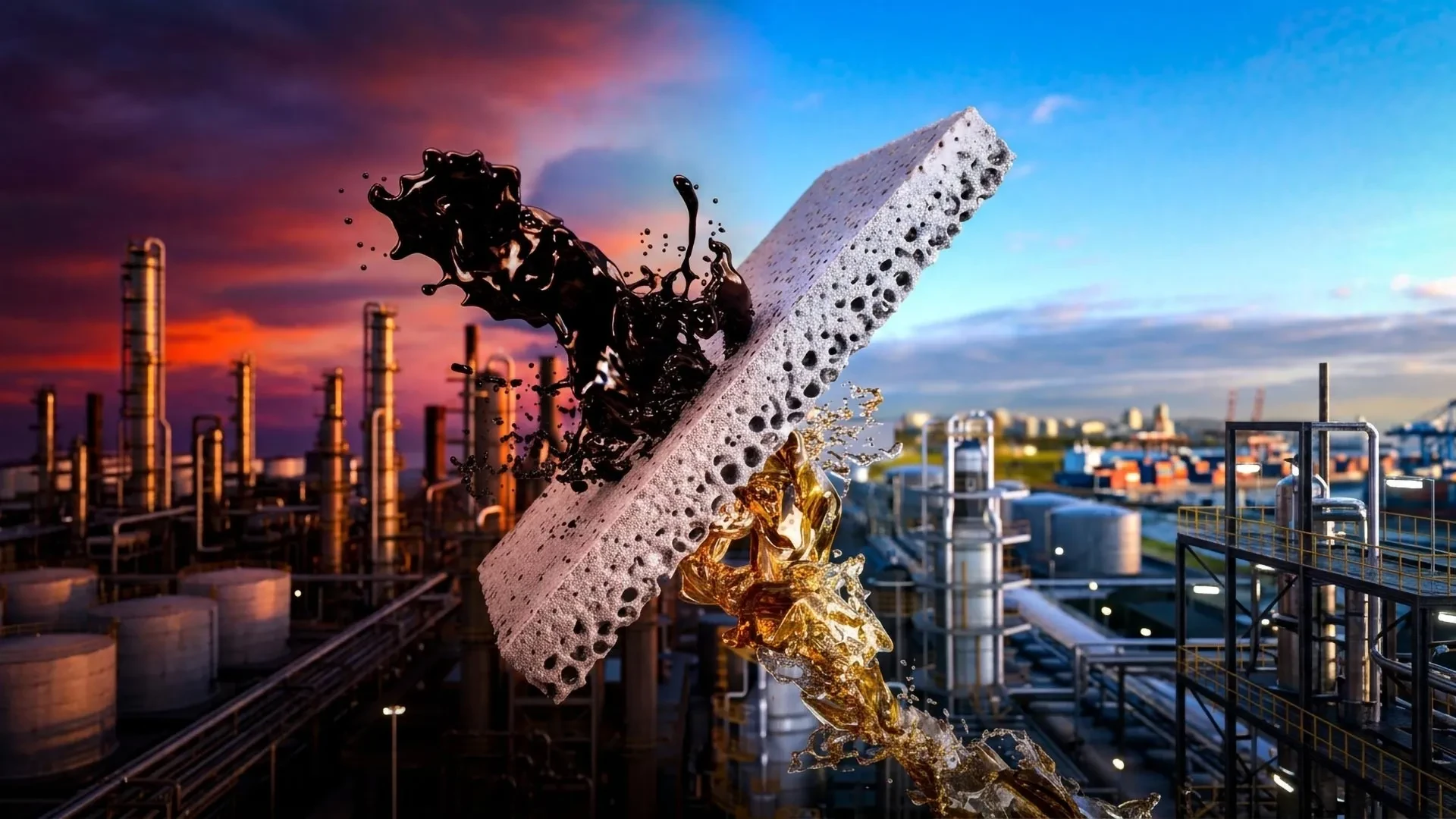
In a development that could fundamentally reshape one of the most energy-intensive sectors of the global economy, researchers have unveiled a revolutionary method for separating crude oil without the need for high-temperature distillation. By utilizing a simple, inexpensive membrane that essentially "self-assembles" to perform complex molecular filtration, a collaborative team led by the Korea Advanced Institute of Science and Technology (KAIST) and the Georgia Institute of Technology has demonstrated a pathway to drastically lower the refining industry’s carbon footprint and operational costs.
The study, which was recently published in the prestigious scientific journal Nature, represents a significant milestone in chemical engineering. The research effort was spearheaded by Professor Dong-Yeun Koh at KAIST, in partnership with Professor Ryan Lively’s research group at Georgia Tech. According to an official announcement from KAIST, led by President Kwang Hyung Lee, the team successfully demonstrated that a specialized membrane could effectively separate crude oil components at room temperature—a stark departure from the heat-heavy processes that have defined the industry for over a century.
The Heavy Toll of Conventional Refining
To understand the magnitude of this discovery, one must look at the current state of the global petrochemical landscape. Crude oil serves as the foundational feedstock for an immense array of products, ranging from transportation fuels like gasoline and kerosene to the raw materials required for plastics, textiles, packaging, and myriad consumer goods. Because the refining process is so deeply embedded in the production chain, any inefficiency in how oil is separated translates into higher costs for virtually every sector of the modern economy.
For more than a hundred years, the backbone of this industry has been thermal distillation. This process requires heating crude oil to temperatures exceeding 350 degrees Celsius to vaporize its components, which are then cooled and collected as separate fractions. The energy requirements for this process are staggering. Global crude oil distillation consumes approximately 1,100 terawatt-hours (TWh) of energy annually. To put this into perspective, the energy consumed by this single industrial process is equivalent to the combined annual electricity output of roughly 130 one-gigawatt nuclear power plants operating at full capacity.
This immense energy demand makes distillation a primary contributor to both fuel consumption and greenhouse gas emissions within the industrial sector. As economic pressures mount and global climate goals become increasingly stringent, the petrochemical industry has been under growing pressure to identify and adopt more sustainable, low-energy alternatives.
Challenging the Membrane Paradigm
Membranes have long been touted as the "holy grail" of separation technology because they theoretically allow for the sorting of molecules without the need for extreme temperature changes. However, the path to industrial adoption has been fraught with technical obstacles. Traditionally, the scientific community operated under the assumption that for a membrane to be effective at molecular separation, it required a highly complex, ultra-thin, and specialized surface coating.
These coatings, while effective at achieving the necessary precision for chemical separation, carry significant drawbacks. They are expensive to manufacture, and, more importantly, they are prone to developing microscopic defects during the transition from laboratory-scale testing to large-scale industrial production. These limitations have historically prevented membrane technology from displacing the well-entrenched, albeit energy-hungry, distillation columns of traditional refineries.
A Counterintuitive Discovery: Turning Fouling into a Feature
The KAIST and Georgia Tech research team decided to bypass the industry-standard reliance on complex coatings. Instead, they opted to use a bare, porous polyacrylonitrile (PAN) membrane. PAN is an inexpensive, chemically robust polymer that is already a staple in industrial filtration, typically used as a structural support material rather than the primary filtration medium.
What the researchers observed when they introduced crude oil to this "unadorned" membrane was both surprising and transformative. As the oil began to flow through the pores of the PAN material, the heavier hydrocarbon molecules within the crude oil naturally began to accumulate along the inner walls of the pores. This phenomenon, which the researchers termed a form of controlled "fouling," was the key to the entire process.
In any other filtration context, fouling is considered a catastrophic failure. It is the process by which a filter becomes clogged, reducing performance and necessitating frequent, costly cleaning or replacement. However, in this specific application, the buildup of heavy molecules served to effectively narrow the membrane’s pores, creating extremely precise channels measuring less than 2 nanometers across. In effect, the crude oil was not just being filtered; it was actively participating in the creation of the microscopic infrastructure required to separate its own components.
These spontaneously formed channels acted as a highly selective sieve. Lighter fractions—including valuable products such as naphtha, gasoline, and kerosene—passed through the membrane with ease, while the heavier substances were effectively blocked. The results were record-breaking: the uncoated PAN membrane achieved crude oil permeation rates approximately 23 times higher than those previously reported for leading experimental separation membranes. Perhaps most significantly for industrial viability, the membrane maintained stable performance for 28 consecutive days of operation.
Professor Ryan Lively of Georgia Tech highlighted the industrial implications of these findings, noting that a primary hurdle for membrane systems had always been the low productivities of previous units. By leveraging this surprising mechanism, the team has managed to dramatically increase productivity to a point where industry leaders can no longer afford to ignore the potential for adoption.
The Path to Industrial Integration
One of the most compelling aspects of this technology is its compatibility with existing infrastructure. Refineries would not necessarily need to engage in a total overhaul of their facilities to implement these membranes. Instead, the membrane could be integrated as a modular, "add-on" filtration system that processes crude oil before it enters the energy-intensive distillation equipment. By separating a significant portion of the lighter fractions at room temperature, the load on the heating and distillation stages would be substantially reduced, allowing the facility to function more efficiently while utilizing its current, multi-billion-dollar infrastructure.
The projected impact of such an integration is profound. Computer simulations conducted by the research team suggest that incorporating this membrane technology could reduce energy consumption in the refining process by 31.6%. Carbon dioxide emissions are projected to fall by 37.6%, while the need for cooling water—a vital resource in industrial processing—could drop by 20.7%. Furthermore, the calculations point toward a potential 36% reduction in overall operating costs.
If adopted on a national scale, the environmental benefits would be substantial. Researchers estimate that full implementation within Korea’s refining and petrochemical sectors could prevent approximately 10 million tonnes of greenhouse gas emissions annually. To visualize the scale of this impact, that is equivalent to removing roughly four million internal combustion engine vehicles from the road every year. While these figures are based on process simulations, they offer a compelling proof-of-concept for the viability of membrane filtration in real-world industrial settings.
Broader Horizons: Beyond Crude Oil
While the initial focus of the research was the optimization of crude oil refining, the underlying scientific principle—using complex liquid mixtures to form their own separation pathways—holds vast potential for other industrial applications.
The technology could prove instrumental in the burgeoning field of chemical recycling, specifically in the treatment of pyrolysis oil derived from plastic waste. By refining this oil more efficiently, the transition to a circular plastics economy could be significantly accelerated. Other potential applications include the recovery of high-value solvents used in the manufacturing of lithium-ion batteries, the purification of sensitive pharmaceutical compounds, and the enhancement of biofuel production processes.
Professor Dong-Yeun Koh emphasized the importance of the collaboration, noting that the study reveals a fundamentally new scientific principle: the ability of a membrane to interact with a complex, real-world mixture to spontaneously form its own separation channels. The team’s decision to use actual crude oil supplied by HD Hyundai Oilbank was critical, as it ensured the findings were validated under the challenging, "dirty" conditions of industrial feedstocks rather than in a sanitized laboratory environment.
As the team looks toward the future, the primary focus is on scaling up the technology. The researchers are currently working to improve membrane production at larger scales and are conducting further tests to ensure the long-term operational reliability required for a 24/7 industrial environment.
Professor Jae W. Lee, a co-corresponding author of the study, emphasized the team’s commitment to this goal, stating that by advancing large-area modularization and verifying long-term stability, they hope to broaden the adoption of membrane-based processes throughout the entire refining and petrochemical landscape. Dr. Jihoon Choi and Dr. Hyeokjun Seo, the study’s co-first authors, echoed this sentiment, aiming to refine the "spontaneous pore-constriction" phenomenon into a robust platform that could eventually support broader carbon-neutrality initiatives across multiple chemical industries.
Supported by the Korean Ministry of Science and ICT through the Basic Research Program for Outstanding Early-Career Researchers and the Engineering Research Center (ERC) Program, the research provides a promising roadmap for an industry that has remained largely unchanged for generations. By turning the challenge of pore fouling into a precision tool for separation, the team has provided a glimpse into a more efficient, less carbon-intensive future for global manufacturing.