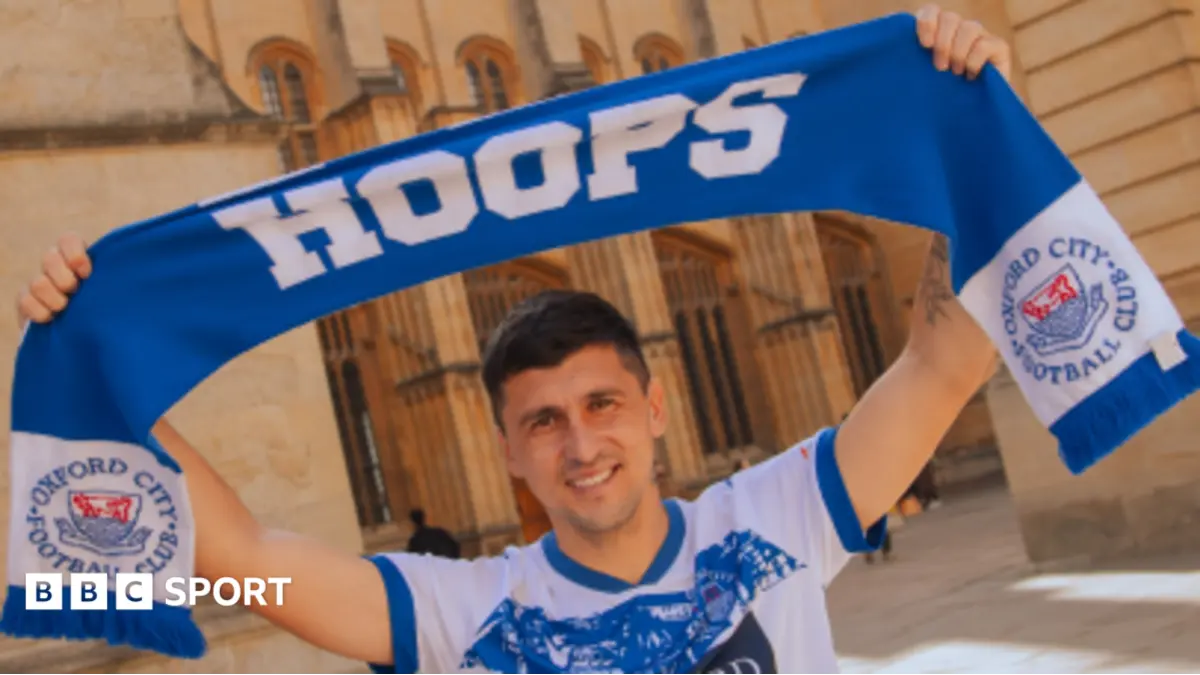
The scene at the Hebburn Sports and Social Ground on a crisp Saturday afternoon in October felt a world away from the gilded arenas that once defined Fernando Forestieri’s professional life. As the match clock ticked into the 81st minute, a small portion of the Hebburn Town faithful had already begun their trek toward the exits, resigned to the fate of their side, who trailed 3-0 to a clinical Oxford City performance. Amidst this quiet resignation, the fourth official held up the board. For the traveling Oxford City contingent, it was a moment of surreal significance: the club’s new marquee signing, a man who had once graced the hallowed turf of the Santiago Bernabéu in front of 72,000 spectators, was entering the fray.
At 36 years old, Forestieri’s debut for the "Hoops" in English football’s sixth tier was witnessed by a modest crowd of 873. It was a stark contrast to the high-stakes environments of Serie A or the Spanish La Liga, yet the Argentine forward, whose career has spanned continents and elite divisions, approached the moment with a seasoned professional’s focus. Reflecting on the frenetic energy of the National League North, Forestieri told BBC Sport, "It was like a tennis match, the ball going one way one second, then the other way the next." Despite the tactical differences from the structured leagues of his past, the match resulted in a crucial three points for Oxford City, marking their seventh victory in 11 games and cementing their place in the upper echelons of the league table.
The timing of Forestieri’s arrival could not be more poetic. This Friday, the spotlight of the footballing world will descend on Oxford City as they host Leicester City in the first round of the FA Cup. For a club operating in the non-league structure, the visit of the former Premier League champions—even if the Foxes are now operating in the Football League—represents a quintessential "magic of the cup" narrative. Forestieri, a veteran of the Championship play-off grind and high-profile domestic campaigns, is tasked with helping bridge the divide between the two sides.
It is a curious quirk of history that the two clubs find themselves at such different junctures. It has been exactly a decade since Leicester City achieved the impossible by winning the Premier League title, a season that saw Forestieri pushing for his own slice of glory with Sheffield Wednesday, reaching the Championship play-off final at Wembley before a heartbreaking defeat to Hull City.
"There’s a big gap between what Leicester did 10 years ago and where they are now," Forestieri acknowledged, looking ahead to the Friday night clash at 19:45 GMT. Despite the disparity in resources and stature, the Argentine remains undeterred by the odds. "Why can’t Oxford City cause an upset? This is what the FA Cup is all about."
To understand the weight of Forestieri’s presence in a non-league dressing room, one must look at the company he has kept. His journey through the top echelons of European football brought him into direct contact with the modern icons of the sport. While playing for Malaga during the 2009-10 La Liga season, Forestieri stood on the same pitch as Barcelona’s legendary trio of Lionel Messi, Zlatan Ibrahimovic, and their teammates. Five years ago, while plying his trade for Udinese in Serie A, he found himself once again in the orbit of Cristiano Ronaldo during a clash with Juventus.
"You never forget being on the same pitch as these big players," Forestieri said, reflecting on a career that also included a memorable goal against Inter Milan while playing for Siena. "Messi, Ronaldo, Ibrahimovic… unbelievable skills. I’m very lucky. Being that close to them, you remember their first touch, their vision."
These experiences were worlds away from the humble beginnings that shaped his temperament. Born in Rosario, the same Argentine city that gave the world Lionel Messi, Forestieri grew up in a reality defined by poverty and a profound love for the game. Like millions of others in his homeland, he idolized Diego Maradona. When the icon passed away in 2020, the impact was deeply personal for Forestieri, who paid tribute by writing a heartfelt message on the back of his Udinese shirt.
"Growing up in Argentina, everyone pretended to be Diego," he recalled. "He was a hero to everyone. On every corner of every street, someone painted his face on a wall."
His upbringing was marked by hardship. Forestieri speaks candidly about the struggle of his early years, where he shared a single room with his parents and two brothers. Rosario was a volatile environment, and the dangers of the streets were a constant shadow; he recalls with solemn gratitude the survival of his brother, Maximiliano, who was shot and wounded during their youth. These experiences forged a resilience that carried him through the prestigious academies of Newell’s Old Boys and Boca Juniors before he made the leap to Italy at age 16.
His transition to Europe was swift. He made his senior debut for Genoa shortly after arriving, and by virtue of his grandfather’s heritage, he became eligible to represent Italy, eventually playing for the Azzurri at various youth levels. His career path has been nothing if not eclectic, featuring spells in Malaysia and Cyprus before his recent return to England. The decision to settle back in the UK was driven by family, specifically the birth of his third son, Luciano.
Now based in north London with his wife, Andria, and their sons Santiago and Maximiliano, Forestieri is entering the twilight of his playing days with a sense of perspective. He is currently pursuing his coaching badges, looking to translate his decades of experience into the next phase of his career. Yet, the itch to play remains potent. He describes his weekends as being defined by a simple, enduring love for the sport—even in the quiet moments. "I still have passion for football," he said. "Whenever I’m walking in the park with Santiago and we see someone playing football, we stop and join in. That’s how much I still love football."
The immediate future, however, is firmly fixed on the professional pitch. After the glamour of the Leicester City FA Cup tie—a match expected to draw a capacity crowd of 3,500—Oxford City must turn their attention back to the rigors of the National League North, starting with a grueling long-distance journey to face Darlington next Tuesday.
For a player who has lived through the highest pressures of the Bernabéu and the intensity of Serie A, the transition to the lower tiers of English football is managed with a pragmatic understanding of his own limitations. "You need to listen to your body when you reach 36," he noted. Yet, for all the talk of age and the toll of long-distance travel, there is a clear sense of gratitude in his voice. "But I’m lucky to be still playing and that a club still wants me to play for them."
As he laces up his boots for a non-league campaign, Fernando Forestieri remains a testament to the enduring allure of the game. Whether in front of 72,000 in Madrid or a few hundred in Tyne & Wear, the objective for the Argentine remains unchanged: to influence the game, to guide his teammates, and to contribute to the collective success of his new club, one match at a time.