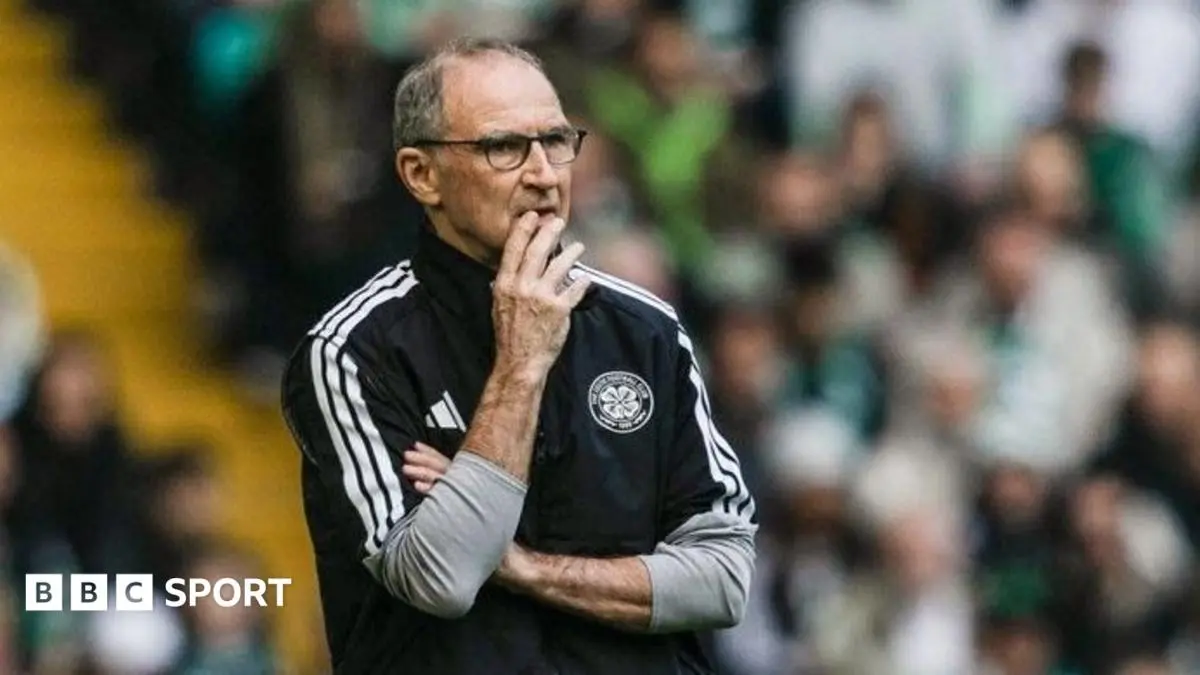
Martin O’Neill finds himself at a precarious crossroads in his storied managerial career at Celtic, with the veteran boss admitting he will use the current international break to deeply reflect on his future following a turbulent period for the club. While the 74-year-old’s position has come under intense scrutiny following a series of damaging results, former Celtic captain Paul Lambert has emerged as a vocal defender of his former manager’s legacy, insisting that while an exit would not surprise him, a sacking would be an act of profound ingratitude toward a man who has delivered so much to the Parkhead side.
The pressure on O’Neill has mounted significantly over the last month. The catalyst for this scrutiny has been a dismal run of form, highlighted by back-to-back defeats against fierce rivals Rangers. These Old Firm setbacks were compounded by a disappointing home loss to Hungarian side Ferencvaros in the Europa League. Furthermore, the memory of the August Champions League collapse—in which Celtic surrendered a commanding 4-0 aggregate lead to LASK—still lingers, casting a shadow over the early months of the campaign.
O’Neill, who returned to the dugout on a permanent basis this summer after two successful stints as interim boss last season that yielded both the league title and the Scottish Cup, is acutely aware of the weight of the current situation. Addressing the media during this hiatus in the domestic schedule, O’Neill was characteristically honest about his standing.
"I will reflect on the games," O’Neill stated, acknowledging the gravity of the recent results. "I’m not immune from criticism. Absolutely and utterly far from it. I think there’s every reason to ask, ‘Can you turn this round? Can you change the whole thing?’ I have to kind of look at the bigger picture at this minute."
For a manager who secured seven major trophies during his initial tenure at the club between 2000 and 2005, this level of questioning is unfamiliar territory. However, O’Neill’s recent history at Celtic—having stabilized the club during the chaotic departures of Brendan Rodgers and Wilfried Nancy last season—is viewed by many, including Paul Lambert, as a testament to his enduring quality.
Lambert, who played under O’Neill during those golden years, remains steadfast in his belief that the current manager stands as the most significant figure at the club since the legendary Jock Stein. Despite this deep respect, Lambert admitted that he would not be stunned if O’Neill chose to walk away from the role voluntarily.
"It wouldn’t surprise me if he left," Lambert told BBC Radio Scotland. "I don’t think he needs it. I’d be shocked and disappointed if Celtic sacked him. I think they should give him the option, if that’s what’s on his mind, if he did want to walk away."
Lambert’s defense of O’Neill is rooted in the belief that managers of such high standing earn a level of long-term security, or at the very least, the dignity to decide their own departure. He pointed to the recent history of the club, noting how quickly the narrative has shifted from celebrating the manager’s successes to calling for his removal.
"He’s got enough credit in the bank," Lambert argued. "It wasn’t that long ago people were shouting for a statue for him, so I don’t think you can go from one extreme to the other. If he wants to go, then he goes himself."
Lambert’s assessment of O’Neill’s impact is heavily informed by the rescue mission the manager undertook last year. When the club was in crisis, drifting without direction, it was O’Neill who was brought in to steady the ship. Lambert recalls that period vividly, noting, "They were hanging on by a thread and he turned that around. There was only one person who could rescue Celtic last season and he did that." For Lambert, the man in the dugout remains the same tactical mind that achieved such feats in the past, suggesting that the current malaise is not a failure of management, but rather a crisis of player accountability.
This point of contention—player responsibility—is where Lambert’s frustration becomes most apparent. He was deeply critical of the squad’s performance during the recent losses to Rangers, particularly regarding the post-match comments made by defender Cameron Carter-Vickers. Following the defeat, Carter-Vickers suggested the team was playing "too random" and expressed a desire for a clearer "script" to stick to during matches.
Lambert did not mince his words when reacting to these comments, labeling them "cringeworthy." The former Ipswich Town and Norwich City manager believes that the onus for performance lies firmly with the players on the pitch, rather than the instructions provided by the coaching staff.
"The players need to take responsibility," Lambert insisted. "I watched the game and dear oh dear… That was cringeworthy, the stuff from Carter-Vickers. I thought, ‘Hang on, you’re not making a movie.’ Solve the problem yourselves. When something is not going right, you look to rectify it, you don’t look to a manager to say ‘do this or do that.’ I thought that was bang out of order, coming from someone who’s been a decent player for Celtic."
Lambert’s critique suggests a disconnect between the tactical expectations of the players and the reality of professional football, where adaptability and individual leadership are expected. By publicly shifting the focus toward the manager’s "script," Lambert believes the players are abdicating their duties and failing to meet the standards required of a club of Celtic’s stature.
As the international break continues, the focus remains on O’Neill’s decision-making process. The manager finds himself in a position where he must weigh his own drive and commitment against the mounting frustration of the supporters and the visible cracks in the team’s performance. For someone of O’Neill’s experience, the "bigger picture" he refers to likely encompasses not just the short-term results, but the viability of the current squad’s philosophy and his own capacity to inspire the change needed to reverse the trend.
The sentiment within the Celtic faithful is currently fractured. While a vocal section of the support is clearly exhausted by the recent European disappointments and the failures in the Old Firm fixtures, there remains a deep-seated respect for O’Neill’s past contributions. Whether that respect is enough to grant him the time to navigate through this crisis remains to be seen.
Ultimately, Lambert’s perspective serves as a reminder of the stature of the man currently under fire. He maintains that O’Neill’s approach has not fundamentally changed since his successful return last year, which suggests the current struggle is a complex issue involving personnel, confidence, and internal chemistry. As the club waits for the manager to conclude his period of reflection, the air of uncertainty at Parkhead is palpable.
For Martin O’Neill, the coming days will be pivotal. He has proven his ability to salvage a season before, and those who know him best, like Lambert, continue to advocate for a measured approach. However, the modern realities of football management often leave little room for sentimentality, and as the manager himself conceded, he is far from immune to the harsh realities of the game. Whether he emerges from this break with a renewed plan to fix the "random" nature of the current performances or decides that his time has come to step aside, the decision will undoubtedly shape the remainder of Celtic’s season and, quite possibly, define the final chapter of O’Neill’s storied association with the club.