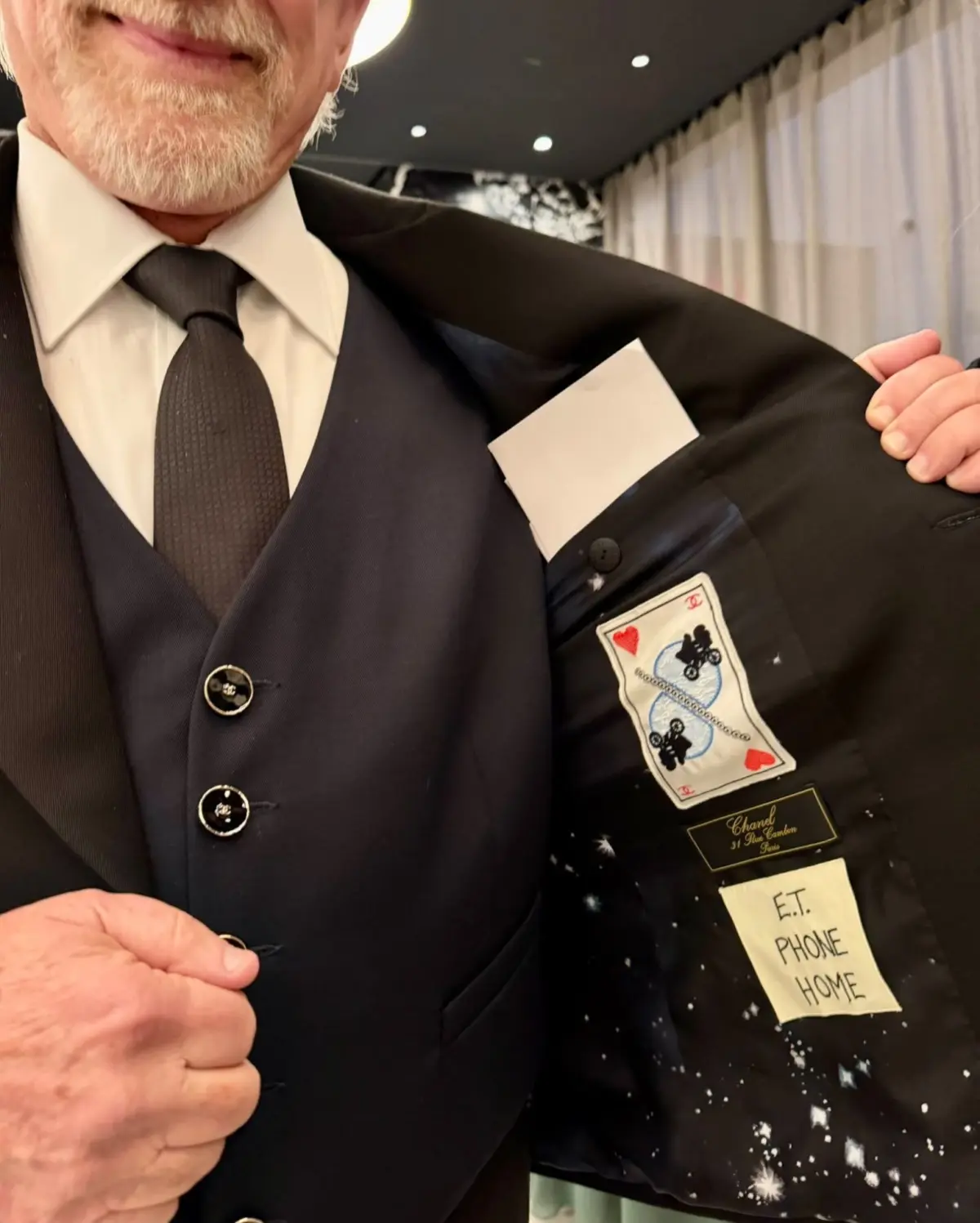
E.T., phone home! Or if you are Steven Spielberg getting honored at the Museum of Modern Art’s annual Film Benefit, phone Chanel. On a recent Thursday night, the legendary filmmaker offered a peek inside his bespoke Chanel tuxedo jacket, crafted courtesy of designer Matthieu Blazy. Beneath the classic, impeccably tailored black exterior lay a galaxy-speckled lining, an embroidered playing card featuring E.T. on his bicycle, and a small patch bearing the iconic words: “E.T. PHONE HOME.” Spielberg proudly flashed the whimsical details for all to see, proving that statement linings are having a major cultural moment.
This playful reveal is just the latest in a series of delightfully personal flourishes emerging from Blazy’s Chanel atelier. For his spring 2026 haute couture debut, the designer invited models to contribute something deeply meaningful to their looks: a love letter, a birth date, a lucky symbol, or an intimate thought. These personal touches were then translated into exquisite embroideries by the house’s legendary Lesage atelier, stitched directly into garments or onto tiny silk notes tucked safely inside delicate, translucent Chanel handbags. Model Stephanie Cavalli reportedly chose a heartfelt letter from her husband, proving that the emotional sentiment behind the garments was just as breathtaking as the physical craftsmanship.

Blazy has continued to play with this poetic notion of garments carrying memories. In the lead up to the spring 2027 Chanel show, models Bhavitha Mandava and Awar Odhiang discovered embroidered playing cards tucked neatly inside their jacket linings. The cards depicted Gabrielle Chanel herself wearing the very looks the models had previously walked down the runway in, creating a brilliant bridge across generations of fashion history.
Couture clients can reportedly request this kind of bespoke personalization, too. At October’s Academy Museum Gala, Hailey Bieber’s custom bubblegum-pink Chanel gown concealed another tender, handwritten detail: a discreet note featuring the name of her son, Jack, accompanied by an arrow-pierced heart.
The practice of leaving something deeply personal inside a garment is hardly new in the annals of fashion history. Alexander McQueen famously made a rebellious and sometimes provocative art of it. While working for Romeo Gigli in Milan as a young designer, McQueen reportedly left a rather less romantic, hidden message inside a jacket after being made to repeatedly redo its construction: “Fuck you, Romeo.” There are also the legendary, though frequently disputed, tales of profanities hidden inside bespoke suits made for Prince Charles during his early Savile Row apprenticeship. More poignantly, McQueen stitched locks of his own hair into the linings of his 1992 graduate collection, Jack the Ripper Stalks His Victims, and later incorporated them directly into his clothing labels.

Yet, the clothing label itself has also long served as a canvas for designers to express a distinct personality and heritage. Spend an afternoon rifling through the racks of any vintage or thrift store, and you will find a rag-tag assortment of embroidered crests, elaborate cursive fonts, wacky illustrations, and wonderfully earnest mottos from long-forgotten local dressmakers alongside grand houses. Even Burberry’s evolving labels offer a miniature history of the brand: from the old Burberrys name and the original Equestrian Knight emblem, introduced in 1901, to the pared-back modernist identity of recent years, and Daniel Lee’s celebrated revival of the knight in 2023. A label can do so much more than simply announce who manufactured a garment.
A new generation of independent designers is rediscovering the joy of these small, characterful details. Take Sofia Testino, whose young eponymous label imagines an entire world of professions and their fictional, eccentric wardrobes. It has been a joy for industry watchers to observe her brand identity develop through old-fashioned woven labels, complete with evolving colorful geometric borders, winged crests, and the earnest tagline: “Style, Quality, Value.” There are even shoeboxes bearing a cartoonish evolution from an ape to a woman in high heels. Testino has spoken candidly about collecting vintage labels and old flight-attendant uniforms, mixing and matching elements to forge her own distinctive identity.
In a recent interview, Testino lamented that labels, packaging, and thoughtful details have largely been lost in modern commercial retail. While so many contemporary brands have settled for a homogenizing, identity-flattening minimalism, she is steadily building an entire creative universe—complete with a fleet of well-dressed fictional staff—down to the very last stitch.

Elsewhere, London-based knitwear designer Oscar Ouyang has made a sweet little lamb a recurring signature, appearing regularly on his whimsical knits and charming clothing labels. For her recent collaboration with Frankies Bikinis, Devon Lee Carlson joined forces with longtime friend Francesca Aiello to revisit treasured vintage pieces from their own personal wardrobes, complete with sweet pink co-branded labels decorated with a playful little dog and blooming flowers. In another corner of London, Sinéad O’Dwyer has been thoughtfully rethinking her brand identity as her loyal customers grow up alongside her, with her newly imagined logo finding its way into the custom stitching on the back of her jeans.
For London-based demi-couture designer Ellie Misner, a clothing label can likewise serve as a miniature love letter commemorating a particularly monumental life moment. Misner, who specializes in bespoke pieces for high-profile clients, has taken to hand-embroidering her clients’ names directly above her own handwritten logo. For Raye, who fulfilled a long-held career dream by headlining the Reading and Leeds Festival, Misner stitched her name in rich burgundy thread inside a crimson corseted gown. For Tems, whose Glastonbury main-stage performance marked another massive milestone, it was a striking cobalt-blue signature sewn onto the inside of a midnight-blue ensemble.
Explaining her creative process to Vogue, Misner notes that her labels are literally her handwriting. She handwrites the wearer’s name and then embroiders it by hand, frequently choosing a thread color that harmonizes with the garment. For a performance that carries profound meaning for both the artist and the designer, it offers a tangible way of marking the occasion, elevating the piece beyond just another standard custom commission. Misner likens the gesture to writing “a love note to their garment,” adding that while she wishes she could offer the intricate touch to everyone, the time-consuming process makes each finished piece all the more exceptional. These gestures may not all fit the traditional definition of couture, but they share an uncompromising spirit that insists on individuality and the quiet pleasure of details kept entirely to oneself.

There is something especially resonant about this artisanal resurgence in an age dominated by AI-generated imagery, algorithmically dictated taste, and increasingly impersonal consumer habits. Fashion seems increasingly keen to remind the public that there are actual human beings with tangible skills, histories, and emotions behind the clothes they wear. At Chanel’s fall 2026 couture show, artist Joël Blanc painted the runway live in watercolors, capturing the spectacle in real time. Similarly, recent holiday campaigns from luxury houses like Prada, Dior, and Bottega Veneta have warmly embraced the nostalgic charms of illustration and animation. Prada, in particular, has celebrated hand-drawn artistry by enlisting veteran animator John Pomeroy to conjure a whimsical winter wonderland populated by snow lynxes and mischievous mice.
In a modern manufacturing landscape where almost anything can be endlessly reproduced by machines, the idiosyncratic, the intimate, and the hand-crafted feel increasingly precious. Ultimately, these subtle touches suggest that the most meaningful thing about what we wear might just be something nobody else can see at all.