There is nothing writers love more than talking about how excruciatingly difficult it is to write. Stephen King famously described the writing process as being “like crossing the Atlantic Ocean in a bathtub.” Sportswriter Red Smith, in a sentiment frequently and erroneously attributed to Ernest Hemingway, compared the endeavor to sitting down at a typewriter and bleeding. Gwendolyn Brooks called it a “delicious agony,” while George Orwell likened it to “like a long bout of some painful illness.”
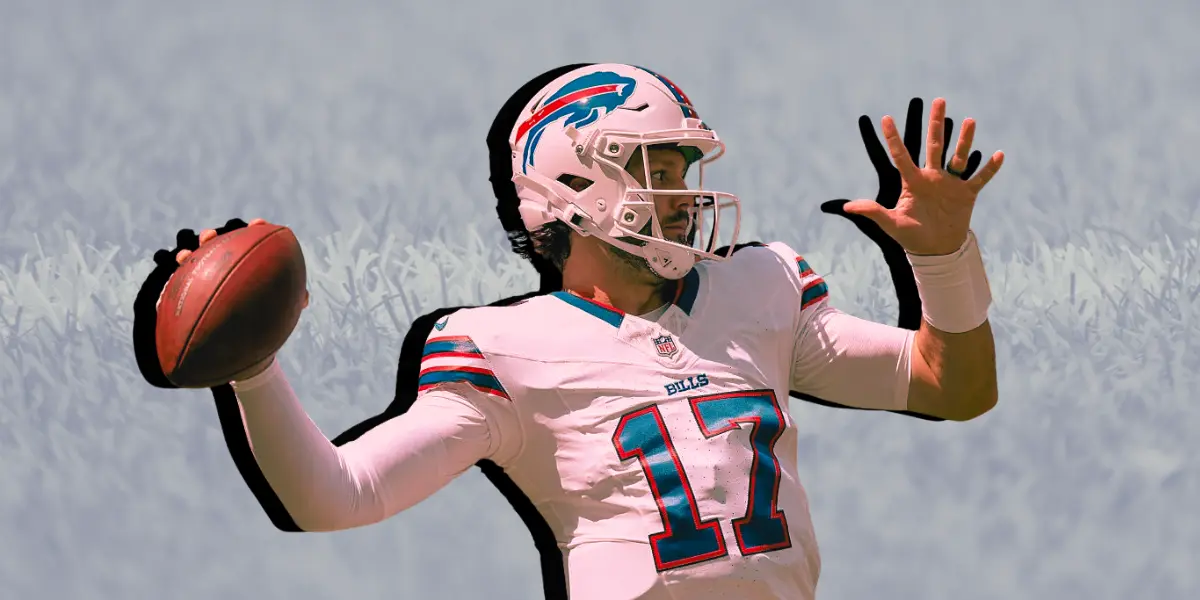
As it turns out, that is also precisely what it feels like to watch the Buffalo Bills.
Like most lifelong adherents to the Bills franchise, one is practically born into this particular brand of sporting serfdom with no possibility of escape. There exists, for instance, a photograph of a proud father, clad in a Bills sweatshirt and matching hat, holding his two-day-old child in a hospital room. Just out of frame sits the team-branded cooler of Miller Lite he brought along to watch the Bills play the Miami Dolphins on the hospital’s television set. It was Western New York in the late 1980s. The Bills boasted legendary talents like Jim Kelly, Thurman Thomas, and Bruce Smith, and they were on the precipice of an unprecedented era that would culminate in four consecutive Super Bowl appearances. It was, by all accounts, a bringing-beer-to-the-hospital era.
Yet those hospital beers could not last forever. Those four successive AFC championships transformed rapidly into four consecutive Super Bowl losses—a feat that had never occurred before in the history of the National Football League and has never been equaled since. The Bills stand firmly among history’s most prolific losers, functioning almost as the grand masters of the devastating defeat. They are losing virtuosos, and they have historically been quite loud about it. Their infamous seventeen-season-long playoff drought was among the longest in NFL history, encompassing entire generations of schooling, from middle school through college and well into early adulthood. For many, a first Technicolor football memory is watching the Bills crash out of the postseason during the heart-wrenching Music City Miracle, when the Tennessee Titans returned a kickoff for a touchdown in the final moments of a Wild Card game via a famously questionable lateral.
The Bills would not return to the playoffs until 2017, and they would not secure another postseason victory until the 2020 season, a milestone celebrated by fans watching from home during the height of the COVID-19 pandemic. While the Bills have arguably won more football games over recent seasons than nearly any other team in the league, the lingering scent of historical failure coats the franchise with the stubborn persistence of dive bar grime. Over the decades, cultural commentators and critics have linked the collective psyche of the team’s struggles to broader historical moments, with some cultural analyses even tongue-in-cheekly or metaphorically blaming the franchise’s agony for inflicting everything from cultural despair to national political shifts. More recently, high-profile medical tragedies on the field and analytical deep-dives in publications like The Atlantic have continued to cement the narrative of the franchise as one of the most uniquely snakebitten in American sports.
With a fandom defined by such cyclical heartbreak, it is perhaps no surprise that many supporters ultimately find their way into creative professions like writing. Long before fully understanding the mechanics of prose, a young fan absorbs the complexities of a particular kind of suffering—the distinct agony of investing profound passion and personal identity into something completely outside of one’s control and granting it the power to destroy emotional well-being. Whether facing a harsh literary critic, a necrotic publishing market, or an opposing defense with a stifling defensive rating, the underlying truth remains identical: if you want to participate in the creative or sporting arena, you have to be prepared to hurt. That is the fundamental bargain.
Writing requires a formidable tolerance for humiliation and disappointment. Bills fans understand humiliation and disappointment intimately, which perhaps explains why the fandom—collectively known as Bills Mafia—has poetically cataloged both themselves and the team’s most agonizing losses. From minor heartbreaks like the “Hail Murray” and costly procedural penalties like having twelve men on the field, to bone-dislocating failures like “Wide Right,” the Music City Miracle, and the staggering loss known simply as “Thirteen Seconds,” the emotional toll is immense. Watching star quarterback Josh Allen sit silently on the sidelines with his helmet still on, absorbing the reality that his team had squandered a lead with mere ticks remaining on the clock in the divisional playoffs, carries a weight that feels eternal.
Watching that kind of collapse feels remarkably similar to the reality of publishing a book. Writing a book, by contrast, is an immense joy. Even the frustrating parts—such as stubborn writer’s block and awkward
sentences requiring extensive line editing—are vastly superior to the mundane realities of most standard desk jobs. Anyone who has spent hours wrestling with corporate spreadsheets while the relentless ping of workplace communication software blares in the background understands the blessed quiet of an empty page. There is a quiet delight in crafting a sentence, rereading it, and smiling because it successfully conveys the intended meaning.
Publishing that book, however, tells an entirely different story. The process is fraught with the normal indignities of the industry: endless rejections, deafening silences that default to rejections, constant comparisons of advance and sales numbers to peers, and exhausting attempts to distill a complex novel into bite-sized, digestible content for social media algorithms. Authors may approach publication day with zero promotional blurbs or face stinging, uncomprehending reviews from readers who fundamentally misunderstood the premise of the work.

This is precisely where being a Bills fan provides an unexpected advantage: who cares about humiliation? Having grown up enduring the zenith of rival dynasties during prolonged eras of sporting irrelevance, fans learn early on what it feels like to be embarrassed and to feel small. Wearing team gear into hostile territory during college years dominated by opposing fanbases provides an education in thick-skinned resilience. It is an understanding of the bargain one has struck with fandom.
This background fosters an intimate familiarity with the art of the lost cause. It forces a unique brand of optimism—an enforced belief that a better world is genuinely possible, that a long-standing drought will eventually break, and that a championship is always within reach for the next campaign. There is simply no other viable choice, and surviving requires owning that hope loudly.
This interplay between despair, persistence, and stubborn optimism forms the thematic core of Caitríona Moran’s debut novel, The Trial of Magdalena Overmorrow, published by G.P. Putnam’s Sons. The novel’s protagonist, Magdalena Overmorrow, is a scholar and healer who moonlights as her city’s sole abortion provider. She begins the narrative as a political prisoner and ultimately finds herself on trial for her life. Throughout the story, she faces relentless systemic cruelty and institutional battering, yet she persists as an inherent optimist.
The author’s journey in shaping this character reflects a broader reckoning with political and social realities. Entering the writing process during a turbulent political climate, and witnessing the ongoing erosion of reproductive rights, the legal harassment of modern medical providers, and the stark realities of post-Roe America, offered little fertile soil for naive hope. Participating in public demonstrations following the overturning of landmark legal protections often evokes a damp exhaustion and a heavy sense of weariness, where traditional optimism feels entirely out of reach.
During such moments, the closest emotional equivalent to hope is often a form of grim spite. That same complex emotional landscape—comprising impotent rage, deep desperation, and a fierce refusal to surrender—mirrors the feelings of volunteering in high-stress medical advocacy environments or standing in solidarity at political rallies. The fundamental task of a novelist is to remind readers that every individual possesses a rich, whole internal universe. Yet, when confronted with intense public hostility, maintaining empathy can feel nearly impossible, leaving behind a hard shell of determination.
In The Trial of Magdalena Overmorrow, the protagonist’s hope manifests as an active, open curiosity about her place of exile and the people surrounding her. Rather than retreating inward to brood over her persecution, she chooses to live as though her life retains inherent dignity, thereby placing that dignity beyond the reach of her oppressors. She builds relationships, falls in love, and offers assistance when asked, even when doing so jeopardizes her standing. While despair inevitably visits her before her scheduled execution, the hope she cultivated along the way buys her invaluable time and unyielding spirit.
Opting for optimism can frequently feel uncomfortable. No one enjoys feeling like a naive participant, nor do they enjoy having it rubbed in their face that they believed in a fundamental fairness or decency that the universe—or the structured chaos of professional sports—continually denies. Yet individuals who maintain the belief that better outcomes are possible, despite all empirical evidence to the contrary, and who doggedly act upon that belief, remain vital to cultural and social endurance.
Functioning in daily life requires a baseline of trust in the unlikely. Writing a book is fundamentally a delusional act, requiring an author to materialize something out of nothing and subsequently convince others to exchange legal currency for it. Believing that a historically star-crossed sports franchise can finally capture a championship is similarly irrational. So too is the belief that a coalition of activists, medical professionals, and policymakers can successfully restore reproductive rights in a challenging political climate.
Yet striving for major systemic possibilities relies heavily on practicing belief in smaller, seemingly improbable possibilities first—whether that means trusting that a local football team can finally reach the Super Bowl or believing that an independent creative project can find its audience. It functions as a series of inoculations against hopelessness, with each iteration reinforcing resilience.
Fandom traditions often lean heavily into this humorous desperation, from ceremonial pre-game candle-lighting rituals bearing hopeful, pleading slogans to enthusiastic starts to a new athletic season. Paired with the simultaneous launch of a debut novel, these milestones serve as reminders that optimism, however bruised, remains an active choice. And if a particular season ultimately falls short of the ultimate prize, the underlying ethos of the fandom endures unchanged. There is always next year.