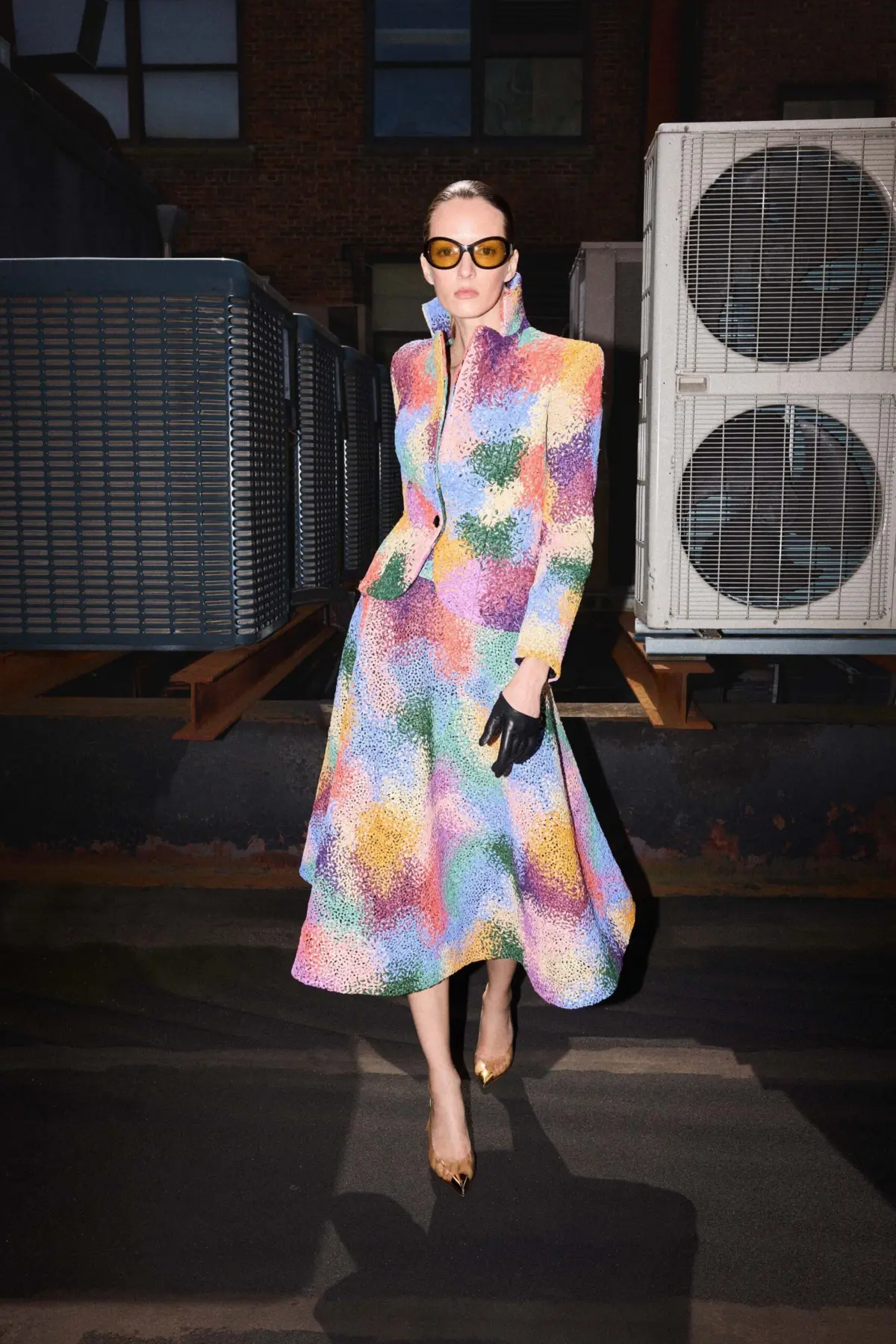
Running a high-end fashion label is a demanding enterprise that consumes the time, energy, and creative focus of even the most seasoned designers, particularly in the current economic landscape. Yet, amidst the rigorous demands of managing a successful global brand, veteran designer Naeem Khan has quietly cultivated a second, highly successful career as a fine painter. Over the past couple of years, Khan has immersed himself in the world of visual arts, developing a distinct studio practice alongside his friend and collaborator Stanley Casselman. Together, the two artists create and exhibit under the collective name KACE.
This artistic pursuit has not remained isolated to the canvas. Instead, it has recently bled directly into Khan’s primary vocation, serving as the core inspiration for his latest spring ready-to-wear collection. For Khan, the transition from fine art to high fashion felt like a natural evolution of his lifelong obsession with color, composition, and texture. Noting the rapid momentum of his visual art career, the designer embraced the painterly endeavors of late, allowing his experiences with paint, canvas, and color theory to dictate the aesthetic trajectory of his newest garments.
This season, Khan expressed a clear desire to push the boundaries of his signature glitzy finishes, elevating his already renowned craftsmanship to new artistic heights. The opening look of the runway presentation immediately established this crossover between fine art and haute couture. It featured a meticulously constructed blazer and matching skirt crafted entirely from hand-dyed raffia. The material was manipulated and colored to emulate the delicate, translucent qualities of a watercolor painting rendered in soft pastels. This garment served as a manifesto for the entire collection, translating the physical processes of the painter’s studio directly into the realm of apparel.
The chromatic scheme of the collection is directly indebted to Khan’s recent portfolio of canvas paintings. By utilizing the same technical and expressive processes he applies to his fine art, but adapting them for textiles, the designer successfully blurred the line between gallery art and wearable fashion. The second look in the lineup further underscored this ambition: a sheer mini dress completely enveloped in hand-beaded, multi-colored florals, with several blossoms uniquely accented by fringed stems that added a dynamic, three-dimensional element to the fabric. Throughout his career, Khan’s reputation has been anchored by his intricate handwork, and this collection offered a compelling display of a designer taking bolder, more experimental approaches with his artisanal strengths.
It was evident to observers and critics alike that Khan and his atelier had a tremendous amount of intellectual and creative fun during the development phase of this collection. The runway was populated by garments that demonstrated a profound mastery of material manipulation and ornamental design. Among the standout pieces was a statement-making cherry blossoms gown, constructed using sophisticated laser-cut fabric petals that gave the impression of delicate blooms resting naturally against the body.
Eveningwear and party-ready silhouettes received an equally inventive treatment. A pastel-blue mini dress, densely covered in feathers, captured an effortless, buoyant energy suited for festive celebrations. This mood was echoed by a beaded fringe mini dress that executed a seamless ombre transition, shifting gracefully from a light sky blue at the shoulders and neckline down to a lustrous silver at the hem.
Beyond color and texture, Khan demonstrated a rigorous attention to composition and scale, treating the human silhouette much like a blank canvas requiring careful structural balance. This was perhaps most apparent in a sophisticated black top coat embellished with white pearls. Rather than applying the pearls uniformly, Khan graduated the embellishment, beginning with a sparse distribution across the upper chest and shoulders before becoming heavily bunched at the waist. This careful manipulation of density and placement created a striking hourglass optical illusion, elevating a classic outerwear piece into a work of sartorial art. The garment possessed a fanciful, sculptural quality so refined that it would not look out of place enclosed in a museum exhibition case celebrating the intersection of fashion and fine art.