Ralph Lauren continues to prove that true style is entirely immune to the passage of time. Earlier this week, the legendary American designer added yet another prestigious accolade to his sprawling career, picking up the Menswear Designer of the Year Award at the Council of Fashion Designers of America (CFDA) awards. Remarkably, Lauren also took home the organization’s very first men’s prize back in 1981. This milestone highlights a staggering professional reality: Lauren has remained at the absolute pinnacle of American fashion for so long that he was already dominating the industry before this year’s fellow CFDA winners were even born.
In an industry where the business model is almost exclusively built on constant change, reinvention, and fleeting trends, the ability to renew and maintain a legacy is often just as difficult as building one from scratch. Yet, even as his iconic global brand approaches its monumental 60th anniversary, Ralph Lauren still commands the undivided attention of the fashion world. The enduring cultural footprint of the brand was recently underscored by PoloFest, a massive vintage marketplace that the company organized in Tokyo last month. The event drew an astonishing 10,000 visitors who lined up to explore an expertly curated selection of 5,000 specially chosen archival Polo pieces. It was a masterclass in heritage marketing that is bound to spawn imitators across the wider retail and luxury business landscape.
While PoloFest was an undeniable public spectacle designed to make major noise and celebrate the brand’s rich history, the house’s latest pre-fall collection was not built for shock value. Instead, the new lineup is as deeply and comfortably rooted in the brand’s foundational iconography as anything else the company has ever produced. Rather than chasing the erratic whims of the modern fashion cycle, the collection leans heavily into the familiar, reassuring codes that have defined the Ralph Lauren aesthetic for decades.
Take, for instance, the glen plaid pantsuit featured in look three. The garment is not a random studio creation; it is directly based on a classic suit that Ralph Lauren himself frequently wears in his day-to-day life. Crafted meticulously by skilled master tailors in Italy, the pantsuit utilizes the specialized, traditional techniques that give high-end men’s suiting its characteristically sharp lines, defined structure, and immaculate drape. By translating his personal menswear uniform into womenswear with uncompromising tailoring standards, Lauren continues to blur the lines between traditional gendered dressing with effortless authority.
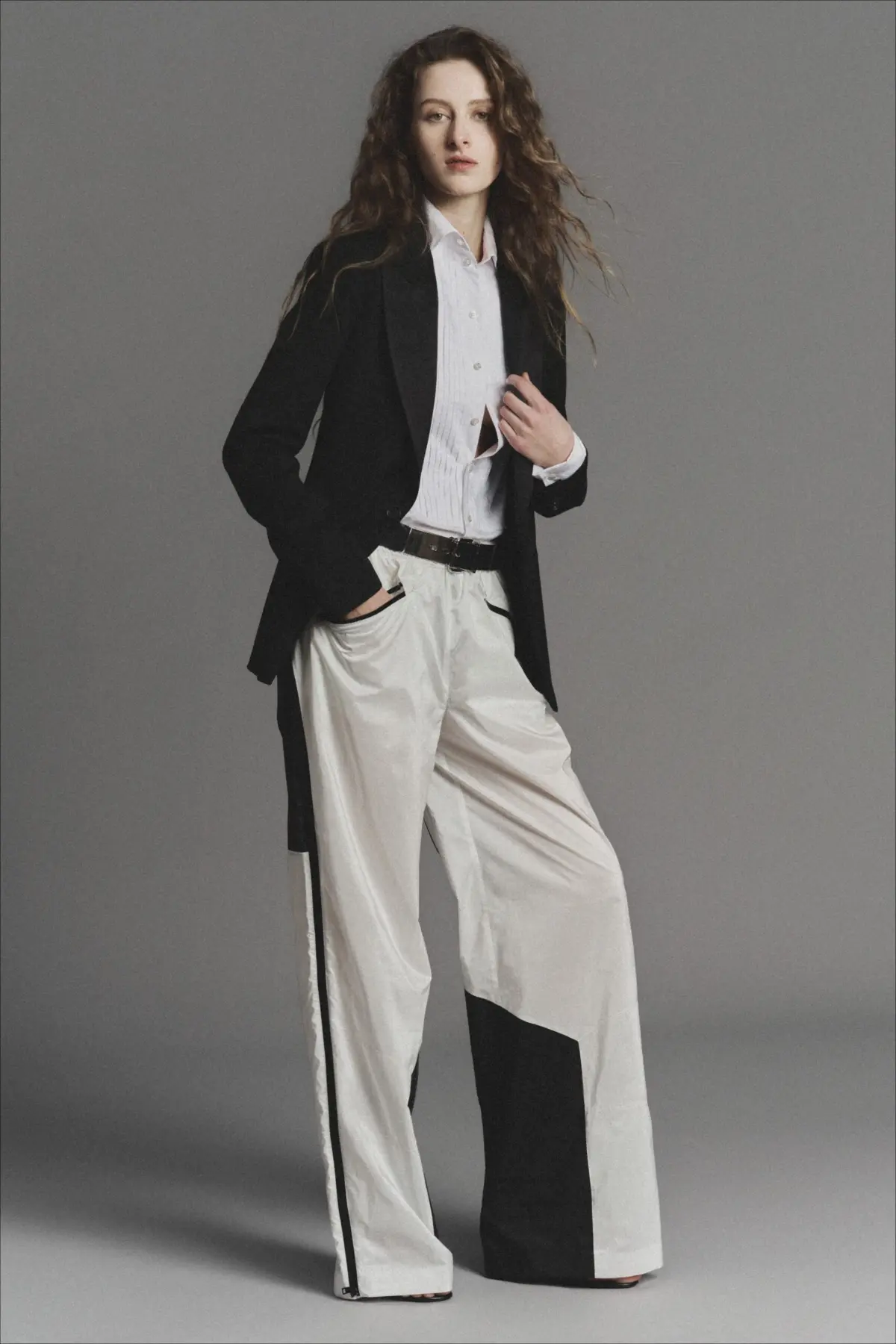
Similarly, the track pants in look one represent another classic stylistic tic long associated with the designer. Throughout his career, Lauren has always favored the deliberate juxtaposition of casual and formal elements, effortlessly mixing high fashion with low-key sportswear. This high-low philosophy remains a cornerstone of the brand’s visual identity, proving that comfort and elegance are never mutually exclusive.
When it comes to color theory for the upcoming season, purple emerges as a prominent accent color, mirroring a broader palette choice seen across much of the contemporary fashion landscape. Alongside purple, minty green plays a supporting role, though observers note that the brand is hardly following the herd. Indeed, the design team pays virtually no heed to prevailing commercial currents or short-lived internet micro-trends.
A prime case in point is the silvery plunge-front halter top introduced in the pre-fall lineup. Far from being a modern trend-forecasted piece, the striking top is a direct lift from the designer’s own personal archives dating back to the 1990s. By pulling directly from his past work, Lauren demonstrates that true luxury is circular and that designs possessing genuine integrity never truly go out of style. As the brand marches steadily toward its sixth decade, Ralph Lauren remains the master of his own universe, entirely content to let the rest of the industry chase whatever is next while he perfects what has always worked.