
Ethereum co-founder Vitalik Buterin has argued that the network should actively promote Ether (ETH) as a robust store of value (SoV) rather than an asset whose worth is primarily derived from burning transaction fees.
In a recent discussion thread, Buterin stated that the narrative surrounding "ETH as a fee-burning token never was as strong as it seemed." He cautioned that aggressively optimizing tokenomics around fee burns would negatively impact Ethereum’s core priorities of decentralization and capture resistance. Instead, Buterin believes that Ethereum’s long-term value should stem from the fundamental stability provided by its unwavering focus on what he terms "CROPS"—referring to censorship and capture resistance, open source principles, privacy, and security. He contends these attributes will become increasingly paramount in an era dominated by artificial intelligence disruption.
The conversation around Ethereum’s tokenomics gained heavy traction following the 2021 EIP-1559 upgrade, which temporarily pushed the network into a deflationary state during periods of high fee revenue. This prompted prominent ecosystem voices, such as the creators of the Bankless podcast, to coin the term "ultrasound money." However, due to ongoing network optimizations and design choices, transaction fees and overall revenue have steadily declined. Data shows that median transaction fees dropped from 35 cents to just 3.5 cents between January and October, even as the number of daily transactions surged by more than 50%, making the deflationary fee-burn narrative increasingly difficult to sustain.

Reactions across the wider cryptocurrency industry were swift and polarized. Prominent Bitcoin advocates, who view Bitcoin’s distinct store-of-value status as sacred, criticized Buterin’s comments. Held Media founder Dan Held dismissed the remarks, suggesting that Ethereum was attempting to pivot toward Bitcoin’s SoV narrative after previous narratives lost steam. Held questioned how a protocol with a frequently updated monetary policy could be considered sound money. In contrast, Ethereum proponents welcomed the clarity. MetaLeX attorney Gabriel Shapiro described the pivot as a welcome alignment with fundamentals, claiming that ETH could ultimately function as a much stronger store of value than competing assets like Zcash or Bitcoin. Solana co-founder Anatoly Yakovenko also weighed in, agreeing that networks cannot sustainably focus on transaction fees as their primary product, though he offered a subtle critique of Ethereum’s overarching architecture.
Washington Faces Uncertain Regulatory Future Following Democratic Sweep
Despite the crypto industry pouring an unprecedented $176 million across 100 congressional seats—including a targeted $64 million effort that ultimately failed to keep Senator Sherrod Brown out of the Senate—the direct legislative influence of political action committees during the midterm elections has left analysts questioning the path forward.
With Democrats maintaining control of both the Senate and the House of Representatives, advocacy groups like Stand With Crypto note that majorities of lawmakers in both legislative chambers are still categorized as pro-crypto. Statistics indicate that 50 of the 100 senators and 241 members of the House lean favorably toward the industry, compared to 33 anti-crypto senators and 106 dissenting representatives.
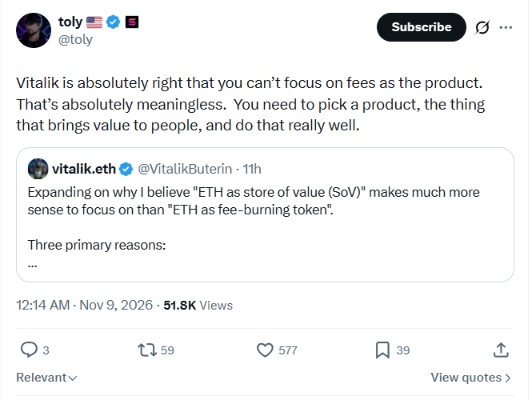
Despite these apparent majorities, staunch critics of the sector are slated to hold influential leadership positions. Senator Brown is expected to join the Senate Agriculture Committee, while Elizabeth Warren is tipped to chair the Senate Banking Committee. Kyle Bligen, executive director at the Decentralization Research Center, noted that the upcoming Congress will introduce a fundamentally different regulatory environment characterized by significantly heightened scrutiny.
Reports indicate that Democratic lawmakers are already considering expanding proposals originally introduced by Representative Maxine Waters into a comprehensive market structure bill. While a resurrected version of the CLARITY Act remains an outside possibility, it would likely require stringent ethics provisions aimed at addressing concerns over political figures issuing digital assets. Fidelity Digital founder Hadley Stern highlighted these governance concerns, pointing to controversies surrounding political memecoins and stablecoins as a distinct regulatory hurdle for the sector. Meanwhile, the broader markets reacted to the political shift, with AI-related stocks declining and Bitcoin retreating below the $76,000 threshold.
Sophisticated Social Engineering Leads to Massive Binance Hack
Global cryptocurrency exchange Binance confirmed that a devastating security breach resulting in the loss of $6.34 billion originated from a targeted social engineering campaign deployed months prior. According to internal reports, North Korean threat actors initially breached network perimeters in June when an employee inadvertently downloaded a compromised Homebrew installation while attempting to set up an AI coding assistant. Although the exchange detected the initial intrusion, attackers successfully gathered intelligence regarding personnel working on internal wallet infrastructure.
In September, attackers posing as recruiters targeted another software engineer, tricking them into downloading a malicious file disguised as a technical coding assignment. By Oct. 20, the perpetrators leveraged the compromised workstation and integrated internal AI development tools to pivot into the systems of two additional engineers, ultimately deploying malware that granted them unauthorized access to the exchange’s internal wallet-signing service. Binance co-CEO Richard Teng characterized the incident not as a single oversight, but as a sophisticated, months-long infiltration campaign.
Ethereum Developer Targets Accelerated Quantum Resistance Timeline
Ethereum Foundation researcher Justin Drake has proposed an accelerated timeline for the network’s post-quantum transition, targeting December 2028 for completion—a full year ahead of the previously announced deadline of December 2029.
Speaking at Devcon 8 in Mumbai, Drake outlined the updated roadmap, explaining that developers have a strict 24-month window to successfully deliver three vital network upgrades. However, this aggressive timeline arrives while the broader core development pipeline experiences temporary bottlenecks, as teams navigate security evaluations and delays surrounding the planned Glamsterdam upgrade.

THORChain Resumes Operations Despite Law Enforcement Warnings
Decentralized liquidity protocol THORChain has resumed trading activities across the majority of supported networks, explicitly bypassing an advisory warning from the Federal Bureau of Investigation urging platforms to block funds associated with the recent Binance exploit. Following the restoration of swaps for major assets including Bitcoin, Ethereum, Litecoin, and Dogecoin, the native RUNE token experienced a 15% price increase within a 24-hour window.
Blockchain analytics firm Chainalysis reported that THORChain processed upwards of $46 million linked to the hack during its initial operational hours before an automated safety circuit breaker paused trading due to an unrelated Ethereum block reorganization. Co-founder JPThor defended the protocol’s automated functionality, asserting that the network’s inability to manually comply with the federal directive demonstrated its genuinely decentralized nature.
Market Performance and Weekly Industry Developments
At the conclusion of the trading week, major digital assets faced downward pressure. Bitcoin declined 4.5% to $74,302, Ethereum fell 6.3% to $2,117, and XRP decreased 5% to $1.11, bringing the aggregate cryptocurrency market capitalization down to $2.49 trillion. Among the top 100 digital assets, top altcoin gainers included Pieverse, Injective, and Tether Gold, while underperformers featured official political memecoins and decentralized identity tokens.
Industry analysts continue to assess the fallout from the Binance security incident. Grayscale head of research Zach Pandl suggested that while the multi-billion-dollar exploit represents a temporary blow to market confidence, it will ultimately catalyze stricter security standards across centralized platforms and highlight the importance of institutional-grade custody solutions.
Simultaneously, regional regulatory pressures continue to reshape exchange footprints. Binance France announced plans to shutter local user accounts by Dec. 31, implementing monthly maintenance fees on remaining balances starting in late November. The decision follows previous announcements regarding European service limitations resulting from strict compliance requirements under the Markets in Crypto-Assets framework.
Security concerns extended beyond centralized exchanges, as Visa debit card provider Gnosis Pay disclosed a data breach affecting a legacy consumer card system. The incident exposed customer payment details, residential addresses, and associated cryptocurrency wallet information, though core user funds and separate enterprise infrastructure remained secure.