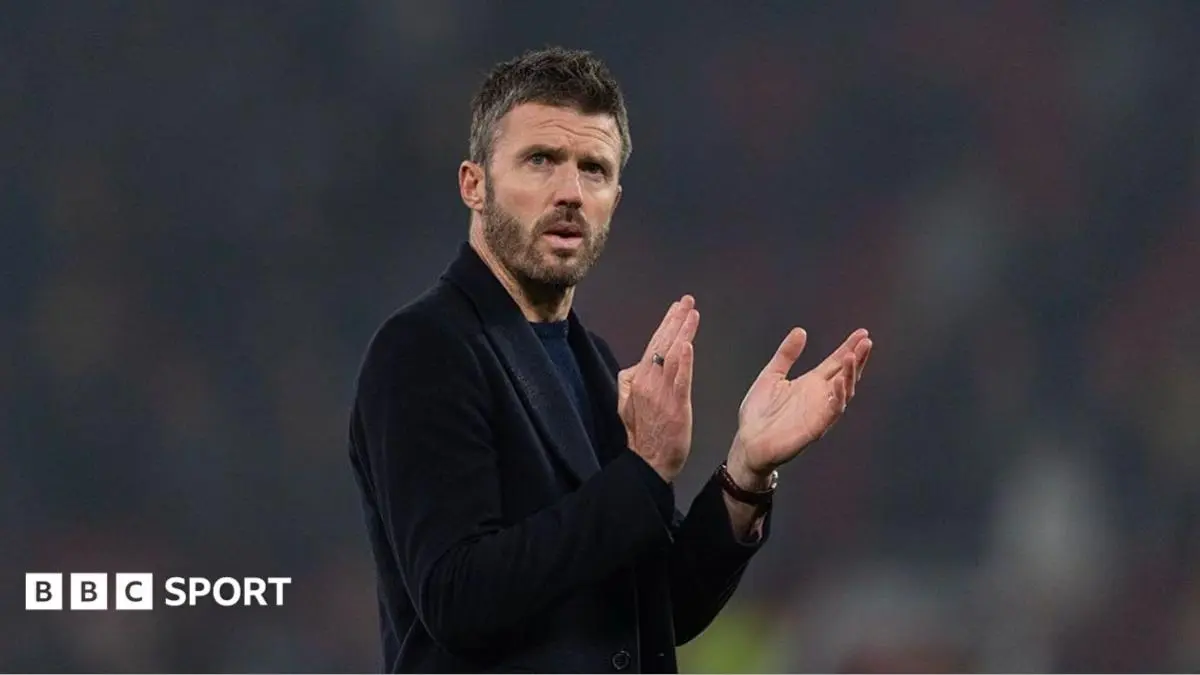
Manchester United appear to be approaching a definitive turning point regarding the future of head coach Michael Carrick. Following a sustained period of poor results and a growing sense of instability at Old Trafford, the club’s leadership is increasingly expected to move toward a change in management. While the board has maintained a disciplined approach to evaluating the situation, the mounting pressure of a historic domestic decline suggests that Carrick’s tenure may be nearing its conclusion.
The current atmosphere surrounding the club is one of heavy scrutiny. Following the demoralizing 3-0 home defeat to Bournemouth on 25 October, the club’s hierarchy made a conscious decision to retain Carrick, opting against a knee-jerk reaction. At the time, the consensus among the club’s leadership was that a period of reflection was necessary, with the intention of reassessing the manager’s position during the November international break. This window, which allows for a brief respite from the relentless fixture schedule, is widely viewed as the natural point for the club to make a strategic decision regarding their long-term direction.
Multiple sources have confirmed to BBC Sport that the club’s board remains committed to this deliberative process. Despite the intense media speculation and the frustration emanating from the fanbase, no final decision on Carrick’s immediate future has been formally ratified or announced. The club is clearly attempting to balance the need for swift action against the requirement for a methodical, evidence-based assessment of the coaching staff’s performance.
However, the internal climate is shifting. There is a growing expectation within the corridors of Old Trafford that chief executive Omar Berrada and director of football Jason Wilcox will ultimately recommend to minority owner Sir Jim Ratcliffe and the Glazer family that Carrick’s time at the helm should come to an end. Such a recommendation would carry significant weight, as it would represent the collective view of the key decision-makers tasked with restructuring the club’s sporting operations. For Sir Jim Ratcliffe, who has sought to overhaul the club’s culture and performance metrics, a change in the dugout may be viewed as a necessary step to arrest a slide that threatens to derail the entire campaign.
The urgency of this situation is underscored by the team’s dismal performance on the pitch. Sunday’s 4-4 draw with Aston Villa was a microcosm of the defensive fragility and inconsistency that have plagued the side throughout the season. The result leaves Manchester United languishing in 18th place in the Premier League table. Perhaps most damning is the statistical reality of this campaign: the club has now recorded its worst start to a domestic season in 40 years. This level of underperformance is, by the standards of a club with United’s history and resources, widely considered unsustainable. The gap between expectation and reality has widened to a point where the board’s patience is being tested to its absolute limit.
The lack of progress has forced the club to look toward potential alternatives long before a formal vacancy has been created. As reported by BBC Sport back in October, the club had already begun the process of sounding out potential successors. Among those discussed in internal circles are former Newcastle United manager Eddie Howe and the former Germany head coach Julian Nagelsmann. Both figures possess significant experience in top-tier European football and would represent a shift in the club’s managerial strategy, though the complexity of negotiating such appointments during an active season remains a significant hurdle.
The managerial market, however, is not limited to those currently without a club. Former Chelsea manager Antonio Conte has long been linked with the role and is understood to be keen on the prospect of taking charge at Old Trafford. Conte, known for his demanding nature and tactical rigor, has a proven track record of delivering domestic success in England. Similarly, multiple sources have indicated to BBC Sport that Mauricio Pochettino, the current United States men’s national team coach, is open to the possibility of returning to the Premier League.
Pochettino’s situation is particularly noteworthy given his recent appointment in the United States. Having only signed an extension to his contract with the U.S. Soccer Federation in August, any pursuit of the Argentine would require navigating the specific terms of his current deal. While the contract binds him to the USMNT, it is widely believed that the agreement contains release clauses that would allow him to depart for high-profile managerial roles should the opportunity arise. This nuance makes him a potential candidate for a club of Manchester United’s stature, provided the board is willing to trigger the necessary mechanisms to bring him back to club management.
The timeline for any potential movement remains tight. The United States team is scheduled to play a high-stakes, two-legged Concacaf Nations League play-off against Haiti on 14 and 18 November. This international window mirrors the very period in which Manchester United are expected to make their final decision on Carrick. The overlap between these two sets of events serves as a reminder that while the club is currently in a state of stasis, the wider footballing landscape continues to move, and the window for making a decisive managerial change is rapidly closing.
For now, the status quo remains in place, but it is a status quo defined by profound uncertainty. The silence from the board is not necessarily an indication of support for Carrick, but rather a reflection of the gravity of the situation. Every match that passes without a victory or a tangible improvement in performance further erodes the argument for continuity. The players, the staff, and the supporters are all acutely aware that the club is at a crossroads.
As the international break progresses, the focus of the Manchester United hierarchy will be on weighing the risks of a mid-season managerial change against the risks of allowing the current decline to continue unchecked. The legacy of a forty-year low is a heavy burden for any manager to bear, and the data suggests that the team is currently ill-equipped to reverse the trend under the existing leadership structure. Whether the club chooses to stay the course in a final bid for stability or opts to initiate a comprehensive rebuild under new guidance remains the defining question of the coming days.
For Sir Jim Ratcliffe and his team, the challenge is to determine if the current malaise is a temporary dip or a systemic failure that can only be rectified by a fresh start. The recommendation from Berrada and Wilcox will be the final piece of the puzzle. Until that recommendation is delivered and a decision is reached, Manchester United remains a club holding its breath, waiting to see if the axe will fall on Michael Carrick and who, if anyone, will be tasked with the daunting responsibility of leading the club out of its current crisis. The coming week is set to be one of the most consequential in the club’s recent history, with the eyes of the footballing world fixed firmly on Old Trafford to see how the board navigates this historic downward spiral.