While Hollywood history is filled with actors and cultural icons who profess a deep affection for automobiles and the intricacies of their engineering, very few truly understand the mechanics behind the machines they drive. Steve McQueen, however, stood apart from the crowd.
Widely celebrated as the undisputed "King of Cool," McQueen possessed an undeniable magnetism that commanded attention on the silver screen and projected effortless suaveness off it. Beyond his legendary cinematic presence, he maintained a genuine, hands-on appreciation for cars and motorcycles that extended far beyond a casual hobby. McQueen actively competed in various levels of motorsport throughout his lifetime, testing his skills and machine limits on tracks and off-road courses. At one point, his automotive expertise was respected enough that he served as a road tester for Sports Illustrated, putting high-performance vehicles through their paces for a discerning readership.
Unsurprisingly, his personal garage housed an extraordinary collection of machinery, featuring machines that reflected a sophisticated and adventurous palate. Over the years, vehicles associated with the iconic actor have commanded staggering sums at major auction houses, with no fewer than five individual cars from his sphere of influence selling for upwards of $1 million. Now, another crown jewel from that illustrious automotive chapter is preparing to cross the auction block.
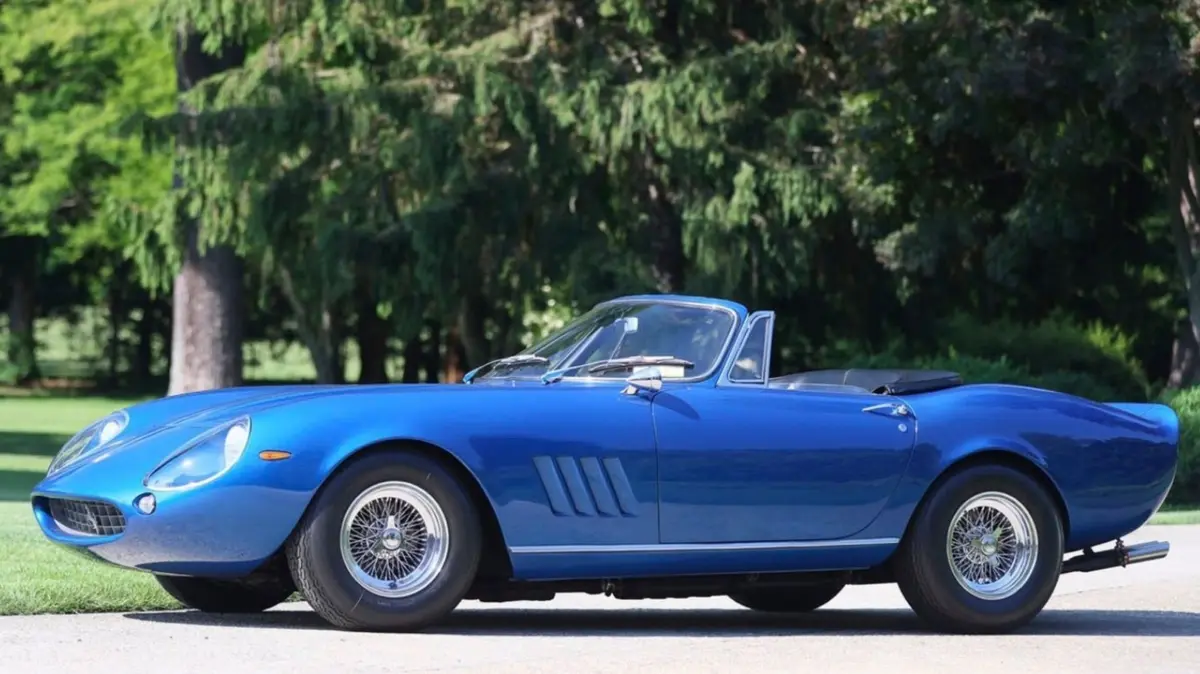
One of McQueen’s most cherished and distinctive vehicles—his former 1967 Ferrari 275 GTB/4*S NART Spider—is heading to auction at Gooding Christie’s upcoming New York event. The high-profile auction is scheduled to take place from November 20 to 21 at the Javits Center in Midtown Manhattan. Automotive market experts and auction specialists have projected that the rare Spider could fetch anywhere between $15 million and $20 million. While such a staggering valuation places the car among the upper echelon of collector vehicles, it remains somewhat grounded when compared against the absolute peaks of the vintage market, such as the ultra-rare Mercedes-Benz 300 SLR Uhlenhaut Coupe that previously shattered records by selling for $143 million.
History with McQueen
The vehicle’s journey into automotive lore begins with its extreme exclusivity. Italian manufacturer Ferrari produced only 10 examples of the NART (North American Racing Team) Spider model, a car born out of importer Luigi Chinetti’s desire to offer an open-top grand tourer tailored for the American market. This particular chassis, bearing number six in the production sequence, holds the distinction of being one of only two examples finished from the factory in the striking shade of ‘Blu Sera,’ or Evening Blue.
McQueen acquired the car sometime in 1967, shortly after its production. Possessing a distinct aesthetic vision and a racer’s eye for detail, the actor wasted little time customizing the machine to suit his personal tastes. He commissioned several modifications soon after taking delivery, opting for a darker metallic blue paint finish and custom-reupholstered seat patterns that differentiated the car from its factory siblings. Further refining the vehicle for a more purposeful, competition-inspired look, McQueen added a smaller, motorsport-style rearview mirror and a quick-fill gas cap, among other bespoke touches, blending grand touring luxury with the utilitarian ethos of a race car.
Even in its modified state, the car was already a true one-of-a-kind creation. However fate intervened following an unfortunate accident along the Pacific Coast Highway, which left the Ferrari with heavy damage to both the front and rear bodywork. Rather than viewing the mishap as a setback, McQueen saw it as an opportunity for further personalization and artistic expression. He entrusted the damaged exotic to Hershel Conway of Junior’s House of Color, a famed automotive restorer and master painter renowned for his exceptional craftsmanship. Conway executed McQueen’s vision by flaring the fenders a little further to accommodate wider stances and fabricating the distinctive ‘flip tail’ upward-facing rear spoiler, giving the Spider an aggressive, unmistakable silhouette.
Beneath its sculpted Italian bodywork lies a mechanical heart that continues to captivate purists. The diminutive drop-top beauty generates approximately 300 horsepower in stock form, courtesy of a legendary 3.3-liter V12 engine. Specifically, this is the illustrious Ferrari ‘Colombo’ V12, an engineering marvel widely regarded by automotive historians and enthusiasts as one of the greatest internal combustion engines of all time. Power is channeled through a traditional five-speed manual transaxle. When shifting through the gates with precision, a driver in the late 1960s could propel the car from zero to 60 miles per hour in just 6.7 seconds, ultimately covering the quarter-mile in 14.7 seconds. Considering these performance figures today, it is essential to remember that the underlying technology powering this convertible is approaching six decades of age.
What happened to it next?
Following his ownership, McQueen parted ways with the Spider in 1971, selling it to J. David Kopf, a multifaceted figure known as a designer, inventor, machinist, and amateur racer. Kopf maintained custody of the high-performance Ferrari for over a decade before eventually passing it along in 1985 to Grand Prix SSR, a specialized New York City-based Ferrari facility.
At the hands of the New York specialists, the car underwent a meticulous restoration process that saw the Spider reverted to its original factory ‘Blu Sera’ paint finish. The team also completed any other vital mechanical and cosmetic work necessary to ensure the vehicle’s structural and operational integrity before it found a new home in the collection of prominent tech businessman and automotive collector Anthony Wang. The Ferrari has remained under Wang’s stewardship ever since. True to its status as an ultra-exclusive private collection piece, the car has rarely been seen by the public eye over the past several decades, believed to have been publicly showcased only twice—once in 1996 and again in 2003.
Over the years, this particular Ferrari has ascended to mythical status within the collector car community, buoyed by its extraordinary rarity, documented provenance, and remarkable condition. Given the convergence of its legendary first owner, its competition-bred lineage, and its scarce production numbers, industry observers fully expect the vehicle to achieve its ambitious pre-auction estimate when the hammer falls in Midtown Manhattan, if not surpass it entirely.
The market for memorabilia and machinery tied to the "King of Cool" has consistently demonstrated immense drawing power. McQueen’s iconic Porsche 917K sports prototype from his classic racing film "Le Mans" previously commanded a staggering sum at auction, much like the vintage 1926 Excelsior Super X motorcycle that he famously rode around his ranch. With such a proven appetite among collectors for authentic artifacts of his life and career, there appears to be little standing in the way of this exceptional Ferrari securing an eye-watering final price, satisfying a collector eager to own a profound piece of automotive and cinematic history.