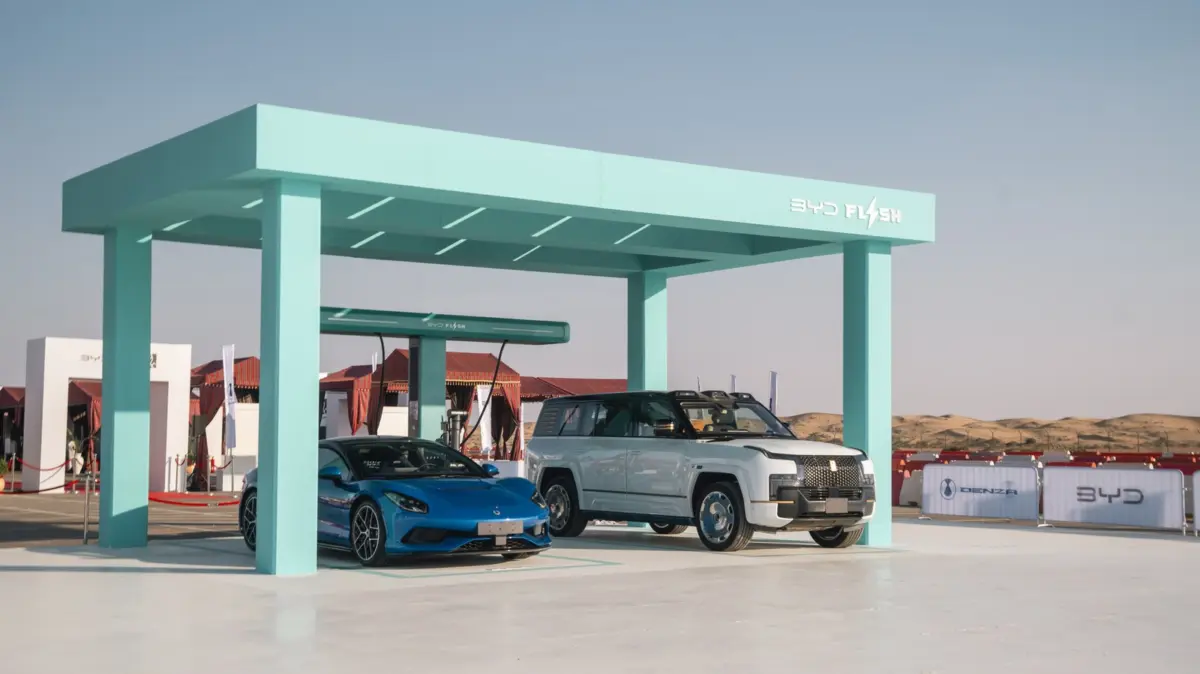
Despite not yet selling passenger vehicles in the United States, China’s BYD is quietly executing a massive takeover of the global electric vehicle market. Having already surpassed Tesla as the world’s largest electric carmaker by global sales volume, the automotive giant has also set its sights on a parallel objective: dethroning Tesla as the provider of the world’s most advanced and comprehensive EV charging network. Now, the company has announced a major, high-tech leap toward that ambitious goal. In a striking showcase held in the demanding environment of the Abu Dhabi desert, BYD revealed a groundbreaking infrastructure project that seamlessly combines clean solar power generation, proprietary high-powered energy storage, ultra-fast flash charging technology, and automated robotic arms into a single, unified electric vehicle charging ecosystem.
The engineering core of this innovative new infrastructure is BYD’s proprietary Flash Charging technology. Like traditional EV charging stations found across the globe, these new stations draw baseline electricity directly from the municipal power grid. However, what sets BYD’s system apart from conventional alternatives is an advanced local energy storage mechanism. Instead of feeding grid power straight to a vehicle at variable speeds, the station routes electricity into two large on-site 185-kilowatt batteries. According to company specifications, this stored reserve can then be discharged into a compatible electric vehicle at speeds vastly superior to what standard direct-grid connections could ever achieve.
Each individual Flash Charger unit is equipped with two heavy-duty connectors designed to handle immense electrical loads. When only a single vehicle is plugged into the station, the system is capable of delivering an astonishing charging rate of up to 1,500 kW. If two vehicles are plugged in simultaneously and sharing the available output, each car can still receive up to 1,000 kW of power. To put these figures into proper perspective, current industry benchmarks pale in comparison. Tesla’s recently deployed V4 Superchargers generally top out at 500 kW, while standard Tesla Superchargers hit 250 kW, and the fastest direct-current fast chargers currently deployed by network operators like Electrify America peak at around 350 kW.
The real-world implications of BYD’s charging speeds are transformative for drivers accustomed to longer pit stops. BYD officially quotes phenomenal charge times for its system, claiming vehicles can replenish their batteries from 10 percent to 70 percent capacity in a mere five minutes. For a more complete charge, going from 10 percent to 97 percent takes just nine minutes. Furthermore, the company has engineered the hardware to withstand extreme environmental conditions. In rigorous cold-weather testing simulating an ambient temperature of minus 30 degrees Fahrenheit, the system is still capable of charging a vehicle from 20 percent to 97 percent capacity in just 12 minutes, proving that the high-power architecture is resilient against severe thermal challenges.
Solar-powered arms race
Building upon this high-capacity foundation, BYD is now actively incorporating clean solar power generation directly into the equation. By capturing energy from the sun and feeding it into those same local 185-kW on-site batteries—presumably via expansive solar panel arrays mounted on top of protective canopies built over the charging bays—the infrastructure achieves a remarkable degree of energy independence. This design means the entire system is significantly less reliant on constant support from the local electrical grid. Such independence is an enormous advantage when deploying high-power charging infrastructure in remote, sun-soaked regions, such as the punishing desert expanses of the United Arab Emirates where BYD chose to debut the new technology.
Adding to the futuristic aesthetic and functional convenience of the installation, BYD is also integrating automated robotic arms into the charging bays. While the overarching concept of automated plug-in technology is far from new—Tesla famously teased robotic charging concepts a decade ago, and established competitors like Volkswagen, Hyundai, and China’s Xiaomi have all built their own experimental renditions over the years—seeing it deployed in a commercial, high-powered desert setting marks a significant operational milestone. The premise is elegantly simple for the end user: upon parking the vehicle in the designated bay, an automated robotic arm utilizes computer vision and sensors to precisely locate the car’s charging port, automatically open the protective cover, and smoothly insert the heavy-duty connector without requiring any physical effort from the driver.
Looking ahead, BYD has laid out an aggressive global rollout schedule to scale this infrastructure. The automaker plans to manufacture and install a staggering 6,000 Flash Charging stations worldwide by the end of next year. Industry analysts note that not all, or even a majority, of these initial deployments will immediately feature solar power arrays or the newly unveiled robotic arms straight out of the gate. However, if BYD can successfully validate and scale its vision of five-minute ultra-fast charging backed by solar energy and automated robotics over the next couple of years, the automotive industry may well be witnessing the rise of a formidable new king in the global EV charging network landscape.