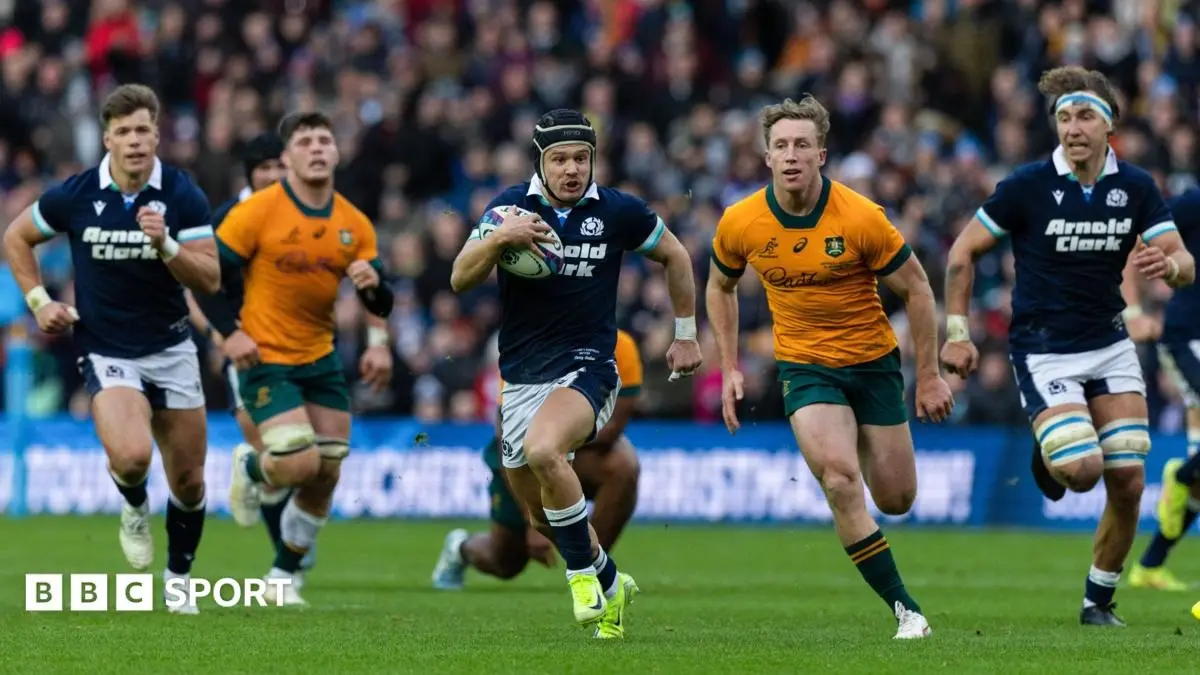
In the high-stakes theater of the Nations Championship, Sunday’s fixture between Scotland and Australia has emerged as the definitive "Battle of the Unpredictables." Both nations enter the contest at Murrayfield as sides that are as thrilling as they are perplexing, possessing the rare ability to reach scintillating heights of attacking rugby one moment, only to fall into a state of structural disintegration the next. It is a match defined by inconsistency, and for both camps, the upcoming eighty minutes represent a crucial opportunity to prove that their respective ceilings are far higher than their recent floors.
Both teams arrive in Edinburgh nursing significant wounds following chastening defeats last weekend. The Wallabies were dismantled by England in a difficult outing at Twickenham, while Scotland suffered a demoralizing loss to the All Blacks at Murrayfield. The nature of these defeats has left both squads under immense pressure to deliver a response, not just for the sake of the tournament standings, but for the collective morale of their respective setups.
For Scotland captain Sione Tuipulotu, the match carries a unique layer of personal narrative. Born in Australia, the midfielder admits that facing the Wallabies always stokes a familiar fire within him. However, he is quick to emphasize that the primary motivation for this weekend is not historical sentimentality, but rather the urgent need to make amends for a second-half performance against New Zealand that he and his teammates view as a significant collective failure.
"It is always hard to watch the footage back after a defeat like that where we missed some big opportunities and let ourselves down in certain areas," Tuipulotu admitted during a pre-match press conference. "As a group, we have confronted that, and I’ve been very proud of the boys in terms of how they have rallied this week. We know that Australia will also be a wounded team coming here after what happened against England at Twickenham. I think I will always have that little bit of fire bubbling away whenever I play against the Wallabies. I’ve done it a few times now, both with Scotland and also with the Lions. But there’s a bigger picture than just looking at me and my history with Australia. Our minds are firmly set on bouncing back after last week. That performance wasn’t good enough. We know that and we want to put that right."
The intensity of the scrutiny surrounding this match is matched only by the spotlight on specific individuals. In the wake of the Wallabies’ humbling at the hands of England, a considerable portion of the public and punditry criticism was aimed squarely at Joseph Suaalii. The 23-year-old rugby league convert, who has been thrust into the international rugby union spotlight, carries the weight of his nation’s expectations on his shoulders—a dynamic similar to the pressure faced by Scotland’s own mercurial playmaker, Finn Russell.
When the Wallabies struggle, as they did at Twickenham, Suaalii is often the first to be targeted by critics questioning the transition from league to union. Former England international Chris Ashton, who himself navigated the difficult path between the two codes, was particularly blunt in his assessment of the young star. "This Suaalii gamble, I dread to think how much he gets paid. He doesn’t look like an international rugby union player to me," Ashton remarked, echoing the sentiment of many who feel the Wallabies’ tactical experimentation has come at too high a price.
Despite the external noise, Australia has moved to reshape its midfield for the trip to Edinburgh. Having started on the wing at Twickenham last weekend, Suaalii has been shifted back into the 13 jersey, a move that places him directly into the heart of the midfield maelstrom to lock horns with Tuipulotu. The two players share a history defined by physical brutality; when the sides met two years ago, Suaalii caught Tuipulotu with a collision of such staggering force that it effectively ended the Australian’s afternoon, forcing him off the pitch due to injury.
The verbal exchanges between the two in the aftermath of that hit were described by onlookers as "spicy," yet Tuipulotu maintains a deep respect for his opponent’s capabilities. He remains wary of the possibility that the heavy criticism leveled at Suaalii this week might serve as a catalyst for a standout performance on Sunday.
"I know there’s been a few things flying around this week about him. I wish they could have done that in another week," Tuipulotu joked, acknowledging the danger of a motivated elite athlete. "My brother, Mosese, who is now with Edinburgh, was with him at the Waratahs, and he only had good things to say about him, to be honest. I know how much of a talented athlete he is, and there’s only so much you can poke someone before they respond. We are wary of the bounce back, and we’re certainly not delusional enough to think that these kind of players won’t play well against us. I expect the very best version of Joseph Suaalii in this game, and I’m excited to go up against him again."
The stakes for Scotland have been sharpened by developments elsewhere in the Nations Championship. France’s epic victory over the world champion Springboks in Paris on Friday has all but extinguished any realistic hope for Scotland to finish at the summit of the northern hemisphere table. With the path to first place blocked, the Scots are left to fight for a secondary, yet equally vital, objective: securing victories over Australia this weekend and Japan next week.
Securing those wins is the only way for Gregor Townsend’s men to ensure they qualify for a meaningful, high-profile fixture against one of the southern hemisphere heavyweights on finals weekend in London. For a squad looking to build momentum and tactical maturity ahead of next year’s World Cup, the opportunity to test themselves against the best in a high-pressure environment is invaluable. Conversely, falling into a "dead-rubber" fixture against a lower-ranked opponent would be a missed opportunity for a team desperate to prove its pedigree on the global stage.
"For us, it’s a ‘got-to-have-it’ game," Tuipulotu said, summarizing the atmosphere within the Scottish camp. "That’s the mood in the place. It’s such a different feeling around the training ground when you’ve either won or lost. We know we need to win this game. We want to get that positive feeling back around the camp again. We want to get our Nations Championship back on track and give ourselves a big game going into that finals weekend."
As Sunday approaches, both Scotland and Australia find themselves at a crossroads. For Scotland, it is about reclaiming their identity after a collapse against the All Blacks; for Australia, it is about silencing the critics and justifying the ambitious selections that have left them under fire. In a match where both teams are prone to moments of both brilliance and inexplicable error, the side that manages to hold its nerve—and its defensive structure—will likely emerge victorious. At Murrayfield, the battle for pride, points, and progression begins, with neither side willing to accept anything less than a redemption-fueled victory.