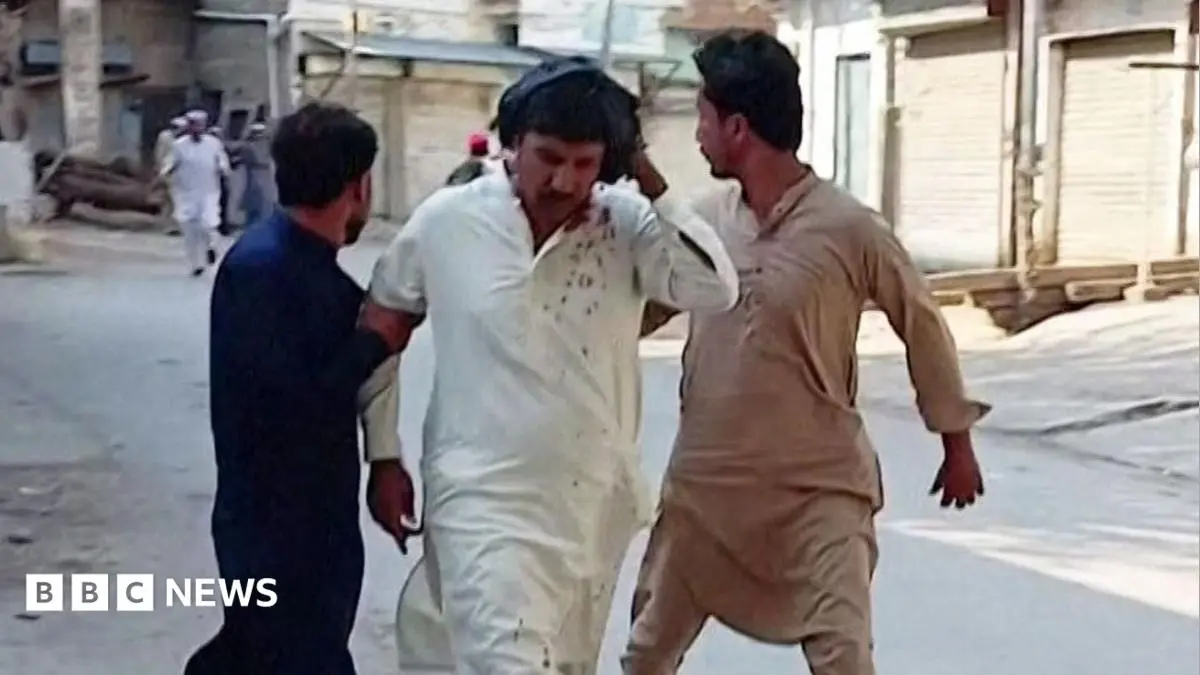
A catastrophic car-bomb attack coupled with a coordinated militant assault on a mosque and a neighboring police facility in north-western Pakistan has claimed the lives of at least 21 people, officials confirmed on Friday. The violence, which unfolded during the height of communal Friday prayers, has left over 100 individuals injured, many of whom remain in critical condition as hospitals in the Khyber Pakhtunkhwa province struggle to cope with the influx of casualties.
The attack, which targeted the city of Kohat, has sent shockwaves through a region already grappling with a persistent and escalating security crisis. According to reports from the state-run Associated Press of Pakistan (APP), the death toll includes 15 police officers, underscoring the deliberate nature of the strike against law enforcement personnel. Among the civilian casualties, the loss of a four-year-old child has drawn particular public outcry, highlighting the indiscriminate brutality of the violence.
The sequence of events began at approximately 13:15 local time (08:15 GMT), a moment when mosques across the country are typically filled with worshippers attending the weekly congregational prayers. Witness accounts and preliminary findings suggest that the assailants utilized a vehicle-borne improvised explosive device (VBIED) to breach the security perimeter, followed by a tactical assault involving gunmen who opened fire on a nearby police facility.
Video footage, which has been verified by BBC Verify, depicts a harrowing scene of total destruction. The site of the mosque is blanketed in thick layers of rubble, twisted metal, and shattered concrete. In the immediate aftermath, frantic scenes of survivors and local residents attempting to provide first aid to the wounded were captured, with the debris-strewn ground serving as a grim testament to the force of the blast.
Khyber Pakhtunkhwa police Inspector General Zulfikar Hameed, speaking to the news agency Reuters, characterized the incident as a "suicide attack." According to Hameed, the assault was multifaceted; the initial explosion was followed by a sustained gun battle between the attackers and security forces. All seven of the militants involved in the operation were killed during the explosion and the subsequent retaliatory fire from the police. Despite the tactical conclusion of the immediate threat, a comprehensive clearance operation remains underway as authorities comb the area for potential secondary devices and gather forensic evidence.
In the hours following the tragedy, high-ranking government officials have issued statements condemning the atrocity. Pakistan’s President, Asif Ali Zardari, formally expressed his condolences to the bereaved families and issued a statement conveying "his best wishes for the swift recovery of those injured in the explosion." Prime Minister Muhammad Shehbaz Sharif also issued a sharp condemnation, labeling the attack an assault on the peace and stability of the nation. As of Friday evening, no militant group had claimed responsibility for the carnage, a development that has left security analysts and government officials closely monitoring intelligence channels for clues regarding the perpetrators’ affiliations.
The incident in Kohat occurs against a backdrop of deteriorating security in Pakistan’s border regions. Over the past several months, the country has witnessed a sharp, consistent rise in militancy. Armed groups have increasingly focused their efforts on high-profile targets, specifically the military and police establishments. This pattern of violence has placed immense strain on the state’s security apparatus, which is currently engaged in a multi-front effort to quell internal instability.
The broader geopolitical context of this surge in militancy remains a point of intense friction between Islamabad and the Taliban administration in Afghanistan. For years, the Pakistani government has maintained that these militant groups utilize Afghanistan as a safe haven, leveraging the rugged border terrain to train recruits, store weaponry, and plan sophisticated attacks within Pakistani territory. Islamabad has repeatedly urged the authorities in Kabul to take decisive action to curb the movement of these insurgents.
Conversely, the Taliban government in Afghanistan has consistently denied these allegations. They argue that the militant groups operating within Pakistan are a domestic problem, rooted in internal political and social grievances rather than external support or sanctuary. This diplomatic impasse has complicated counter-terrorism efforts, leaving border provinces like Khyber Pakhtunkhwa particularly vulnerable to the overflow of violence.
As the clearance operation continues in Kohat, the focus of the authorities has shifted toward the dual tasks of maintaining order and providing medical assistance to the victims. The high number of casualties has overwhelmed local health facilities, forcing medical staff to work around the clock to treat severe trauma injuries. Local authorities have called for blood donations and requested additional medical supplies from neighboring districts to sustain the emergency response.
The scale of the attack, particularly the loss of police officers, suggests a high level of coordination and planning by the assailants. By targeting both a place of worship and a police facility, the perpetrators aimed not only to maximize casualties but to strike at the symbols of state authority and religious life simultaneously. Such tactics are designed to sow fear and demonstrate a capability to bypass security measures even in heavily guarded urban centers.
Security experts suggest that the recent surge in attacks is indicative of a broader strategy by militant factions to exploit current political tensions within Pakistan. As the state grapples with economic challenges and internal political debates, the security environment has become increasingly fragile. The resilience of these militant networks—many of which have proven capable of regrouping after military operations—poses a long-term challenge to the stability of the Khyber Pakhtunkhwa province.
For the residents of Kohat, the tragedy has left a deep scar on the community. The mosque, a central pillar of local life, now stands as a ruin. In the coming days, the government is expected to face mounting pressure to provide a transparent account of how the attackers were able to bypass security protocols. The investigation into the incident, led by provincial authorities, will likely focus on intelligence failures and potential security gaps that allowed the militants to stage such a lethal assault in broad daylight.
While the immediate emergency response is the current priority, the national conversation in Pakistan will inevitably turn toward the sustainability of the current security strategy. With no group having claimed the attack, the uncertainty surrounding the identity of the perpetrators has only added to the anxiety of the local population. As investigators analyze the evidence recovered from the site and piece together the final moments of the seven attackers, the government remains under immense pressure to prevent further escalations in a region that has known far too much conflict in recent years.
The tragedy in Kohat serves as a stark reminder of the persistent and evolving threat posed by militancy in Pakistan. As the nation mourns the loss of the 21 victims—including the young child and the fallen police officers—the path forward remains fraught with difficulty. The combination of domestic security challenges and the complex, fraught relationship with neighboring Afghanistan continues to define the landscape in which these violent events unfold. For now, the people of Kohat are left to bury their dead and await answers in the wake of one of the most violent days the province has seen in recent memory. The clearance operations continue, and the nation watches closely, hoping for stability in a region that has been pushed to the brink by the actions of faceless, violent actors.