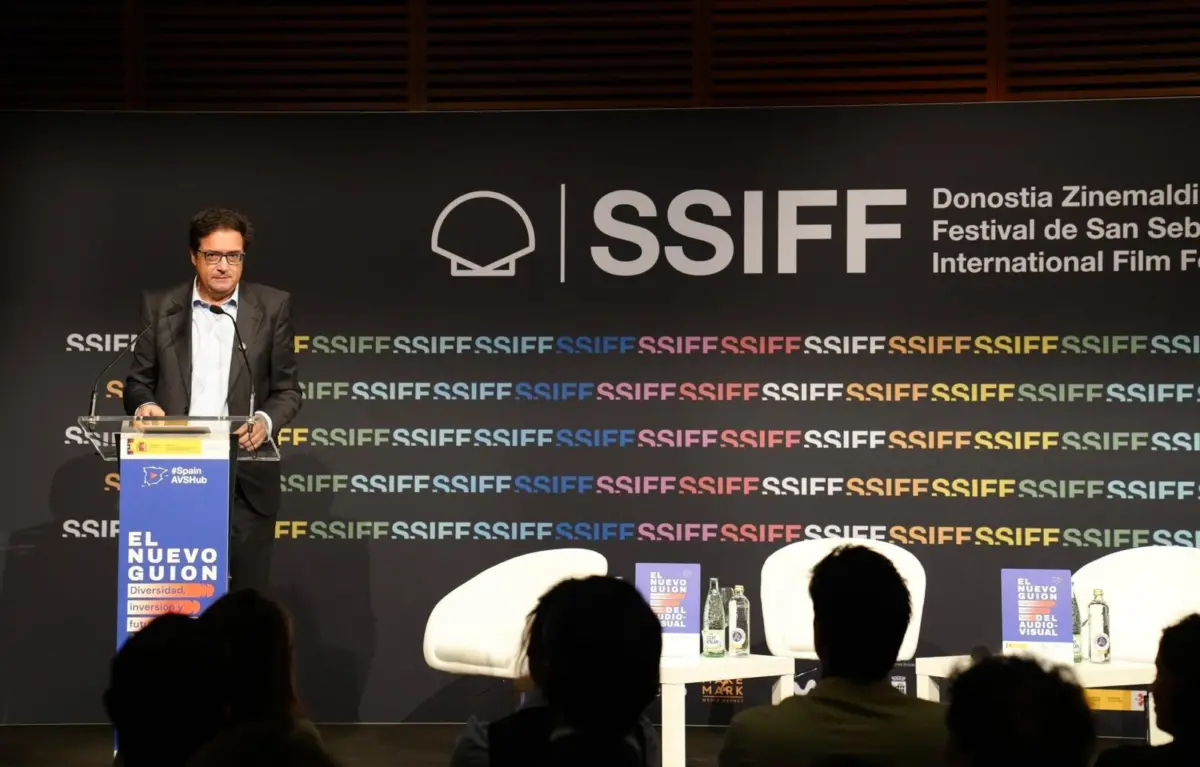
Spain is doubling down on its ascent as a global audiovisual heavyweight, with the government pledging to maintain its aggressive support for the industry through long-term institutional commitments. Speaking at the San Sebastian Festival during a conference titled “The New Script of the Audiovisual Industry,” Óscar López, Spain’s Minister for Digital Transformation and Public Administration, confirmed that the government intends to solidify the sector’s recent successes through the “Spain Crece” (Spain Grows) fund.
The minister’s remarks signal a shift from viewing audiovisual production as a peripheral cultural endeavor to treating it as a cornerstone of the nation’s economic strategy. Central to this approach is the continued deployment of capital via the Spanish Society for Technological Transformation (SETT), the Ministry’s sovereign venture capital fund. For López, the results of recent years have been too significant to ignore, prompting a commitment to move beyond short-term fixes.
“When a public policy works, it should be maintained without a deadline. It is the golden age for our audiovisual sector,” López stated, highlighting a series of record-breaking milestones that underscore the country’s transformation.
A Global Stage for Spanish Talent
The government’s confidence comes at a time when Spanish content is enjoying an unprecedented international spotlight. Just hours after the minister’s speech, the film “La Bola Negra,” directed by Javier Calvo and Javier Ambrossi, secured the prestigious TIFF People’s Choice Award at the Toronto International Film Festival. The prize, widely regarded by industry analysts as a bellwether for potential Oscar momentum, serves as a high-profile validation of the creative quality emerging from Spanish studios.
This critical acclaim is bolstered by cold, hard data. Spain currently boasts a dominant presence on global streaming platforms; Netflix’s all-time Top 10 lists for non-English hits include four seasons of Spanish series and three Spanish-produced films, a feat unmatched by any other nation.
López framed this success as the product of aligning long-standing creative potential with modern political and financial infrastructure. “We had the talent, the ideas, and the locations. What was missing was political will and a significant injection of capital,” he explained. He pointed to the “Spain Audiovisual Hub Plan” as the catalyst for this change, describing it as an unprecedented institutional commitment that allowed the government to design an economic transformation on a scale previously unseen in the sector. With €1.6 billion already mobilized, the minister noted that the nation is now firmly in the phase of “reaping the benefits and expanding our horizons.”
Dramatic Growth and Economic Impact
The statistical trajectory of the Spanish industry is nothing short of transformative. According to data cited by the Ministry, Spain has emerged as the European Union’s largest production market. In 2025 alone, audiovisual production in the country surged by 31%. The reach of these productions is equally striking, with Spanish content accounting for nine of the 11 most-watched series across Europe.
Perhaps most significantly, the sector has become a vital engine for job creation. Employment within the industry has more than doubled since 2020, climbing from approximately 30,900 workers to over 64,000 in 2025. This growth is set to receive further momentum, with López noting that an additional €450 million in investments is currently being mobilized by SETT, directed toward established and emerging production powerhouses such as Lazona, Good Films, and Aurora Media.
Private Sector Perspectives and International Synergy
The government’s strategy is finding strong support among industry veterans. During the panel sessions at San Sebastian, Miriam Segal, founder of Good Film Studios, offered a glowing assessment of the Spanish ecosystem. Drawing on her extensive experience across the U.S., UK, and European markets, Segal admitted that she was previously unaware of the depth of infrastructure available in Spain. She praised the “extraordinary passion and commitment” shown by the government, noting that for the first time in her career as an independent producer, this state support has provided the security to offer pay-or-play deals to actors, significantly de-risking her projects.
Similarly, José Carlos García of Ánima Kitchen credited the intervention of SETT for enabling the company to scale its operations. He highlighted that the funding has been crucial for talent recruitment and the realization of an ambitious roadmap that includes three high-end animated feature films over the next five years, cementing the firm’s leadership in the global animation market.
Mapping the Future of European Audiovisual Strategy
The discussions in San Sebastian also focused on the broader European landscape, with representatives from Spain, Greece, and Denmark debating how the continent can maintain its cultural diversity while remaining competitive in an increasingly globalized market.
Carla Redondo, representing Spain’s Ministry of Digital Transformation, argued that there is no singular “European model.” Instead, she identified the region’s inherent diversity as its greatest strength. While Spain focused its presentation on the success of incentives and infrastructure, other nations offered complementary insights. Greece emphasized the role of international productions in building local training capacity, while Esben Snoer Iversen of the Danish Ministry of Culture underscored the importance of regional cooperation and flexible funding models to navigate the volatile media landscape.
A recurring theme among the participants was the need for administrative harmonization across the EU to better support emerging creative industries. Leonidas Christopoulos of Ekkomed summarized the consensus effectively, noting that while policy and funding are vital, the industry must remain focused on the core product: “It’s all about the stories. Strong content ultimately drives international competitiveness.”
The Evolution of the Ecosystem
Addressing the shifting landscape of media consumption, the final panel of the conference challenged the narrative that linear television is in decline. Fernando Hernaiz of Mediaset argued that television has not died but has instead evolved into a broader, more complex ecosystem that encompasses linear channels, streaming platforms, and advanced distribution networks.
“We have a capacity to adapt,” Hernaiz said, characterizing the modern television business as a sophisticated marriage of “technology, creation, scripts, and business.” Industry leaders, including representatives from RTVE, Atresmedia, and Movistar Plus, echoed this sentiment, calling for a regulatory environment that keeps pace with the rapid technological changes affecting platforms and social media. They agreed that investment and promotion remain the primary drivers in ensuring that Spanish storytelling resonates with international audiences.
Projections and Data-Driven Policy
As the festival drew to a close, a preview of the upcoming Olsberg-SPI report provided a clearer picture of the industry’s economic footprint. The study estimates that between 2020 and 2025, the sector saw €20 billion in direct production expenditure, generating nearly €18 billion in gross value added.
The report highlights that the audiovisual sector acts as a powerful multiplier for the wider economy, with more than half of the jobs created occurring in related supply chains, such as construction, hospitality, and transport. Leon Forde of Olsberg SPI and the Spain Film Commission’s Juan Manuel Guimerans described the industry as a fragile but essential “ecosystem” where all components are interdependent. They emphasized that while growth has been impressive—with direct investment rising by 45% and gross value added by 38%—continued, balanced investment is necessary to sustain the momentum. A comprehensive version of the report, which is expected to serve as a roadmap for future policy decisions, is scheduled for presentation on September 22.