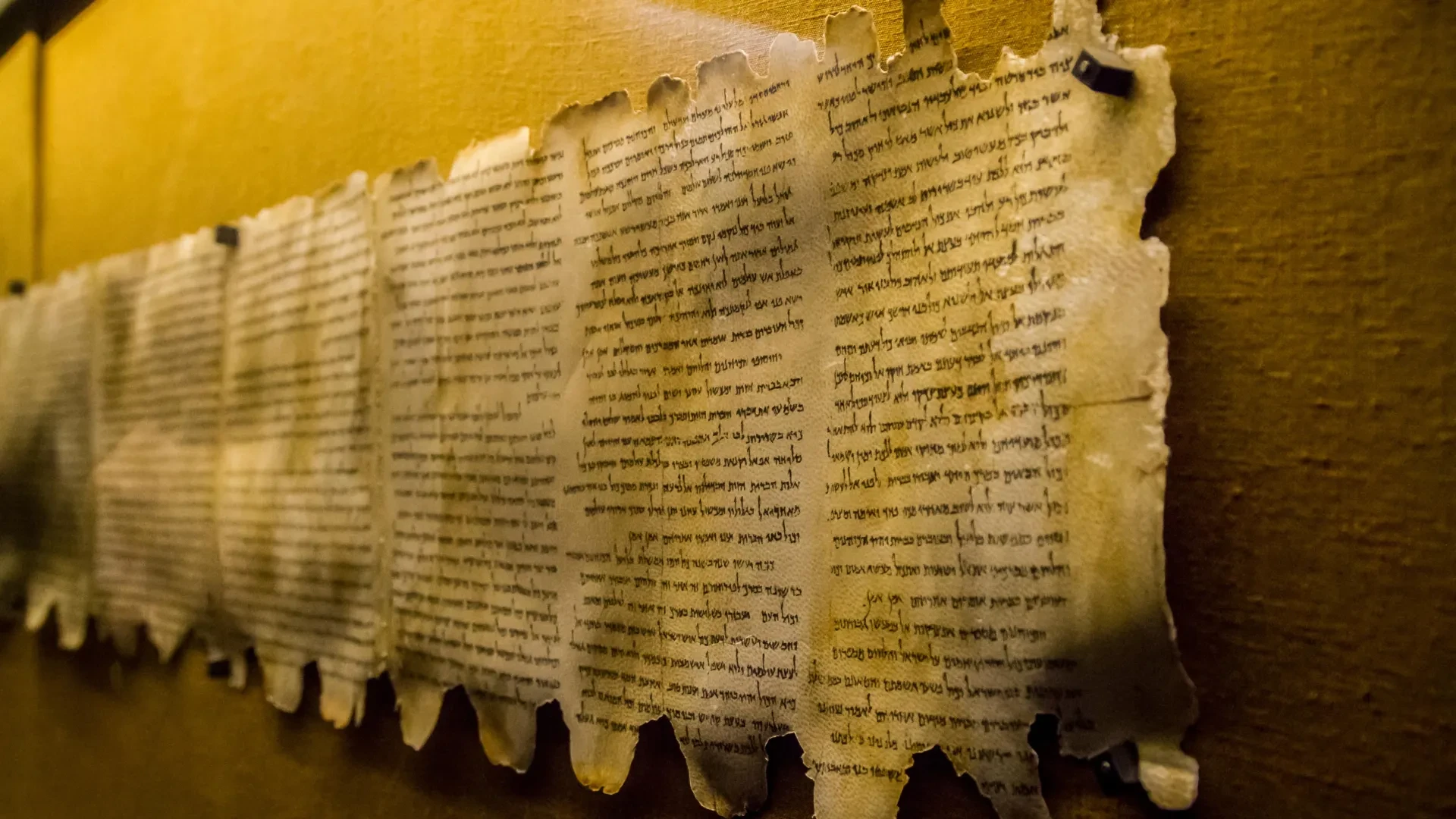
A longstanding mystery surrounding the Dead Sea Scrolls—the collection of ancient Jewish manuscripts discovered in the caves of Qumran—may finally have a coherent explanation. For decades, researchers have debated the nature of the sect’s peculiar 364-day calendar. Was this rigid, mathematically symmetrical system a practical tool used to govern the daily lives of the Qumran community, or did it exist primarily as a religious, theoretical ideal, removed from the realities of seasonal timekeeping?
A new study from Tel Aviv University, conducted by Prof. Eshbal Ratzon of the Department of Jewish Philosophy and the Cohn Institute for the History and Philosophy of Science and Ideas at the Entin Faculty of Humanities, suggests that the truth may lie somewhere in between. According to the proposed reconstruction, the sect likely utilized the calendar during its early formative history, a period marked by intense theological disagreements that ultimately drove the group to separate from the Jerusalem establishment. Over time, however, the system appears to have been abandoned, pushed aside by a combination of inherent astronomical flaws and a shifting political landscape under the Hasmonean leadership of Alexander Jannaeus. The findings were published in the Tarbiz Quarterly for Jewish Studies.
A Calendar Built Around 52 Perfect Weeks
The Qumran calendar stood in stark contrast to the lunisolar calendar that governed Jewish religious life during the Second Temple period. The standard Jewish calendar, reliant on the cycles of the moon, required frequent adjustments to keep festivals aligned with the solar year and the agricultural seasons. In contrast, the Qumran system was defined by its uncompromising mathematical elegance.
The Qumran year consisted of exactly 364 days. Because 364 is divisible by seven, the calendar yielded exactly 52 complete weeks every year. This structure offered a significant practical benefit: religious festivals would always fall on the same day of the week, year after year. For the members of the Qumran sect, this was far more than a mere convenience of calculation. They viewed the orderly, unchanging nature of the calendar as a reflection of a perfect, divine system.
Beyond its internal logic, the calendar served as a potent symbol of religious and political identity. The authorities at the Temple in Jerusalem determined the dates of sacred observances based on their own observations and calculations. The Qumran sect, however, vehemently rejected the idea that human leaders—whom they viewed as corrupt or compromised—should possess the authority to determine the timing of divine festivals. Members of the community believed that these dates had been fixed by God at the moment of Creation and, consequently, were not subject to human alteration.
The Hidden Problem With 364 Days
The very feature that provided the Qumran calendar with its aesthetic and mathematical perfection also contained the seeds of its eventual obsolescence. An astronomical year—the time it takes for the Earth to orbit the Sun—is approximately 365.25 days. By adhering to a 364-day cycle, the Qumran calendar was inherently shorter than the solar year by roughly one and a quarter days.
While this discrepancy might appear negligible over the course of a single year, it grew steadily and inexorably over time. If a community were to follow such a system without making periodic, corrective adjustments, their calendar would drift out of sync with the natural seasons. After only twenty years, religious festivals would have shifted by nearly four weeks relative to the actual seasons. Over several decades, this drift would become extreme; a festival intended to celebrate the arrival of spring could eventually migrate into the heart of winter or the depths of autumn.
For a society whose religious life was deeply intertwined with the rhythms of agriculture—harvesting, the offering of first fruits, and the seasonal cycle—such a drift would have been catastrophic. The problem is analogous to a clock that loses one minute every day. The error is imperceptible in the short term, but as months and years pass, the clock ceases to reflect the actual time, eventually rendering it useless for coordinating daily activity. Prof. Ratzon’s study suggests that the Qumran community encountered this exact phenomenon. Despite the elegance of their system, it gradually lost its utility as it drifted further away from the natural environment it was intended to organize.
Was the Calendar Ever Really Used?
For years, scholars have proposed various theories to resolve the puzzle of this calendar. Some have argued that the Qumran community must have periodically inserted "intercalary" days or weeks to keep their calendar aligned with the seasons, despite the lack of explicit evidence for such a practice in their texts. Others have contended that the 364-day system was never intended for practical use at all, serving instead as an idealized religious framework—a theoretical vision of how time should be, rather than how it was measured in the field.
Prof. Ratzon argues that the Dead Sea Scrolls themselves do not provide clear support for either of these traditional interpretations. Instead, she points to evidence indicating that the calendar was a cornerstone of the sect’s identity and a central point of contention in their estrangement from the Jerusalem religious authorities. The sheer volume of evidence is compelling: nearly twenty scrolls recovered from the Qumran caves focus on calendars and astronomy. This is an unusually high number for such a specific topic, suggesting that the measurement of time was a matter of profound importance to the community.
One of the most important works preserved in the Qumran library, the Book of Jubilees, serves as a vital piece of evidence. The text offers a scathing critique of the lunar-based calendar used by mainstream Judaism and explicitly presents the 364-day system as the original, authentic calendar revealed to Moses on Mount Sinai.
A Calendar at the Center of a Religious Conflict
Building upon this textual foundation, Prof. Ratzon proposes a new historical narrative. She suggests that the Qumran sect did, in fact, actively implement the 364-day calendar during its formative period in the second century BCE. The intense dispute over the measurement of sacred time likely fueled the sect’s growing conflict with the religious leadership in Jerusalem, serving as a primary catalyst for their isolation and withdrawal into the desert.
However, as decades passed, the reality of the calendar’s drift became increasingly difficult for the community to ignore. At the same time, the broader political environment underwent significant changes. Relations between the Qumran sect and the ruling Hasmonean dynasty saw a period of relative improvement during the reign of Alexander Jannaeus. Notably, Jannaeus supported a halacha (religious law) that shared certain commonalities with the sect’s own traditions and stood in opposition to the Pharisaic leadership. According to the study, this changing political context may have provided the community with an opening to move away from its previously rigid stance and eventually adopt the more practical, prevailing calendar used at the Temple.
This does not necessarily mean that the 364-day calendar vanished entirely from the sect’s worldview. Instead, it likely transitioned from a practical tool to a symbolic ideal—a system believed to have been valid at the dawn of Creation and one that would, according to the sect’s eschatological hopes, be restored in the End of Days.
A Possible Solution to a Dead Sea Scrolls Mystery
This interpretive framework offers a compelling explanation for why the 364-day calendar occupies such a central place in the Qumran writings, even as it appears to have faded from practical historical application. By viewing the calendar through the lens of both functional utility and evolving political identity, scholars can resolve the apparent contradiction between its status as a foundational rule and its eventual abandonment.
"The Qumran calendar has long been regarded as one of the Qumran sect’s defining features, but also as one of the most baffling mysteries of the Dead Sea Scrolls," Prof. Ratzon concludes. "This study proposes an alternative for the seeming contradiction between a functional calendar and a theoretical one. It is quite possible that the calendar was in fact used for a certain period of time, but then, losing its practical role due to both inherent problems and political changes, became a religious ideal and a symbol of identity. This would explain both its centrality in the Qumran scrolls and its gradual disappearance from historical reality."
By bridging the gap between mathematical theory and the lived experience of an ancient sect, this research offers a new way to understand the motivations, internal struggles, and eventual decline of the mysterious community at Qumran.