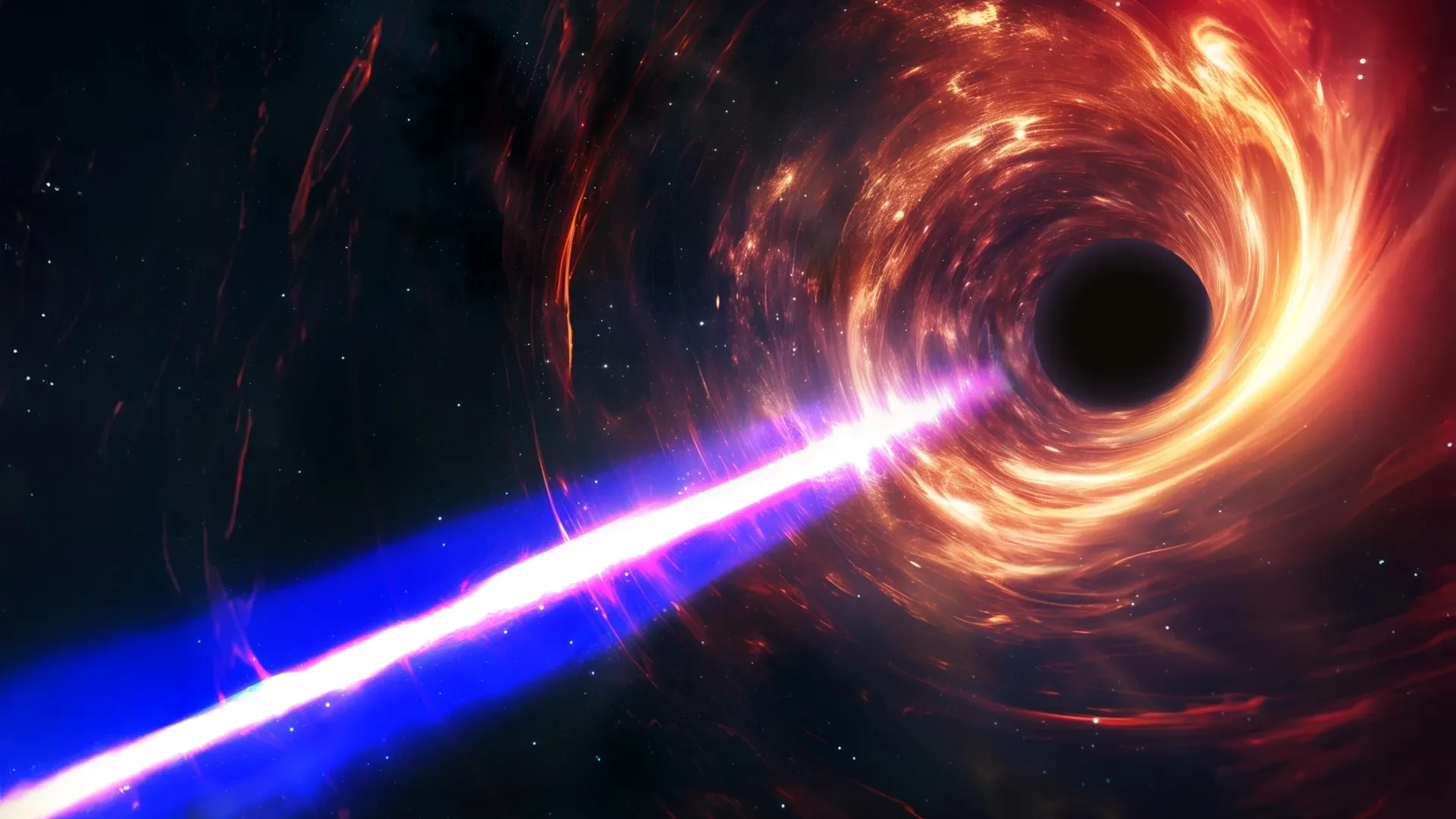
An international team of researchers, co-led by a scholar from the Institute for Advanced Study (IAS), has identified what appears to be a fundamental, universal rule governing one of the most violent and energetic phenomena in the cosmos: the production of powerful relativistic jets by black holes. By studying the chaotic aftermath of stars being torn apart by gravity, the team has confirmed that black holes, regardless of their staggering differences in mass, adhere to a specific "feeding" threshold when launching these massive outflows into space.
The study, published in Nature Astronomy under the title "A universal critical accretion rate for black hole jet formation," represents a major step forward in high-energy astrophysics. The research was spearheaded by Andrew Mummery, a Martin A. and Helen Chooljian Member (2025–30) at the Institute for Advanced Study’s School of Natural Sciences, and Adelle Goodwin, a Forrest Research Foundation Fellow at the International Centre of Radio Astronomy Research (ICRAR) at Curtin University in Western Australia.
Watching Black Holes Tear Stars Apart
The investigation hinged on the study of tidal disruption events (TDEs). These cataclysmic occurrences take place when a star wanders too close to a supermassive black hole. The black hole’s intense gravitational gradient exerts a tidal force that overcomes the star’s own gravity, effectively shredding it into a stream of gas. This influx of stellar material provides scientists with a front-row seat to the black hole’s feeding cycle, allowing them to observe how the object reacts when suddenly presented with a significant supply of matter.
For decades, the mechanisms behind the ignition of black hole jets have remained shrouded in mystery. "We really wanted to figure out this massive puzzle," explained Mummery. "Why do some supermassive black holes blast out radio jets right after shredding a star, while others just sit there looking completely dormant, only to suddenly fire up their jets months or even years later?"
Black holes are frequently described in popular science as cosmic vacuum cleaners, but in reality, their feeding habits are far more erratic and inefficient. As Goodwin noted, "When a black hole tears apart a star, it does not swallow everything neatly." Instead, much of the material is caught in a turbulent dance around the event horizon. While some of this matter is consumed, a significant portion is violently expelled back into the surrounding space. These massive cosmic "burps" are not merely spectacular light shows; they are powerful outflows that can travel across vast intergalactic distances, potentially influencing the growth, chemical enrichment, and overall evolution of the host galaxies that house these behemoths.
A Faster Way to Study Supermassive Black Holes
The quest to find a unified theory for black hole behavior has long been hindered by the limitations of human timescales. Astronomers have long suspected that black holes—ranging from "stellar-mass" objects about ten times the mass of our sun to supermassive giants millions or billions of times heavier—should theoretically follow the same basic physical principles. However, confirming this hypothesis has been notoriously difficult. Changes in the accretion discs around supermassive black holes typically unfold over geological or even cosmological timescales, spanning thousands or millions of years, far beyond the reach of a single human career.
Tidal disruption events provide a vital loophole. Because a TDE forces a supermassive black hole to process a star’s worth of mass in a compressed timeframe, the resulting feeding episode evolves over the course of just a few years. This rapid acceleration of physical processes allows researchers to track, in real-time, phenomena that would otherwise be impossible to observe in a lifespan.
The breakthrough for the research team came from a surprisingly informal setting. While attending an astrophysics conference in Madrid, Mummery and Goodwin began discussing the physics of black hole jets. During their conversation, they realized that the specific rules governing jet production in smaller stellar-mass black holes might be perfectly applicable to their supermassive counterparts. This realization spurred a rigorous, data-driven effort to test the hypothesis.
Two Distinct Phases of Black Hole Jets
To validate their theory, the team synthesized years of observations across a wide range of wavelengths. By combining data from sophisticated telescopes in America, Australia, India, and South Africa, as well as space-based observatories, the team focused their analysis on twenty tidal disruption events. From this initial group, they narrowed their focus to ten high-quality events where they could reliably correlate the black hole’s feeding rate—the rate at which it consumed the shredded star—with the exact timing of its radio emissions.
The results of the analysis revealed that jet formation is not a continuous, steady state but rather occurs during two distinct, predictable phases. The first phase occurs early in the process, during the initial peak of the feeding cycle when the black hole is consuming material at an extremely high rate. The second phase, however, occurs much later—often hundreds or even thousands of days after the initial disruption of the star.
The researchers discovered that this second phase of jet formation is triggered when the black hole’s feeding rate drops to approximately two percent of its Eddington limit. The Eddington limit is the theoretical point of equilibrium where the outward pressure of radiation generated by the black hole balances the inward pull of gravity.
This two-percent threshold is of profound significance because it has been previously identified as the exact point that triggers jet formation in stellar-mass black holes within our own galaxy. Discovering that supermassive black holes follow this identical threshold provides compelling evidence that the fundamental physics governing jet production is universal, holding true across an immense range of mass scales.
Predicting When Black Holes Will Erupt
The implications of this discovery extend well beyond theoretical physics; it offers a significant practical tool for the global astronomical community. If researchers can accurately predict when a black hole is approaching this two-percent threshold, they can optimize their observation schedules.
Modern telescopes are heavily oversubscribed, with many researchers competing for limited time on the world’s most powerful instruments. By being able to anticipate when a black hole will "fire up" its jets, astronomers can increase their chances of capturing these short-lived, high-energy events as they happen, rather than wasting valuable resources observing dormant systems.
This predictive capability will become increasingly important as the next generation of astronomical infrastructure comes online. The Square Kilometre Array (SKA) radio telescope, which is slated to begin collecting scientific data in 2028, will require highly targeted observations to maximize its revolutionary potential. The ability to forecast the activity of these black holes will ensure that such massive technological investments are used to their fullest potential.
"We hope that our work will pave the way for even more profound discoveries about our universe," Mummery said. By bridging the gap between stellar-mass black holes and their supermassive counterparts, the team has provided a new framework for understanding the lifecycle of galaxies and the dramatic, energetic eruptions that shape the cosmos. As observational technology continues to advance, this universal rule of black hole feeding will likely serve as a cornerstone for future studies into the most extreme environments in the universe.