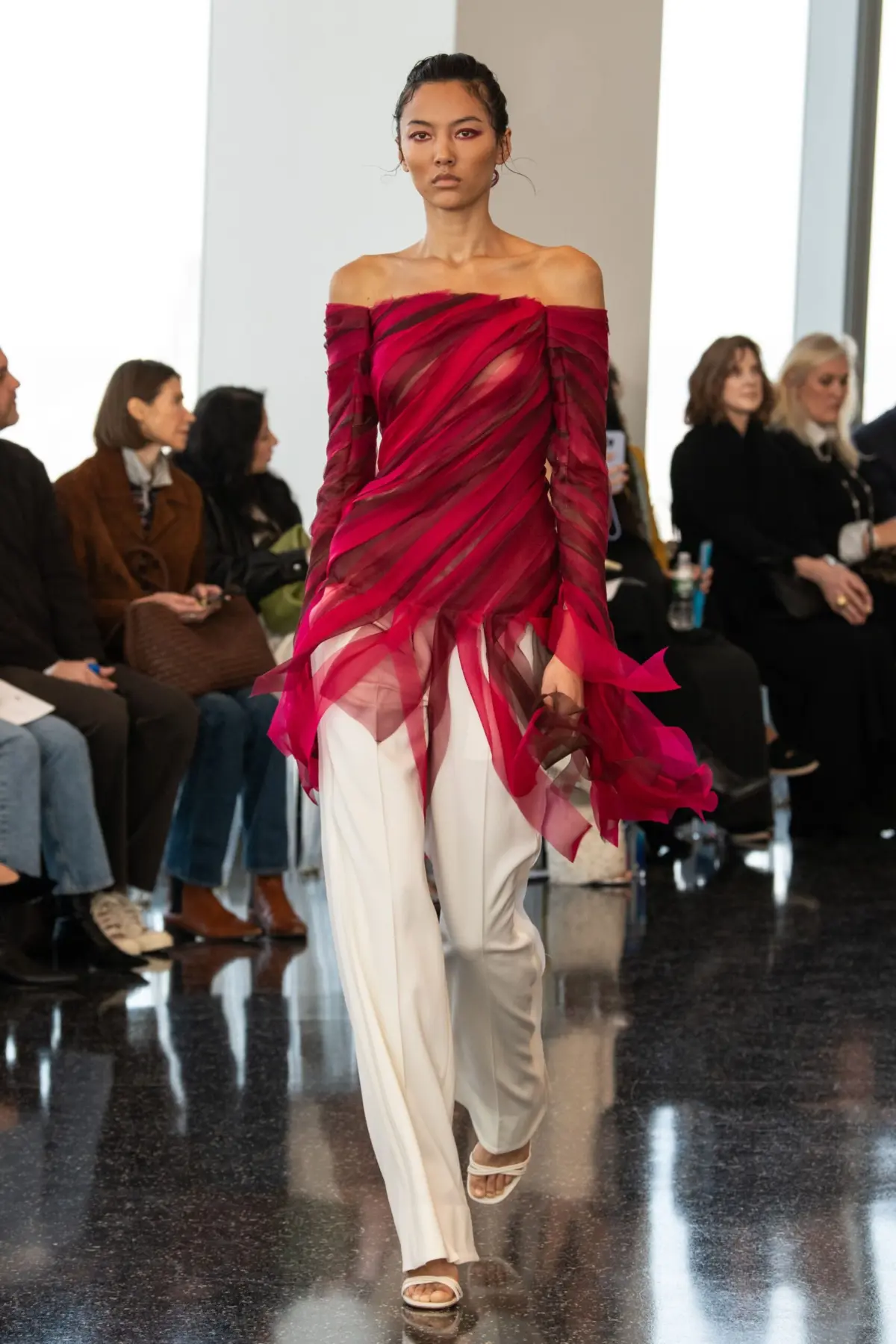
J. Mendel brought its storied uptown glamour downtown and into the clouds yesterday, staging its latest presentation on the dramatic 102nd floor of One World Trade Center. The event marked a significant milestone for the heritage brand, representing the first collection reviewed by Vogue Runway since 2022 and serving as the official debut for the label’s new resident creative director, Jonathan Cohen. Set against a panoramic, bird’s-eye view of New York City, the grandeur of the sky-high location would be a formidable match for any fashion house; in this instance, however, the breathtaking venue served to emphasize the narrow remit of a company that currently feels somewhat caught in amber, struggling to fully synchronize its illustrious past with the realities of modern dressing.
Founded way back in 1870 in St. Petersburg, Russia, as an exclusive house of furs, the brand has traversed centuries and continents. It operated out of Paris for generations until 1981, when Gilles Mendel made the pivotal move to establish a permanent branch in New York City. (It should be noted that the Mendel family designer has not been associated with the brand since 2018.) As societal attitudes toward fur shifted and the material steadily declined in popularity, the house adapted to the changing times, officially introducing its ready-to-wear line in 2002. That pivotal year ushered in the golden era of Manhattan socialites—names like Tinsley, Byrdie, and Muffie—and glamorous fixtures on the social calendar such as the Frick Young Fellows Ball. During this period, J. Mendel’s feathered and embroidered dresses, alongside luxurious fur tippets, added an unmistakable touch of romantic opulence to the city’s high-society events.
The brand’s cultural footprint during that era was cemented in pop culture history when actress Natalie Portman wore a palest pink hand-pleated silk chiffon gown from the label on the prestigious cover of Vogue in January 2011. Reflecting on that defining fashion moment, Jonathan Cohen noted that the impression has stayed with him over the years. "I just always remember that dress being so beautiful and I loved how easy it looked," said Cohen. Yet, rather than replicating that exact silhouette for his inaugural outing, Cohen offered his own distinct take on the concept of pretty in pink with look 15. Inspired by the pop culture iconography of Britney Spears, his modern iteration was cut ultra-short and designed to be intentionally skin-baring, proving that the designer is eager to inject a dose of contemporary pop energy into the brand’s traditional vocabulary.
Cohen’s broader creative remit for the house involves working backwards from traditional evening wear into more versatile day-into-evening attire. The opening look of the collection set the tone for this transitional ambition: slim trousers paired with a flowy top constructed from bias-cut chiffon strips rendered in striking shades of red. This design choice was directly inspired by the intricate, couture-like inner finishing typically hidden away inside the garments crafted within the atelier. It was an outfit clearly envisioned for a sophisticated dressy lunch or an upscale cocktail hour. Elsewhere in the lineup, fur-paneled separates occasionally felt heavy and encumbering for contemporary tastes, whereas more viable, commercially appealing options arrived in the form of flowy pieces executed in printed, pleated chiffon.
Among the standout pieces of the presentation—and one of the designs the creative director was most visibly excited about—was a leather jacket featuring pretty puckered pockets. What made this garment technically remarkable was its method of construction; it was created using a specialized fur machine. This innovative technique meant that the garment’s seams were fused rather than traditionally stitched, successfully eliminating seam allowances altogether and rendering the leather jacket as weightless as physically possible.
This clever transposition of traditional furrier artisanship onto non-fur materials represents an exciting, forward-looking design idea that showcases the untapped potential within the atelier. However, the collection as a whole was occasionally burdened by the overly tight fit of several looks and, more broadly, by a persistent, overarching sense of the past. Cohen unquestionably possesses access to a highly skilled atelier, a resource that is increasingly unique in today’s fast-fashion landscape. To truly make J. Mendel relevant for a modern audience and to ground the flightier "champagne wishes and caviar dreams" aspects of the brand’s historic identity in real life, the designer might consider directing that master-level artisanship toward capturing some of the raw, gritty concrete energy of New York City itself.