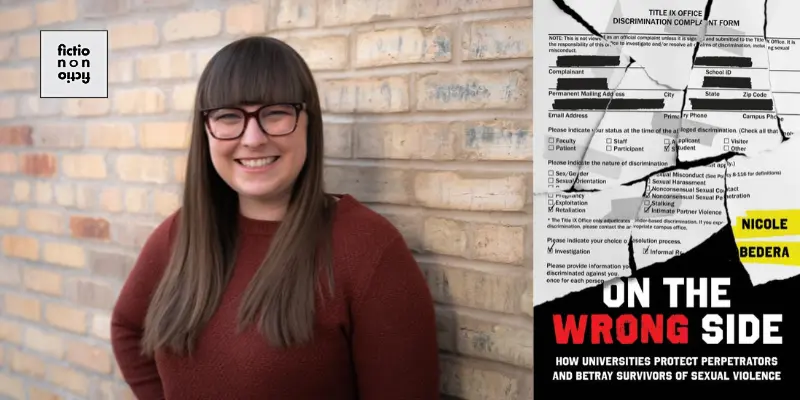
Sociologist Nicole Bedera recently joined co-hosts V.V. Ganeshananthan and Whitney Terrell on the Fiction/Non/Fiction podcast to discuss the high-profile "Cornell 7" case and her newly released book, On the Wrong Side: How Universities Protect Perpetrators and Betray Survivors of Sexual Violence. During the episode, Bedera breaks down how the Cornell case—in which a student alleged she was gang-raped at an Ivy League fraternity party—fits into a long-standing historical pattern of higher education institutions mismanaging sexual violence reports.
Bedera details the history of Title IX, the federal civil rights law that forbids sex-based discrimination, and explains how sexual violence ultimately came to fall under its legal framework. She examines how the effectiveness of Title IX has fluctuated since its establishment in 1972, noting significant regressions under the Trump administration, particularly during the first term when regulations were shifted to help universities evade accountability. Throughout the conversation, Bedera explores what colleges and universities stand to gain by improperly handling sexual violence allegations and why institutional administrators aggressively insist on framing these incidents as isolated anomalies rather than systemic crises.
Addressing common misconceptions surrounding sexual violence and Title IX investigations, Bedera reflects on her background as a victim advocate. Her professional experience allowed her to conduct valuable fieldwork inside an anonymized university Title IX office. She also proposes structural reforms, suggesting that Title IX enforcement could be reimagined as a state agency to achieve greater effectiveness.
For readers interested in hearing the full interview, the episode is available across major podcast platforms including iTunes, Google Play, Stitcher, and Spotify, as well as through the official show website and video versions hosted on Instagram and YouTube. The podcast is produced by V.V. Ganeshananthan, Whitney Terrell, Emily Farris, and Sydney Perkins.
A Conversation with Nicole Bedera
V.V. Ganeshananthan: We want to start by asking you about the case that has become known as the Cornell 7. It has been getting a ton of attention, partly because none of the alleged perpetrators have been charged with criminal wrongdoing, and also because the schools themselves have issued no significant punishments. I’m referring to schools also because I’ve been watching this story unfold related to the University of Chicago, which is also gaining steam and getting more attention on the heels of this Cornell 7 case.
In the first part of On the Wrong Side, you talk about how women who have been assaulted meet with Title IX officers, only to be told there is nothing to be done. The paperwork is shuffled around and they’re basically discouraged from filing complaints; do you think that the attention the Cornell case is getting is going to shift things? Is this a typical case or an atypical situation? Is it a game-changer?
Nicole Bedera: It should be, but I will say that it only is if we decide to make it one. This is a very typical case for a university, and no matter what we’re seeing in public, I can almost guarantee that the conversation happening at Cornell behind closed doors is school administrators being defensive, saying that people just don’t understand their process, don’t understand what a good job that they did. I say that because you know, for anyone who reads On the Wrong Side, there was a big public scandal at that university the year that I was there. A woman was murdered on campus that year. There were actually a number of people who were murdered on campus or in the campus community that year, so there was a good deal of scrutiny from at least the local community at that time.
When I interviewed school administrators and asked, "Are you thinking about changing anything, given that there was this huge institutional failure and that a woman died as the result of it?" They said, "No, we think our process works just fine." Actually, they blamed the victim and said, "If only she had used it better." That’s really how schools tend to respond in these moments. We’ve already seen some of that response from Cornell, certainly from the police and the DA’s office, making it sound that if Jane Doe just would have reported better, everything would have gone fine, so we really have to push back on that.
You know, to answer your other question of is this a typical case, I would say in a lot of ways it is. One of the only things that’s unusual about it is that Jane Doe made it all the way through the Title IX process because so many survivors can’t. They’re either discouraged from going through an investigation, or it interferes in their education too much. They just can’t tolerate it anymore. It’s really difficult for them to endure. That’s the only thing that makes this case exceptional. But aside from that, the way that Cornell responded to Jane Doe could have been at the university that I studied. I’ve heard from so many readers, "I can tell you were at my school," and I wasn’t. So it really is very, very widespread.
Whitney Terrell: We’re going to be talking a lot about Title IX in this interview because this is sort of the primary framework through which universities discipline or deal with issues of sexual discrimination and violence on campus. That law passed in ’72, and then you point out that in 1980, or you said it says eight years later in the book, that a case, Alexander v. Yale, where sexual violence was then recognized legally as sexual discrimination, or a form of sexual discrimination, thus making it something that would fall under Title IX, if I’m understanding that correctly.
Could you just talk to us about how Title IX happened, how it became the framework for addressing campus sexual violence? Just let our listeners get a little bit of background on that law as we go forward.
Nicole Bedera: So Title IX is a part of the Civil Rights Law. It’s one of the educational amendments of the Civil Rights Act. What was happening at that time, as we’ll get to—it is still happening in a slightly different way now—schools were discriminating on the basis of gender and on the basis of race. So Title IX, it’s only a single sentence, and it just says that schools are prohibited from sex discrimination. Everything else about that law, including how it would be enforced, what we would look at as evidence of compliance or non-compliance, that had to be figured out through either regulation, which the federal government failed to produce, for the most part, they failed to produce it for a very long time, or court cases.
So, when we’re telling the story of Title IX and how sexual violence came to be seen as a form of sex discrimination, it was in that original court case, Alexander v. Yale, in 1980. What that case found is that sexual violence, when it was so widespread at Yale, for victims, it meant that they had worse educational experiences because the impact of trauma interfered in their ability to fully participate in their education. The other thing that was found in that case, and the argument of that case, was that even the other women on campus who had not yet experienced sexual violence, they too were having a worse education because they had to think about it every day, and they had to avoid opportunities like going to office hours with professors because they didn’t know if they might experience a sexual advance. They had to take classes earlier in the day because they didn’t want to walk across campus at night.
When we’re talking about sexual violence, we tend to talk about it from a criminal framework with an individual perpetrator and an individual victim, but under Title IX, we’re talking about it from a systemic framework, which says that as long as this is happening here, this school is not equal, it is discriminating against women in particular. For a long time, schools just ignored it because there wasn’t a clear enforcement mechanism.
You might recall that a lot of our schools did not gender integrate by choice, they opened to men only. They were not thrilled that women were allowed on campus, so there was this resistance to enforcing Title IX to becoming more gender equitable. While schools didn’t want to do it, and it wasn’t until around 2001 that a president said for the first time that Title IX was something schools actually had to do something about, and they needed to at least have a place for students to report if they experienced sex discrimination, including sexual violence. Schools still didn’t do it. There were more. They’re called dear colleague letters, where other presidents and secretaries of the Department of Education would come back and say again, "Hey, schools, you’re discriminating against women. You need to fix this."
They wouldn’t do it, so, our contemporary Title IX era starts in the Obama administration, when Obama’s Department of Education said, "You have not been fulfilling any of the demands of these court cases, any of the reminders that you’ve gotten from the Department of Education about the things you need to do, such as set up Title IX programs, and so we’re going to start investigating schools to make sure that you have the basic things that are required by the courts." Schools did not take kindly to this. Schools were very upset at the idea that they would be investigated, especially because the first 50 schools that were investigated were pretty big name and elite schools. You would recognize probably all of them, if not nearly all of them, so Title IX became this really hot button issue over the course of the last decade. In our current climate, Title IX has turned into a vehicle of gender discrimination itself.
I found that schools have created this entire apparatus, this whole bureaucracy to try to convince all of us that they are compliant with Title IX law, that they’ve stopped discriminating. As we can see in the Jane Doe case at Cornell, they have not, and that from the outside the process looks a lot better than how women who’ve experienced sexual violence or discrimination experience it from the inside.
V.V. Ganeshananthan: One of the most interesting things for me in this part of the book, where you’re talking about this is, you explained to me very clearly, and I’d always wondered, what is the argument for disciplinary systems and systems of justice within universities, and the argument for this essentially is that universities have to to avoid discriminating, deal with this expeditiously, so that the educational experience is not affected. A lot of people looking at these cases are kind of like, what is this internal disciplinary process? Why doesn’t it go straight to criminal courts? What business does a university have doing this anyway? That’s a really clear argument that I appreciated a lot.
So Jane Doe filed a lawsuit against Cornell for failing to prevent her assault, and you know one of those allegations is that some of the perpetrators were merely assigned to write essays. This has become a big part of the discourse, and you also write about another important moment in this timeline when Betsy DeVos, during the first Trump administration, took some actions that made it easier for universities to sidestep accountability. This seems, in some ways, to me, as significant as that initial Title IX change, or really just a real change in the landscape, but I think far fewer people really understand it. I wonder if you can tell our listeners what shifted and if that’s part of what has made situations like this Cornell case possible.
Nicole Bedera: The way I would answer this a few years ago is different than how I’m going to answer it today because at the time that the Trump administration changed the way they were going to regulate Title IX, a lot of experts, myself included, wrote to them to raise concerns that the regulation they had passed would make it harder for victims to come forward, would push more women out of school, and would protect perpetrators in ways that are truly absurd. At the time, I co-authored an article about how there was a provision in Trump’s Title IX regulation that would allow anyone who was accused of sexual assault to remove confessions from the evidence if they just didn’t attend the hearing.
When we’re talking about absurdity in this regulation, we really, really are talking about it, but how it’s actually played out is perhaps even worse, which is that the Trump administration has told schools loudly and clearly that they will no longer accept complaints from student victims saying that their cases were mismanaged at all. The specific provisions of the regulation have ended up mattering a lot less because schools now know that they have carte blanche to do whatever they want, and one of the things that I saw when I conducted my research in the 2018-2019 school year, was once schools had seen the draft of the Trump regulation, though it wasn’t in effect yet, a lot of the schools that I was at, at least, said we’re not going to change almost any of our policies and procedures, maybe a couple of little tweaks, but the Trump administration is just allowing us to do what we’ve already been doing. Now that they know that no one’s looking, they have gotten more extreme than anything that the Trump regulation ever required of them.
I think the right way to think about this: a lot of schools would want to say, "Oh, we would do better if we could, but Trump requires as he becomes this bad guy, this villain that they can point to and blame for their decisions." I don’t think that’s true. I think the real issue is that schools have been discriminating the whole time, and they now have an ally in the Trump administration who is allowing them to discriminate more flagrantly and on a much less defensible basis. They don’t even have to pretend to be following Title IX law anymore. In fact, they can now tell us that following Title IX law under Trump’s definition of it, should be giving special privileges and advantages to men and perpetrators on campus.