When automotive historians and enthusiasts discuss the genesis of modern electric vehicles, General Motors’ EV1 inevitably steals the spotlight. Produced in two distinct runs in 1997 and 1999, the 1,117 sleek, aerodynamic machines captured the public imagination. Yet they became just as famous for their eventual, controversial retirement—where surviving models were largely rounded up and crushed into tiny metal cubes—as they were for introducing groundbreaking electrical innovations to mainstream drivers.
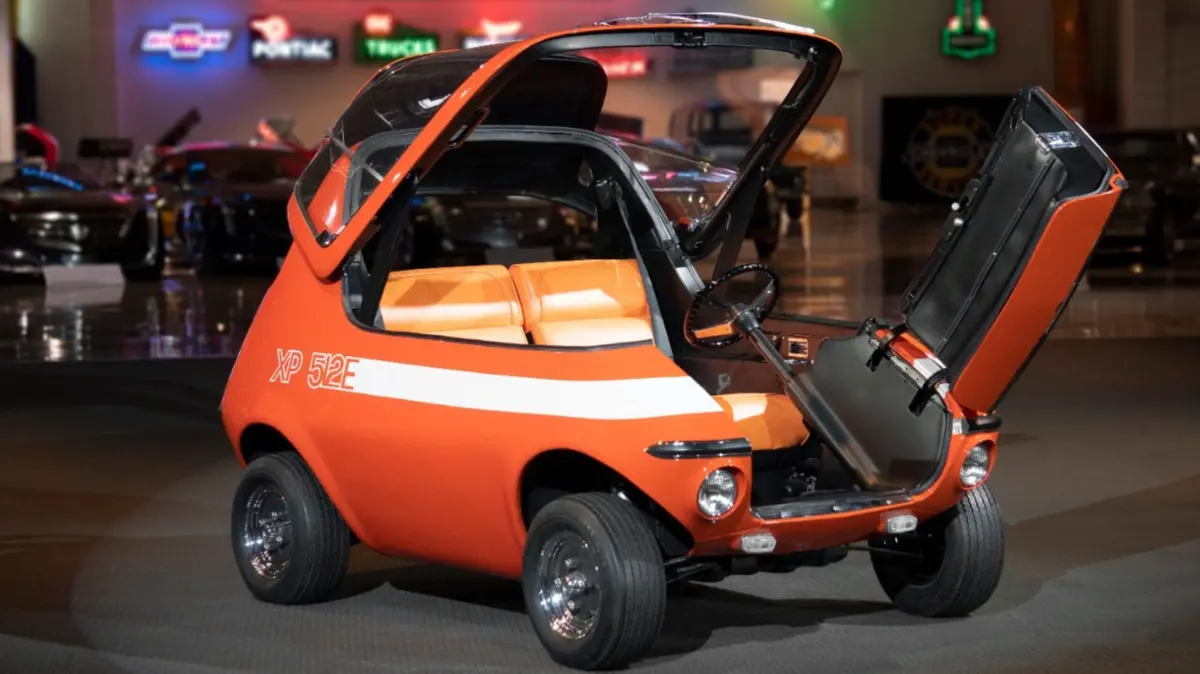
However, the EV1 was far from the historic first all-electric passenger car produced by General Motors. That distinction belongs to an experimental concept vehicle revealed decades earlier: the 1969 XP 512E. Adding further depth to the corporation’s early alternative-powertrain timeline, historical records show that General Motors also manufactured and sold all-electric commercial delivery trucks, though not consumer passenger cars, during a brief window between 1912 and 1916.
The XP 512E did not emerge in a vacuum. It was developed as a prominent member of a family of compact, city-sized experimental vehicles that GM originally engineered to showcase its forward-thinking engineering at the "Progress of Power" exhibition in 1969. This major press event drew automotive journalists, industry analysts, and media representatives from across the United States to the company’s sprawling Technical Center in Warren, Michigan. The gathering was designed to give outsiders an exclusive look at the automaker’s latest powertrain developments and alternative energy research.
Alongside the XP 512 series, the exhibition featured a diverse array of experimental technologies that foreshadowed decades of subsequent automotive research. On display were advanced silver-zinc batteries, early hydrogen fuel cell systems, experimental gas turbine engines, innovative wheel-hub motors, modernized steam-powered propulsion, and early iterations of catalytic converters. In fact, GM’s research during this era laid the groundwork for the company to eventually become the first major automobile manufacturer to develop a production-ready catalytic converter for the commercial market in 1975.
Unlike many concept vehicles that remained strictly static displays meant to be admired from behind velvet ropes, several cars at the 1969 exhibition were made available for journalists to drive. Among them was the XP 512E, which provided reporters with a firsthand feel for early electric mobility. When renowned automotive journalist Tom McCahill of Mechanix Illustrated took his turn behind the wheel, he reported that the car was "quite smooth" to operate, according to archives from Hemmings.
At the same time, the driving experience came with distinct limitations dictated by late-1960s battery technology. The 512E was extraordinarily tiny, and its operational range was severely constrained by the energy density of the era’s power storage. To put its dimensions into perspective, the vehicle’s overall length is shorter than the height of modern NBA star Victor Wembanyama. Its maximum driving range was limited to 58 miles, and that modest figure could only be achieved if the driver maintained a constant, slow speed of 25 mph. When pushed to its absolute maximum velocity of 30 mph, the car’s driving range dropped to a meager 47 miles.
Delving into the XP 512E Details
Officially designated as the 512 Electric Experimental, the 512E was built on a remarkably diminutive footprint. It measured a tidy 86.3 inches in length and 56 inches in width, riding on a wheelbase of just 52 inches. To visualize how small that is, the car’s wheelbase was a full foot shorter and three inches narrower than a modern first-generation Smart Fortwo.
It was also substantially lighter than its distant modern descendants, tipping the scales at approximately 1,250 pounds—about 250 pounds lighter than a typical Smart Fortwo, which usually weighs around 1,500 pounds. General Motors managed to keep the curb weight down through clever material choices, utilizing a lightweight fiberglass body shell paired with an 84-volt lead-acid battery pack that had been custom-engineered specifically to minimize unnecessary mass.
Drivers stepping into the XP 512E, however, would not find the blistering, instantaneous acceleration that defines today’s modern electric vehicles. Powered by a rear-mounted direct-current (DC) electric motor, the car required roughly 12 seconds to crawl from a standstill to its top speed of 30 mph. For context, contemporary automotive engineers can readily assemble a garage full of modern production EVs capable of accelerating from zero to 60 mph in 3.5 seconds or less.
On the other hand, the 512E proved surprisingly competitive when it came to recharging simplicity. Replenishing the depleted battery pack took approximately seven hours when plugged into a standard 115-volt household electrical outlet. While direct comparisons across generations must account for vastly different battery capacities and safety standards, it is worth noting that utilizing a standard Level 1 household charger on a modern electric vehicle can take dozens of hours to achieve a full charge.
The interior of the XP 512E was remarkably spartan, devoid of the complex digital displays, infotainment screens, and luxury amenities found in vehicles today. A single modest bench seat dominated the cabin, complemented only by a basic heater and defroster system, an ashtray, and very little else.
Perhaps the most notable design feature of the vehicle was its unique canopy. The entire upper glass and roof structure tilted backward to permit entry, operating in tandem with a lower front door that opened outward in a manner reminiscent of the classic BMW Isetta. This canopy design effectively created an open-air, drop-top driving experience, as motorists could choose to travel with the upper structure open to the elements.
What Were the Other 1969 XP 512 Cars?
The XP 512E was never intended to stand alone as a singular experiment. It was part of a trios of concepts showcased during GM’s Progress of Power exhibition, a lineup that notably included the corporation’s very first plug-in hybrid vehicle. Looking back at automotive timelines, the 1969 XP 512H premiered more than four decades before the Chevrolet Volt hit the market, a vehicle widely celebrated as the world’s first commercially available plug-in hybrid electric vehicle (PHEV). This technological milestone remains significant, even as the broader automotive landscape continues to debate the long-term role of plug-in hybrids in the global transition toward full electrification.
While detailed technical documentation regarding the XP 512H is scarcer than its all-electric sibling, the fundamental architecture of the vehicle is well-documented. The hybrid concept featured a small 200-cubic-centimeter gasoline engine paired with a DC electric motor, which drew its electrical energy from a 72-volt lead-acid battery pack.
The powertrain configuration possessed a fascinating mechanical duality: the small internal combustion engine was capable of independently driving the wheels while simultaneously operating as a generator to recharge the onboard battery pack. Under normal operation, the vehicle functioned purely on electricity when traveling at speeds up to 10 mph. Once the car surpassed that threshold, the gasoline engine automatically engaged to provide supplemental propulsion.
Like the all-electric 512E, the plug-in hybrid concept was designed for domestic convenience and could be plugged into a standard household electrical outlet for recharging. Supported by this mechanical setup, the hybrid vehicle offered an all-electric driving range of more than five miles when cruising at 30 mph. Furthermore, it demonstrated impressive fuel efficiency, capable of covering up to 150 miles while maintaining a top speed of 35 mph and consuming a mere three gallons of gasoline.
The third and final vehicle in the XP 512 concept family was the 512G, a traditional internal-combustion model powered exclusively by gasoline. This variant utilized a tiny 19-cubic-inch, two-cylinder engine that produced a modest output of 12 horsepower.
Performance metrics for the gasoline-powered model were predictably modest, requiring roughly 18 seconds to accelerate to its top speed of 45 mph. However, what the 512G lacked in raw speed, it more than made up for in sheer efficiency. The vehicle was capable of extracting an astounding 280 miles of total driving range from a diminutive four-gallon fuel tank, translating to an economy rating of approximately 70 miles per gallon.