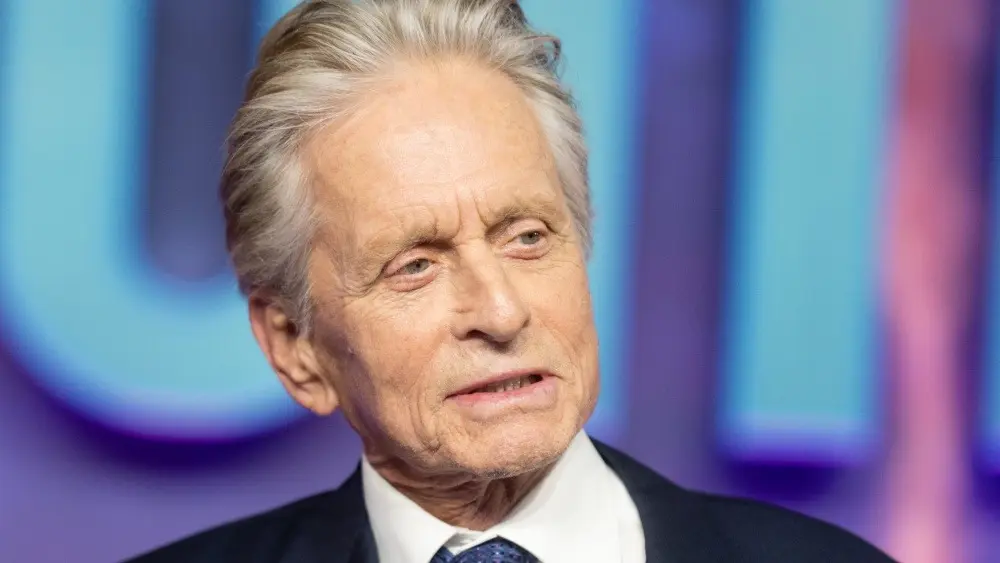
Michael Douglas, an institution in his own right within the American film industry, has officially waded into the contentious and highly publicized “nepo baby” debate. The Academy Award-winning actor, whose career spans over five decades, recently appeared on the SmartLess podcast—hosted by comedic powerhouses Sean Hayes, Jason Bateman, and Will Arnett—to candidly address the scrutiny surrounding Hollywood dynasties and the perceived advantages of being born into show business royalty.
The term “nepo baby,” which has become a ubiquitous shorthand in digital media and cultural criticism, serves to identify individuals in the entertainment industry who have achieved success while being the children of established, influential, or famous figures. For Douglas, the son of the late screen icon Kirk Douglas, the label is not merely a critique of industry access; it is an irritation that he feels overlooks the fundamental realities of professional life across all sectors of society.
During his wide-ranging conversation on SmartLess, the Wall Street actor didn’t hold back when the subject of his own lineage and the broader implications of Hollywood inheritance were raised. “Well, first of all, you know, Hollywood royalty. I mean… this ‘nepo’ thing really pisses me off,” Douglas stated firmly. He went on to articulate a perspective rooted in the belief that helping one’s children navigate their professional path is a universal human impulse rather than an industry-specific corruption.
“I don’t know a career where a father or mother don’t try to help their son or daughter get into their business and this and that,” Douglas explained. “And why they picked on this because of the well-known aspect of it.” His argument suggests that while the spotlight of celebrity makes the lineage of actors like himself, Laura Dern, or Maya Hawke highly visible, the underlying mechanism—parents leveraging their experience and network to benefit their offspring—is a standard practice in fields ranging from law and medicine to trade unions and family-owned small businesses.
The conversation provided a rare moment of introspection for the 79-year-old actor, who has lived his entire life in the shadow and the sunlight of his father’s immense legacy. Kirk Douglas, who passed away in 2020 at the age of 103, remains one of the most significant figures in 20th-century cinema. A titan of the Golden Age of Hollywood, the elder Douglas commanded the screen in legendary productions such as Spartacus, Seven Days in May, 20,000 Leagues Under the Sea, Champion, The Bad and the Beautiful, Lust for Life, Paths of Glory, and Lonely Are the Brave. His impact was formally recognized with three Oscar nominations throughout his career, culminating in an honorary Academy Award in 1996 for his fifty years of creative and moral force in the motion picture community.
For Michael Douglas, carving out a career in the wake of such a monumental figure was a task that required not just a famous last name, but a distinct artistic identity. His filmography, which includes iconic performances in Fatal Attraction, Basic Instinct, and Behind the Candelabra, reflects a performer who has consistently sought out roles that challenge his range and push the boundaries of conventional leading men.
Douglas’s own trophy case is a testament to his success in both the creative and executive sides of the business. He famously secured an Academy Award for best actor in a leading role in 1988 for his portrayal of the ruthless corporate raider Gordon Gekko in Oliver Stone’s Wall Street. Furthermore, he demonstrated his acumen as a producer early in his career, winning an Oscar for best picture in 1976 as a co-producer of the counter-culture masterpiece One Flew Over the Cuckoo’s Nest. These accolades serve as the primary counter-argument to the notion that his success is a product of privilege alone; rather, they point to a career built on strategic choices and the ability to recognize compelling stories.
When asked during the SmartLess episode about the counsel he would offer to the next generation of actors attempting to navigate the precarious waters of Hollywood, Douglas shifted his focus from the politics of pedigree to the essence of the craft itself. He emphasized that, regardless of how one gains entry into the industry, long-term survival is contingent upon one’s ability to identify and execute "good material."
“The problem we all have is we don’t play an instrument, or we don’t paint, or we don’t write,” Douglas noted, reflecting on the unique vulnerability of the actor. “We’re standing there. But a good piece of material, man, a good piece of material helps things along well.”
This sentiment underscores a philosophy that Douglas has practiced throughout his career: the idea that an actor is only as good as the script they are holding. By prioritizing high-quality material, he has managed to maintain relevance across generations, transitioning from the heartthrob roles of his early career to the more complex, nuanced characters he inhabits today. It is a perspective that minimizes the importance of external factors—like a famous parent—and centers the actor’s role as a collaborator in the storytelling process.
The timing of these remarks comes as Douglas prepares for the release of his forthcoming memoir, One Helluva Ride. The book, which is set to hit bookshelves this coming Tuesday, promises to offer a deeper, more intimate look at his life, his relationship with his father, and the evolution of the film industry from his unique vantage point. The memoir is expected to cover the highs and lows of his personal and professional journey, providing context to the man behind the headlines.
As the “nepo baby” discourse continues to swirl across social media and within industry trade publications, the comments from established veterans like Douglas serve to bridge the gap between two different eras of Hollywood. On one side, a generation of younger actors and critics are highlighting the lack of equity and the systemic barriers that prevent those without familial connections from gaining a foothold in the industry. On the other side, figures like Douglas represent an older guard that views the transmission of professional knowledge and opportunity as a natural, if not essential, part of family life.
Ultimately, Douglas’s frustration with the “nepo baby” label highlights the tension between the perception of nepotism and the reality of the work involved. While the debate regarding access and diversity in Hollywood is likely to remain a central theme in cultural discourse for years to come, Douglas’s contribution to the conversation serves as a reminder that the industry is, and always has been, a complex ecosystem of personal relationships, professional risks, and the pursuit of “good material.” Whether one views his career as a beneficiary of his father’s stature or as a sustained series of artistic triumphs, his position remains firm: the work speaks for itself, and the label of “nepo baby” is a reductive simplification of a life spent in the service of the craft.
As audiences prepare to engage with his new memoir, they will be given the opportunity to evaluate these claims through the lens of his own narrative, tracing the path from the son of a legend to an industry heavyweight who continues to command the attention of audiences and peers alike. Whether the industry changes to be more equitable, or whether it continues to operate on the networks and reputations of the past, the career of Michael Douglas stands as a definitive case study in the longevity, challenges, and persistent pressures of Hollywood life.