Americans have argued over the role and purpose of colleges almost as long as they have argued over the existence of the Republic itself. From the earliest days of the nation, higher education has been a battleground for defining American values, economic mobility, and civic responsibility. Thomas Jefferson founded the University of Virginia as a deliberately secular institution, creating a stark contrast to the deeply religious ties that defined nearly all other colonial and early American colleges at the time. Decades later, during the crucible of the Civil War, Abraham Lincoln signed the Morrill Act, fundamentally redefining the federal government’s commitment to public higher education by establishing land-grant universities across the country. Following the conclusion of the Second World War, the landmark GI Bill swung college doors open to millions of returning veterans, helping to build the modern American middle class while permanently expanding the societal footprint of higher education. In virtually every era of the nation’s history, Americans have vigorously debated whom colleges should serve, what they should teach, and what obligations universities ultimately owe to the country at large.
Those intense historical debates continue today, unfolding during an era when broad public opinion regarding higher education appears to be shifting dramatically. Public polling organizations, most notably Gallup, have meticulously documented a much-discussed and persistent decline in public confidence in higher education over the past decade. This erosion of trust has been particularly pronounced among self-identified Republicans and conservative voters. When pollsters and analysts attempt to explain this phenomenon, explanations typically focus on a familiar set of grievances: rising tuition costs, mounting doubts about the financial return on investment of a degree, contentious campus politics, and high-profile ideological conflicts. While these factors undoubtedly matter and shape public perception, standard analyses frequently ignore an equally important question that forms a critical part of the modern story: Where do everyday Americans actually get the information from which they form their firm judgments about colleges and universities?
To help answer this vital question, researchers turned to the Vanderbilt Television News Archive, a comprehensive repository that offers new and compelling empirical evidence about the changing national conversation surrounding higher education. An exhaustive analysis of data drawn from the archive reveals a striking reality: Americans are receiving fundamentally different stories about what is happening on modern college campuses depending on where they tune in. In effect, Americans have been watching the same foundational American institutions, but through two radically different news feeds.
The Changing Information Environment
The Vanderbilt Television News Archive began recording the evening news broadcasts of the major broadcast networks—ABC, CBS, and NBC—all the way back in 1968. Over the decades, the archive expanded its scope, recording evening broadcasts for CNN starting in 1995 and the Fox News Channel beginning in 2004. To capture how the information environment has evolved over the past two decades, researchers conducted an artificial intelligence-assisted content analysis covering the period between 2004 and 2025. This sophisticated analysis successfully identified 517 unique segments devoted specifically to higher education across the evening news shows of all five major networks. Researchers then classified these segments by network and underlying tone. While television is no longer the sole or even the primary source of political and social information for most Americans, its changing coverage speaks volumes about the larger fragmentation of the nation’s information ecosystem.
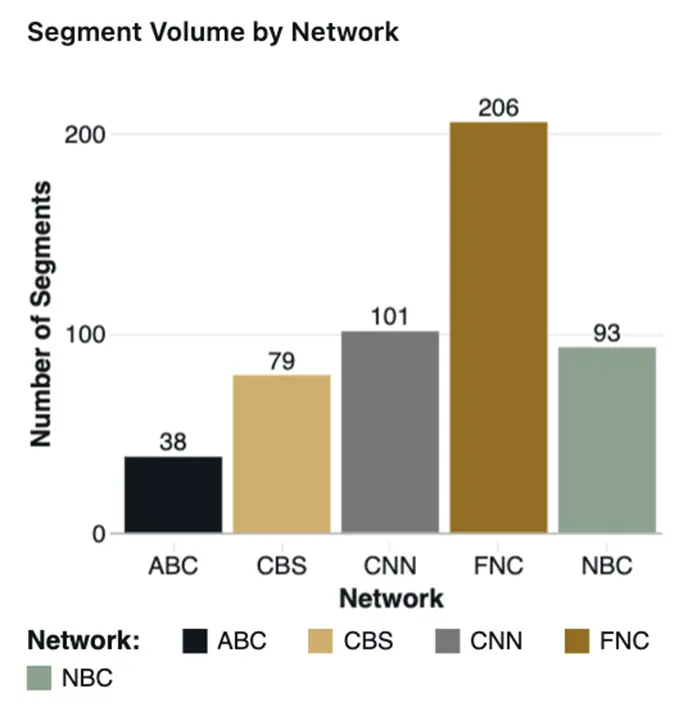
The scale of the disparity in coverage becomes immediately clear when looking at the raw numbers. Between 2004 and 2025, the Fox News Channel alone aired 206 segments devoted to higher education, accounting for a staggering 40 percent of the total coverage across all five networks combined. Meanwhile, ABC, CBS, and NBC together aired a mere 210 segments over the exact same timeframe. The three major broadcast networks that once helped define a unified, common national agenda devoted barely more aggregate attention to the nation’s colleges and universities than a single cable news channel.
Part of that stark difference certainly reflects the structural realities of television formats. Broadcast evening news broadcasts are constrained to a tight 30-minute window, whereas cable news operations fill a full hour of primetime programming. Yet, even when accounting for the length of the format, Fox still devoted twice as much overall attention to higher education as the other major cable outlet with an hourlong evening news program, CNN, which aired 101 segments during the study period.

Tone and Sentiment in Network Coverage
The prevailing tone of that television coverage sharpens the narrative even further. Researchers utilized AI-assisted sentiment analysis to gain a deeper understanding of how the networks talked about higher education, seeking a simple and replicable approach to capture favorable, neutral, and unfavorable accounts. Segments that described students grappling with crippling tuition increases, the deceptive recruiting tactics employed by some for-profit universities, or the intense turmoil and disruption caused by campus protests were classified as negative. Conversely, coverage highlighting student and faculty academic achievements, or focusing on colleges and universities successfully adapting to better meet student needs—such as by expanding enrollment capacity and providing flexible online access—was classified as positive. Coverage that primarily described rather than assessed developments, such as routine policy shifts or changes in university leadership, was classified as neutral.
To maintain academic rigor and accuracy, the research team also manually reviewed each of the 517 segment transcripts to ensure proper sentiment classification. The underlying data and methodological framework have been made publicly available to ensure complete transparency and reproducibility.
The results of the sentiment analysis reveal a sharp divergence among outlets. Nearly 54 percent of Fox News’s coverage of higher education was classified as negative, while only about 11 percent of its coverage was deemed positive. On the other end of the spectrum, CNN maintained the smallest proportion of negative coverage at approximately 27 percent, with more than half of its total coverage falling into the neutral category. The traditional broadcast networks—ABC, CBS, and NBC—were also considerably more likely than Fox to present higher education in neutral, dispassionate terms rather than leaning into overtly negative framing.
The bottom line emerging from the data is clear: the single most persistent voice in the national television conversation about higher education was also by far the most critical.
The Disappearance of a Shared National Narrative
Researchers are careful to point out that this data does not imply that colleges and universities deserve uncritical, favorable coverage from the press. Much of the widespread criticism leveled against higher education has been thoroughly earned. Universities have too often struggled to provide clear, reassuring answers to the public’s most basic questions: Is a college education genuinely affordable? Is it actually worth what it costs families? Are campuses intellectually open to diverse viewpoints? Are institutions truly accountable for the promises they make to students and taxpayers? Failures on these critical fronts have undoubtedly contributed to the measurable decline in public confidence. However, the study’s results suggest that the contemporary crisis of higher education is deeply intertwined with the broader disappearance of a shared national narrative.
It is well-established that media consumers frequently choose their news sources on ideological grounds. This self-sorting means viewers are not only more likely to consume information that reinforces political attitudes they already hold, but they are also far less likely to ever encounter information that runs counter to their preexisting predispositions. Furthermore, both media coverage and public opinion respond dynamically to larger political conflicts. Consequently, these empirical findings reveal a bifurcated information environment that almost certainly helps sustain—and likely deepens—the existing cultural and political divide.

This complex reality presents modern university leaders with an exceptionally difficult leadership task. They should neither hastily dismiss critical media coverage as mere partisan hostility nor should they design institutional reforms solely for the purpose of winning favorable headlines. The data clearly indicates that it is nearly impossible to secure favorable coverage from all corners of today’s fragmented media environment. At the same time, simply writing off all criticism as partisan and therefore illegitimate fails to acknowledge that prevailing public concerns possess at least some genuine merit. Higher education genuinely needs to address very real structural problems—including runaway costs, perceptions of ideological conformity, weak accountability mechanisms, and lingering uncertainty about educational value—because those institutional failures matter deeply. Simultaneously, academic leaders must recognize that even genuine, substantive reforms will be filtered through a modern media ecosystem that rewards conflict and controversy far more readily than nuance and institutional complexity.
The Magnified Impact of Social Media
Some observers may point out that traditional television news is no longer the principal place where everyday Americans encounter political and social information. While that observation is undeniably true, it does not render these findings any less relevant to the ongoing debates surrounding higher education. Stories that originate and air on television news do not remain contained within the broadcast; they rapidly spread across other platforms as they are clipped, reposted, commented upon, and algorithmically amplified on social media feeds, ultimately reaching vast audiences far beyond those who watch traditional evening news programs.
If anything, today’s sprawling social media environment profoundly magnifies the patterns documented in the Vanderbilt archive. Americans no longer merely choose among networks offering different accounts of higher education; they increasingly inhabit deeply personalized news feeds that actively reward attention, conflict, and strong emotional reactions. The two dominant news feeds are therefore less like two distinct television channels and more like two comprehensive information systems, each containing countless digital outlets, online personalities, and recommendation algorithms that reinforce entirely different understandings of the exact same institutions. The television findings offer a measurable, reliable window into that larger societal fragmentation—and may, in reality, understate its ultimate reach and intensity.
Universities cannot control the news cycle, nor should they attempt to do so. They can, however, become much more candid about their own shortcomings, clearer about their foundational educational purposes, and more rigorous in demonstrating their tangible public value to skeptics and supporters alike. Higher education institutions can actively choose to engage audiences that have primarily heard only the case against them. University leaders might be more willing to appear on right-leaning podcasts, contribute thoughtful op-eds to publications like The Wall Street Journal or The New York Post, or engage directly in public debates outside the comfortable confines of academia. Colleges and universities need to be far more intentional about breaking through the barriers of the two distinct news feeds.
Rebuilding broad public support will ultimately require a renewed institutional commitment to core educational missions alongside the pragmatic realization that no single set of reforms will ever yield universal public applause. This challenge extends far beyond a simple public relations exercise. As Thomas Jefferson famously argued, a republican form of government fundamentally depends upon an engaged citizenry capable of exercising informed judgment. That democratic conviction is even more vital today than it was at the founding of the nation. Americans should continue to argue vigorously about what colleges cost, what they teach, and whether they adequately serve the public good. To ensure those vital arguments yield meaningful, constructive change, however, the public and academic leaders alike must recognize that higher education, much like every other foundational institution, is currently operating within a fractured information environment where quick fixes to public confidence simply do not exist.