“Some partnerships don’t end.”
It was a line delivered by Ice-T’s character, Fin Tutuola, during the monumental 600th episode of Law & Order: Special Victims Unit on Thursday night. While the dialogue served as a poignant nod to the complicated history between Olivia Benson and Elliot Stabler, it also functioned as a meta-commentary on the enduring spirit of the show itself. For a series that has defined the procedural landscape since 1999, the milestone serves as a rare testament to the power of creative persistence and the deep-seated bonds formed in the trenches of television production.
The sentiment of a partnership that transcends time is perhaps most visible in the relationship between series lead Mariska Hargitay and executive producer Dick Wolf. Having been at the helm of the show since its inception, the pair has navigated the shifting tides of the television industry for over a quarter of a century. For Hargitay, the word “family,” while often used glibly in the entertainment industry, carries a profound weight when applied to the SVU cast and crew.
“People throw around the word ‘family,’” Hargitay reflects. “But for us, it’s true. To like them, to love them… I go to work and we hug, and it’s real. It feels like you’re going to a good dinner party when you go to work on Monday.”
The celebration of the 600th episode was not confined to the screen. Once the cameras stopped rolling, Wolf organized an intimate gathering for the cast and crew, an event that served as a rare convergence of the show’s past and present. The dinner included key production members, Wolf COO Peter Jankowski, and the man who helped build the foundation of the series alongside Hargitay: Christopher Meloni. During the evening, Wolf took a moment to address the room, his words underscoring the gravity of the achievement. “This has never happened, and it will never happen again,” he remarked, acknowledging the rarity of a show sustaining its cultural relevance and production scale for six centuries of episodes.

For Hargitay, reaching 600 episodes is a surreal milestone that defied the odds of the industry. In an era where a show reaching 100 episodes is considered a resounding success—often warranting syndication and celebration—the idea of a procedural spanning 600 installments seemed like a logistical and creative impossibility. Yet, she credits Wolf’s unwavering vision for the show’s survival. During her own remarks at the dinner, she expressed a sense of awe at what they had collectively accomplished.
“It really doesn’t feel totally real, which, in a way, is exactly how it should feel, because it’s as if we all get to live in this dream of what you thought might be possible someday,” Hargitay told Wolf. “You’ve shown that it’s not only possible, but it’s so much better than anyone could have imagined.”
She went on to dismantle the cynical notion that a long-running show is inherently “tired” or “wheezing along.” Instead, she characterizes SVU as a living, breathing entity. “If somebody told me that there was a show that’s been on the air for 600 episodes, I would say, ‘Really? That’s got to be tired. It’s got to be wheezing along. Must be running on fumes, or they’re catering to some mindless audience that just keeps coming back for some unknown reason,’” she noted. “But here we are with a show that is healthy, that’s muscular, that’s fresh, smart, honest, and just so damn important. And yes, people keep coming back, but not for some unknown reason. They keep coming back because you started something very special that we’ve all had the great privilege of carrying forward for all these years.”
This longevity is something that Hargitay attributes to the culture on set. She takes pride in cultivating an environment that is “conducive to creating,” a space where actors and crew members alike feel the psychological safety required to take risks and engage with difficult subject matter. It is this specific atmosphere that has allowed the show to attract a rotating roster of high-caliber guest stars over the decades, many of whom have remarked on the unique, collaborative energy present on the SVU set.
“People are happy to be there,” she explains. “I love making a space where people feel safe enough to try, to risk, to play, and to hunker down, and know that we’re not playing around here. This is someone’s life. This is serious, and these are important stories. I’m so grateful.”

The 600th episode itself, directed by Brenna Malloy and written by showrunner Michele Fazekas, served as a perfect vehicle to examine the show’s history. The narrative focuses on an old case from 1998 involving a rape and murder. When jury consultant Gwen Sharpe, played by J. Smith-Cameron, urges Benson to re-examine the file, the Captain is confronted with the ghosts of her past. She realizes that the case was one she originally worked on with Stabler, and the investigation exposes the cracks in their earlier professional dynamic.
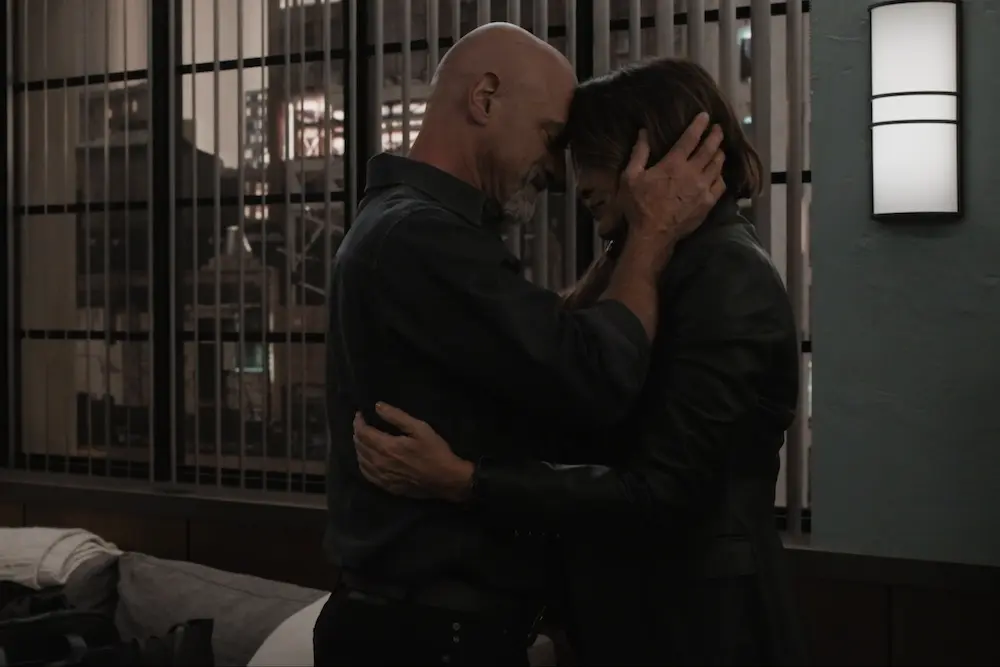
The episode sees Benson navigating the hesitation of revisiting a case where Stabler had effectively cut her out of the interrogation and failed to follow up on critical leads. Despite the tension, Stabler agrees to assist, sparking a narrative that forces both characters to confront how much they have changed. The road trip they take together is not just a quest for justice, but a meditation on their evolving relationship. When Captain Renee Curry challenges the necessity of Stabler’s involvement, noting that he is no longer Benson’s partner, the response from Fin—that some partnerships don’t end even when they do—solidifies the thematic arc of the milestone.
The episode provides a rare moment of clarity for Benson, who finds the strength to address the power imbalance of their past. She tells Stabler, “I let you shut me out… I have to live with the fact that I didn’t do the right thing because I was new, that I didn’t follow my instinct because I thought you knew better.” This interaction highlights a newfound agency in Benson’s character, demonstrating that while the partnership is “forever,” the individuals within it have matured into more assertive, self-assured versions of themselves.
The production of such a significant episode was an intense, exhaustive process. According to Hargitay, the script was massive, with the final cut running nearly 12 minutes over the typical length before the necessary edits were made. The collaborative nature of the writing and filming—often shifting in real-time as the team discovered the emotional beats of the scenes—speaks to the “embarrassment of riches” that characterizes the show’s production.
As Law & Order: SVU looks toward the future, the 600th episode stands as a marker of not just endurance, but of a commitment to the stories being told. It is a show that has managed to remain relevant in a rapidly changing cultural climate, anchored by a core group that treats their work with the gravity it demands. For Hargitay, Wolf, and the entire team, the milestone is not an endpoint, but a reflection of a journey that remains, in every sense, ongoing. The legacy of the show is defined by the stories of the victims, the integrity of the work, and the reality that, much like the partnership between its lead detectives, the bond of the SVU family is one that continues to evolve and persist.