The October 3 installment of Saturday Night Live kicked off with a high-stakes cold open that saw the show’s writers taking direct aim at the current state of Republican party messaging. As the sketch unfolds, the audience is placed inside a frantic campaign war room, where two beleaguered GOP strategists, played by cast members Andrew Dismukes and Ashley Padilla, struggle to manufacture a cohesive narrative in an era defined by political instability and erratic party leadership.
The premise of the sketch centers on the Herculean task facing these strategists: building positive momentum for a party that, at least in the eyes of the SNL writers, appears to be spiraling. The duo serves as the straight-faced anchors for a series of cameos from various high-profile political figures, each of whom highlights a different facet of the modern Republican brand—often with devastatingly satirical results.
The Parade of Political Caricatures
The first figure to enter the frame is Marcello Hernández, stepping into the role of Senator Marco Rubio. Hernández’s portrayal captures a sense of weary pragmatism, as his version of Rubio addresses constituents in Spanish. The comedic tension arises from his candid—and perhaps politically suicidal—admission that Donald Trump has failed to live up to the lofty expectations set by his base. Furthermore, the sketch lampoons the party’s ongoing struggles with foreign policy, with Rubio lamenting that the current "endless war" scenario is failing to improve the material conditions of the American public. By highlighting these contradictions, the sketch underscores the disconnect between traditional GOP talking points and the realities currently facing the party’s leadership.
Following the Rubio segment, the sketch takes a turn into the surreal with the arrival of Mikey Day as a frozen, wheelchair-bound Mitch McConnell. The portrayal is physically comedic, with Day’s McConnell unable to do much more than offer a rigid peace sign. The sketch momentarily breaks the fourth wall when Day, seemingly confused by the script, mistakenly attempts to deliver the iconic "Live from New York" catchphrase far too early in the broadcast. The meta-moment serves to heighten the sense of chaos inherent in the sketch, mirroring the perceived dysfunction within the halls of the Senate.
The parade of political figures continues with Jeremy Culhane taking on the role of Vice President JD Vance. In a biting critique of Vance’s public persona, the sketch focuses squarely on his perceived lack of charisma. During a staged "camera test," Culhane’s Vance stumbles through a robotic, uninspired introduction: "Hi, I’m JD Vance." The scene is abruptly cut short, with his handlers dismissing him immediately, suggesting that his presence is more of a liability than an asset to the party’s broader messaging strategy.
Colin Jost Returns as Pete Hegseth
Perhaps the most talked-about segment of the cold open featured the return of Colin Jost, who stepped into the shoes of Pete Hegseth. The portrayal serves as a direct parody of Hegseth’s recent, widely discussed "State of the Force" address, which focused on the role of the Pentagon and potential personnel overhauls.
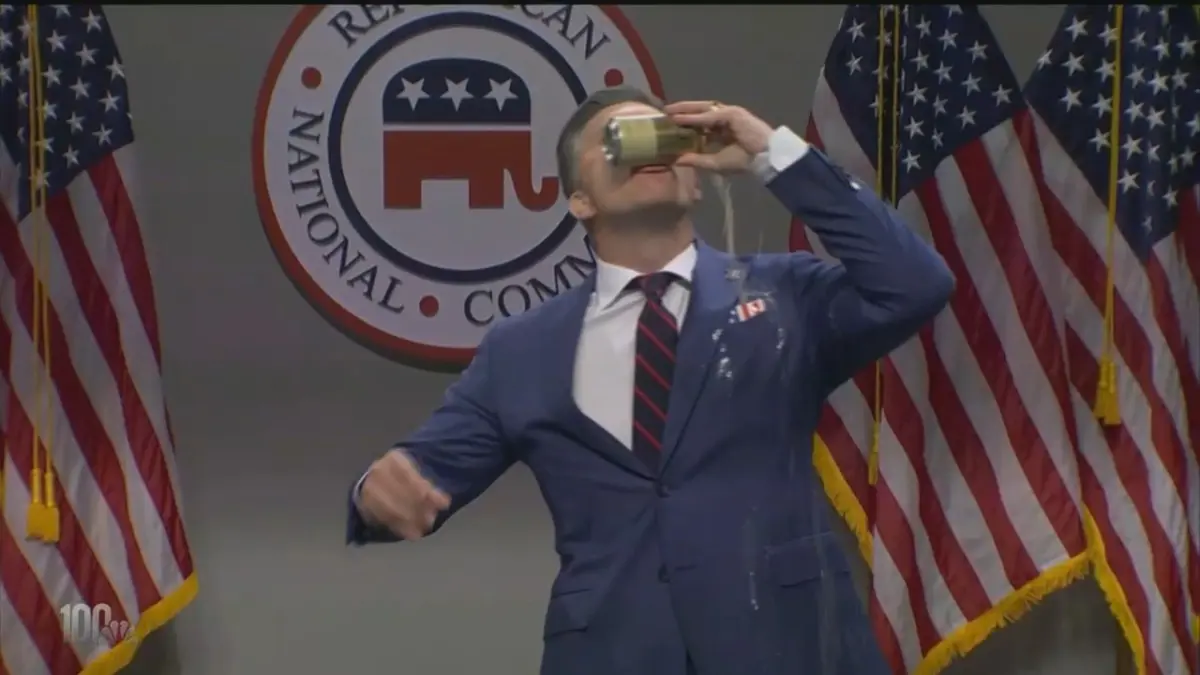
In the SNL version, Jost’s Hegseth is defined by a bizarre, high-energy aggression. Upon entering, he immediately cracks open a Bero beer—the non-alcoholic beverage line backed by actor Tom Holland—only to derisively label it "Spider-Man’s new non-alcoholic bitch beer." The juxtaposition of the masculine, militant rhetoric associated with Hegseth and the branding of the "bitch beer" serves as the primary comedic engine for the scene.
Jost’s Hegseth goes on to deliver a series of increasingly absurd directives to the Republican base. In one particularly memorable moment, he urges his supporters to commit what he describes as "the gayest thing ever and vote." The line is a sharp satirical jab at the rhetoric used by figures on the right, aiming to expose the performative nature of their current political messaging. He further clarifies his vision for the military, boasting, "I’m putting God back in war and it’s working. Our soldiers are praying a lot more than they used to." The dialogue pokes fun at the intersection of religious fundamentalism and military policy, a common theme in Hegseth’s real-world rhetoric.
Trump’s Closing Act
The final political figure to make an appearance is Donald Trump, played by James Austin Johnson. Johnson’s impression, a staple of the show’s recent seasons, focuses on the former president’s unique cadence and stream-of-consciousness delivery. As he enters the war room, he brushes aside the strategists with a casual, "Let me cook."
The sketch then shifts to parodying Trump’s real-life, headline-grabbing strategy of promising financial incentives to voters. Johnson’s Trump leans into the absurdity of the proposal, telling the audience, "If the Republicans win, I’ll give everyone $5,000 and that is not a bribe because I have no intention of following through on that promise." By explicitly highlighting the transactional and often hollow nature of such campaign promises, the SNL writers provide a biting critique of the populist rhetoric currently dominating the political landscape. The segment serves as a fitting conclusion to the cold open, encapsulating the show’s perspective on the current state of Republican campaign tactics.
The episode, which was hosted by actress Dakota Johnson, continued with musical performances by the band Turnstile. As the cold open drew to a close, the segment left viewers with a sharp, albeit cynical, view of the current political cycle, reinforcing Saturday Night Live’s long-standing tradition of using the cold open as a vehicle to process the week’s most polarizing political news. By blending physical comedy, meta-humor, and pointed political commentary, the show once again demonstrated its ability to distill complex, often frustrating political developments into a digestible, and highly satirized, format.
The success of the sketch lies in its ability to take real-world concerns—such as military policy, campaign finance, and internal party dissent—and strip them of their gravity, revealing the performative and often chaotic nature of modern American politics. For the audience, the result is a fast-paced, irreverent look at the figures who dominate the news cycle, delivered through the lens of a show that has, for decades, functioned as a mirror for the nation’s political anxieties. As the curtain fell on the opening segment, the tone was set for an evening of comedy that refused to shy away from the contradictions of the current political environment.