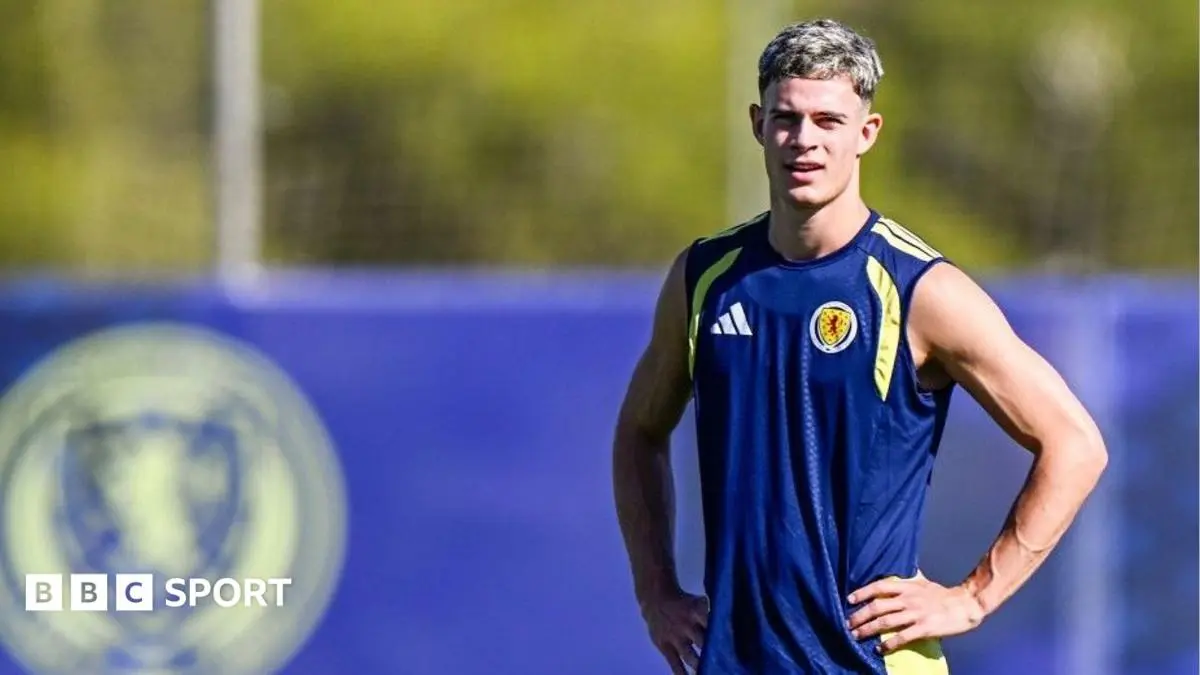
Robbie Ure, cool and confident at just 22 years old, spent his weekend enduring the ultimate footballing baptism of fire. For 90 grueling minutes against Barcelona, he found himself locked in a tactical battle with Pau Cubarsi—the defensive titan who earned man-of-the-match honors in the recent World Cup final. He shared the pitch with Rodri, the tournament’s undisputed player of the tournament, and spent the better part of an hour and a half breathing the same rarefied air as Lamine Yamal. For a young man who, only a few years ago, was struggling to secure a single minute of senior football in Glasgow, the experience was a testament to a career trajectory that has shifted from the fringes of the Scottish Premiership to the center stage of La Liga.
Ure is now the face of a new-ish wave of Scottish strikers, a cohort currently uncapped but brimming with the hope of making a debut this coming Saturday away to Slovenia in the UEFA Nations League. His inclusion in Sebastien Pocognoli’s squad arrives at a critical juncture for the national team. The absence of stalwarts like Lyndon Dykes and George Hirst, combined with injury-enforced absences for Che Adams, Lawrence Shankland, and Ross Stewart—all of whom were part of the Scottish contingent at the World Cup in the United States this summer—has necessitated a radical changing of the guard.
In their place, Pocognoli has turned to an intriguing, youthful mix. Ure is joined in the squad by Hearts’ James Wilson and Sassuolo’s Kieron Bowie, both of whom have two caps to their name. There is also a recall for Hull’s Oli McBurnie, a striker whose international career seemed to have stalled five years ago. Yet, despite the presence of experienced faces, it is the buzz surrounding Ure that feels most palpable. His story is one of resilience: the boy who desperately wanted to succeed at Rangers but found the door firmly closed, only to find his path through the Swedish league and into the arms of Sevilla, who recently secured his services in a deal worth £5.5 million, with an additional £2.5 million in performance-related add-ons.
The scale of his transition is staggering. In his seven appearances for Sevilla since arriving from IK Sirius, Ure has already faced 12 members of Spain’s World Cup-winning squad. Just over three years ago, he was a teenager at Ibrox, fighting for scraps of pitch time. His last senior contributions for Rangers were fleeting: a solitary minute against St Mirren in November 2022 and another brief appearance against Hibernian in May 2023.
Ure has inadvertently become the poster boy for the Scottish FA’s ongoing campaign to persuade domestic clubs to afford their youth players a more legitimate pathway to the first team. He represents the stark reality of the "what-if" scenario in Scottish football. Unable to force his way into the Rangers first team, he opted to leave, embarking on a nomadic journey through Anderlecht and IK Sirius before his high-profile move to Spain.
Reflecting on his recent months, Ure describes them simply as "busy"—a classic understatement for a player operating at a level that, until recently, he could only have imagined. While Sevilla’s 3-1 defeat to Barcelona suggests a difficult result, Ure views the outing as a vital classroom. He is yet to find the back of the net for his new club, but he acknowledges that his current struggles are a non-negotiable part of his development.
"The first half, we were good," Ure says, analyzing the clash against the Catalan giants. "But as the game goes on, they wear you down. Raphinha at the moment… I mean…" He trails off with a knowing smile, an expression that captures the sheer class he is now witnessing on a weekly basis. "I really enjoyed it. But against these players, you give them one chance and most of the time it’s a goal. For me, it was a really good experience. I’m only going to get better as a result of it."
The emotional tether to his childhood club remains, however. When asked about the difficulty of leaving Rangers, Ure is candid. "Yeah, it was," he admits. "All I’d ever known was Rangers. Going in every single day since I was probably eight years old, but it was something that I felt I had to do. I felt like I wasn’t good enough to play for Rangers at the time, which is normal for many 18-year-olds. It was nothing that affected my confidence. I would have loved to have stayed, but I knew myself that I wasn’t going to play, which I accepted."
He recognizes the pressures inherent in a club of Rangers’ stature. "At a club like Rangers, it’s difficult for any 18-year-old to play. I needed a change of scenery and a fresh start, somewhere that I could go to play at a level that would be good enough for me at the time. Anderlecht provided that."
While Belgium served as the initial stepping stone, it was in Sweden that Ure’s career truly caught fire. His 2025-26 campaign saw him net 11 goals in 30 games, but that was merely a preamble to his breakout performance in the early months of this year. Between April and July, Ure featured in 14 games for IK Sirius and scored 15 goals, including a stunning four-goal haul against Mjallby.
"I was scoring near enough every game, so that was probably the happiest I’ve been," Ure reflects. "Every week I was scoring and we were top of the league. I was improving, and that interest in me was getting bigger and bigger."
For Ure, the key was simple: minutes. "At a young age, it’s really important you’re playing. I was playing 90 minutes every week, getting trust from the manager and from the club. I was given time as well. The day I scored the four goals, it was my first hat-trick. I felt like every time I shot, it was going to be a goal. I’ve not had a feeling like that before in football. It was pretty special."
This experience underscores the wider debate currently consuming Scottish football regarding player development. Ure serves as a living, breathing case study of what happens when a young player is given the trust and the platform to perform consistently.
"Everyone’s different," he says, weighing in on the debate. "You have to give players patience and give them time to develop, but the way to do that is, of course, playing minutes at a level where you can develop. I couldn’t find that level in Scotland, so I had to look elsewhere, and I’m happy that I did that."
The level he has found in Spain is, by any metric, stratospheric. While he is still hunting for his first competitive goal in La Liga, he is navigating a savagely tough school of football, one that tests every facet of a striker’s game—positioning, endurance, and technical composure under the most intense pressure.
As he prepares for the upcoming international window, the focus shifts to Pocognoli’s plans for the Nations League. With four games arriving in quick succession, the manager will likely rotate his squad, providing Ure with a genuine opportunity to secure his first senior cap. It will be his chance to shine on an international stage, a reward for the risks he took and the resilience he showed when the path in front of him was anything but clear. He has earned his place in the conversation, and now, the boy who left Glasgow to find his future is ready to show that the journey was worth every step.