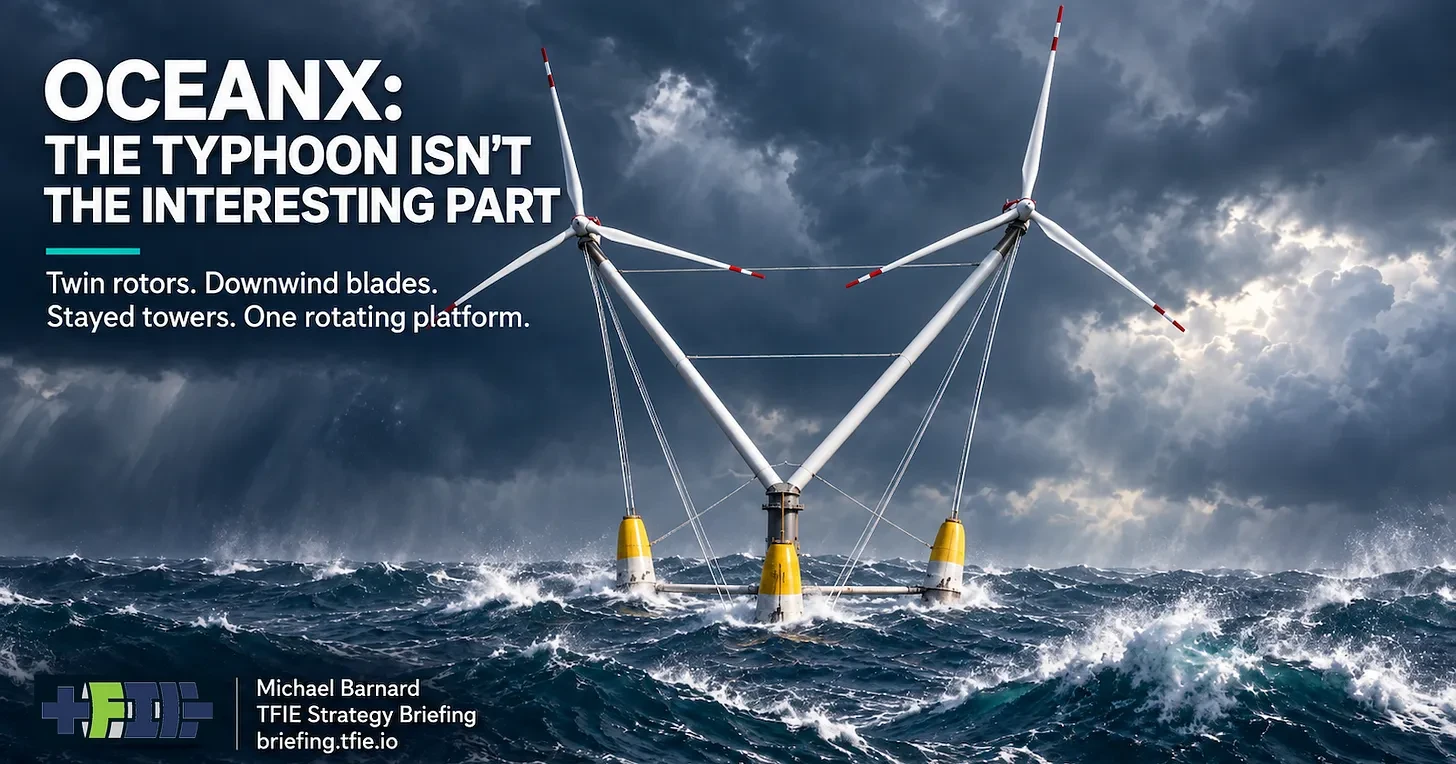
The global wind energy industry has long converged on a standard playbook: massive, three-bladed turbines positioned upwind of a single towering vertical mast. It is a configuration born of decades of trial, error, and optimization. Deviations from this formula are often met with immediate skepticism from engineers and analysts alike. When the unconventional OceanX floating wind platform first emerged, it presented two glaring reasons for immediate doubt: it mounts a pair of turbines on a single floating structure, and it places those rotors downwind of their supports rather than in front of them.
For years, standard industry wisdom dictated that these choices carried insurmountable engineering penalties. However, real-world data can be a powerful disruptor. When the OceanX platform recently weathered the fury of Super Typhoon Yagi, the incoming measurements were robust and credible enough to force a serious re-examination of a machine that many previously dismissed as an unorthodox outlier.
During the height of Super Typhoon Yagi, Mingyang reported punishing environmental conditions at the site. Nacelle winds surged past 41.5 meters per second, accompanied by significant wave heights of 6.5 meters and a maximum individual wave crest reaching 9.8 meters. Despite this immense hydrodynamic and aerodynamic stress, the platform’s response surprised observers. The nacelle inclination varied by only about zero to three degrees throughout the ordeal. Furthermore, project telemetry indicated that the physical platform’s response tracked closely with pre-storm numerical simulations, showing no signs of abnormal structural resonance or a lasting, detrimental change in platform attitude.
For a full-scale floating machine carrying two widely separated rotors on long, inclined supports, these are profoundly useful empirical numbers. The storm did not magically prove that OceanX is economically viable or optimally engineered for a 25-year commercial lifespan. What it did prove, however, was that a heavily coupled, highly unconventional floating structure can behave structurally and dynamically in a completely credible manner under severe wind and wave loading.
Yet, the most compelling takeaway from the event is not merely that the hardware survived a major meteorological disaster. It is that the storm forced a deeper look into the underlying engineering choices around the rotors themselves. A thorough strategy briefing analysis separates the OceanX design into four distinct structural choices: twin rotors, downwind operation, stayed supports, and whole-platform weather-vaning. It is critical to analyze these elements independently, because they solve entirely different engineering problems and should not be automatically credited with one another’s distinct benefits.

To understand why the downwind architecture is drawing renewed interest, one must look at basic aerodynamics. For readers who do not spend their days immersed in turbine architecture, "downwind" simply means that the wind passes the supporting structure before it reaches the rotating blades. The vast majority of modern commercial wind turbines do the exact opposite, placing the blades safely upwind of the tower.
There are historical, pragmatic reasons why the upwind design became dominant. On a traditional downwind turbine, every single blade repeatedly passes directly through the disturbed, turbulent air wake sitting immediately behind a substantial structural tower. These sudden, cyclic changes in aerodynamic loading contribute heavily to mechanical fatigue over time. Historically, this dynamic interaction also helped produce the characteristic rhythmic, low-frequency noise associated with older or poorly designed downwind machines.
Crucially, OceanX does not magically make this classic aerodynamic problem disappear. Instead, it radically changes the physical structure that creates the problem in the first place. Rather than relying on two conventional, thick, freestanding tubular towers, OceanX utilizes unusually slender, inclined structural members that are held rigidly in place by a network of substantial, pretensioned stays. Because these stayed supports are vastly thinner and more streamlined than standard towers, they produce a much narrower and cleaner wake. Consequently, the historical downwind penalty may be materially reduced right at its source, rather than simply endured through heavier blades and overly complex control software.
The floating architecture introduces yet another layer of mechanical innovation. Instead of depending on two conventional, power-hungry nacelle yaw systems to constantly force the rotors to face the shifting wind, the entire massive platform is designed to weather-vane relative to its mooring lines as the wind direction changes. This holistic passive alignment allows the twin rotors, the slender supports, and the tensioned stays to remain in roughly the same harmonious aerodynamic relationship to the incoming airflow. For an engineering design whose entire premise depends on keeping slender structural supports properly aligned with the wind, this passive compliance is a vital mechanism.
This dynamic is precisely why the performance of OceanX has shifted prior assumptions regarding downwind floating wind technology. The historical objections that made downwind machines deeply unattractive to developers were never arbitrary industry conventions; they were rooted in real, quantifiable fatigue and aerodynamic problems. But the emerging frontier of floating wind energy creates entirely new degrees of freedom when it comes to altering the structure positioned ahead of the blades. OceanX utilizes that newfound freedom in a way that directly confronts and addresses the architecture’s historical weaknesses.
At the same time, not every unconventional feature of the platform inspires equal confidence. The twin-rotor configuration remains the most visually striking, yet least convincing, aspect of the design. Operating two turbines inherently means duplicating critical hardware: two separate nacelles, two drivetrains, two hubs, and a total of six blades. Splitting the total generating capacity between two smaller machines can lower hub heights and keep individual components more manageable in scale, which certainly offers structural and manufacturing advantages during fabrication and installation on a floating platform. However, it also duplicates expensive, failure-prone heavy hardware and introduces complex aerodynamic and mechanical interactions that a single, larger rotor simply does not have to manage.

This distinction is vital because the twin rotors dominate every photograph and render of the OceanX platform. They are the feature that makes the machine look radically futuristic, but they are not necessarily the feature that makes it fundamentally interesting from a pure engineering perspective. A stayed support structure, a downwind rotor arrangement, and a weather-vaning floating platform can all coexist and function perfectly well without forcing two complete wind turbines onto the exact same floating hull.
The empirical measurements gathered during Super Typhoon Yagi significantly strengthen the case for taking the overarching architecture seriously, primarily because the storm exercised the entire integrated system simultaneously. Rotor loads, direct aerodynamic wind loads, heavy ocean waves, complex platform motion, mooring line tensions, and the large stayed upper superstructure were all interacting under maximum stress. A reported nacelle inclination of only zero to three degrees under those punishing conditions provides vastly more useful engineering evidence than another theoretical computer rendering or simulation of an unconventional turbine concept.
What the storm data still cannot tell us, however, is whether this novel architecture will emerge victorious from a purely economic standpoint over a 25-year operational lifecycle. Proving commercial viability requires extensive long-term fatigue data, precise structural mass accounting, real-world maintenance experience, standardized component replacement procedures, and a fair, unvarnished comparison against more conventional floating wind turbine designs. Downwind blades still repeatedly pass through disturbed structural wakes. Underwater rotating interfaces still demand rigorous inspection and costly offshore maintenance. Dual drivetrains still create more moving parts that carry the statistical potential for mechanical failure.
These unresolved economic and mechanical questions are precisely why deeper engineering analyses continue to look past the dramatic storm results. Evaluating such technology requires a rigorous step-by-step examination of structural load paths, downwind fatigue evidence, multi-rotor comparisons, whole-platform yaw dynamics, and lifecycle risks before any definitive conclusions can be drawn.
Ultimately, the performance of OceanX during Typhoon Yagi has made the prospect of downwind floating wind far more compelling. The clever combination of a dynamic floating platform, slender stayed supports, and passive whole-platform alignment alters enough of the traditional engineering comparison that the concept firmly deserves fresh consideration. Whether the two-rotor layout can ultimately justify its added complexity remains to be seen, but the underlying structural architecture has proven it can stand up to the sea’s worst.