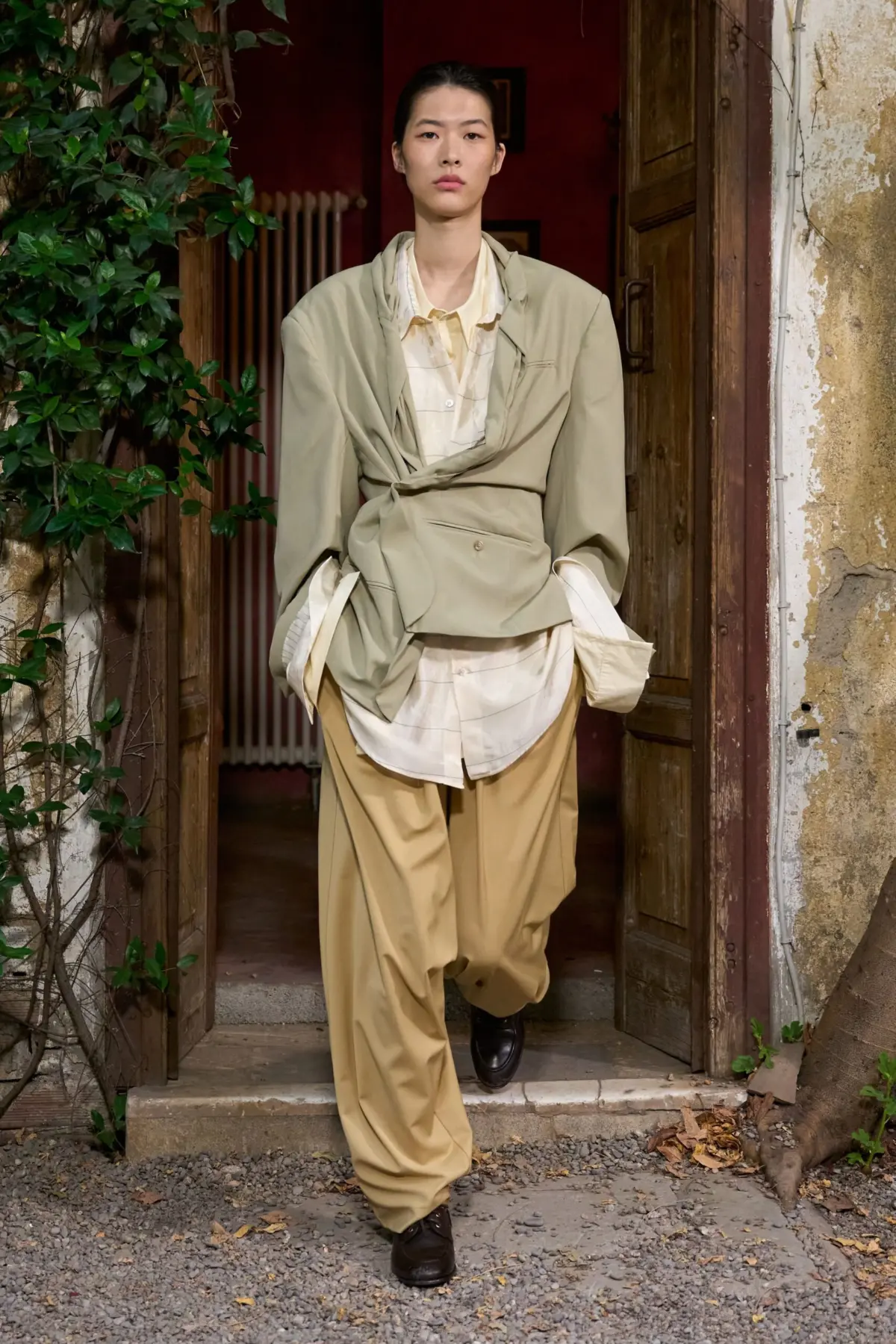
Nestled within a serene, romantic garden concealed behind the historic facade of a Milanese courtyard, designer Luca Lin recently presented a collection that offered a deeply convincing argument for the profound pleasure found in everyday clothes. The presentation setting itself was an extension of this philosophy: lush plants and soft, filtered light engaged in a quiet conversation with the garments on display, as if the pieces had been thoughtfully invited outdoors to reconsider their relationship with the human body. Far from the high-octane, theatrical spectacles that often dominate the international fashion calendar, Lin’s presentation was an exercise in calm deliberation, inviting editors, buyers, and industry insiders to pause and appreciate the subtle nuances of garment construction.
Lin began his creative process with the most prosaic cast of characters found in the everyday wardrobe—standard shirts, classic trousers, and dependable jackets—and proceeded to give each a deliberate, measured nudge. His deep-rooted background in patternmaking remained the powerful engine driving this entire creative journey. Rather than relying on superficial styling tricks to generate interest, Lin approached each foundational garment as a puzzle to be solved. Shirts, trousers, and jackets were meticulously deconstructed and reconstructed, folded and unfolded, until something entirely distinctive emerged, guided by a subtly different internal logic that felt both modern and timeless.
In an industry currently grappling with the environmental and creative consequences of overproduction, Lin’s perspective is both refreshing and timely. "At a moment when there is so much product out there," Lin reflected on the state of contemporary fashion, "I wanted to create something that could stand apart." His thoughtful answer to the perennial problem of establishing a recognizable designer signature was remarkably less gimmicky than the tactics employed by many of his peers. Instead of inventing one instantly identifiable, loud trick designed purely for viral moments on social media, he chose to plant small, intelligent signatures throughout the entire wardrobe.
These quiet details reward the observant eye without demanding undue attention. For example, the buttons on his shirts were sourced in irregular colors from surplus stock rescued safely from larger, unrelated fashion productions. Because of this resourceful approach, although the button fastening on each garment remained perfectly symmetrical and functional, no two shirts were completely alike, imbuing mass-manufactured components with a sense of individual character. Elsewhere, the lapels of his tailored blazers were tightly and precisely rolled to resemble twisted ribbons, adding an unexpected textural dimension to classic tailoring.
Adaptability was seamlessly built into the core construction of the garments from the very beginning of the design phase. Multiple folds thoughtfully placed on the waists of trousers and voluminous balloon skirts allowed these pieces to adjust dynamically to the wearer’s body, offering both comfort and sculptural form. Meanwhile, a seemingly straightforward jacket might feature two clever, detachable sleeves, allowing the garment to transform fluidly from a structured vest into a capelike outer layer depending entirely on the wearer’s mood, the weather, or the demands of the circumstance. Deconstruction in Lin’s hands was never utilized as a cold, sterile intellectual exercise performed on helpless clothes; rather, it functioned as an imaginative and deeply practical way of granting garments more than one life, extending their utility and relevance in a fast-paced world.
Color provided yet another sophisticated layer of distinction within the presentation. Rather than treating color as a flat, declarative statement, Lin worked patiently through multiple subtle shades of the same core hues and across a diverse array of different materials. This layering technique allowed colors to accumulate naturally through the various overlapping layers of an outfit rather than sitting heavily on the clothes as a single, overwhelming block. The resulting visual effect possessed a delicate intensity, perfectly helping to give the entire collection its particular, luminous quality and atmosphere.
Sustainability, while rarely preached from a platform, formed the bedrock of the collection’s material reality. Approximately 80 percent of the entire collection was constructed using deadstock fabrics, an eco-conscious approach that fits neatly alongside Lin’s overarching philosophical interest in making less rather than adding indiscriminately to an already overcrowded and overwhelmed global wardrobe. Notably absent, however, was any heavy-handed sermonizing about sustainability or environmental virtue. The much better argument for sustainability was simply made within the clothes themselves: existing, forgotten materials were skillfully made to feel entirely new, familiar everyday garments were made slightly strange and captivating, and true individuality was achieved through details small enough to be genuinely noticed rather than loudly announced to the room.
Lin, who was born in Reggio Emilia to Chinese parents, has been steadily and quietly refining this distinct design language over the years. His recent selection as a semifinalist for this year’s prestigious LVMH Prize felt like a deeply meaningful and appropriate marker of that steady evolution. What is particularly encouraging about his trajectory is not a sudden, disruptive reinvention of his aesthetic, but precisely the opposite—a growing, unshakeable confidence in his own unique grammatical approach to fashion.
The collection felt unfailingly sophisticated in its structural execution yet wonderfully fluid and poetic in its overall spirit, remaining distinctive without ever insisting aggressively on its own cleverness. Throughout the Milanese presentation, Luca Lin demonstrated that he is deeply interested in tackling the much harder proposition within contemporary design: achieving true clarity of purpose through the quiet coherence of his thinking, until authorship eventually becomes something the observer naturally registers rather than something that constantly needs to be declared.