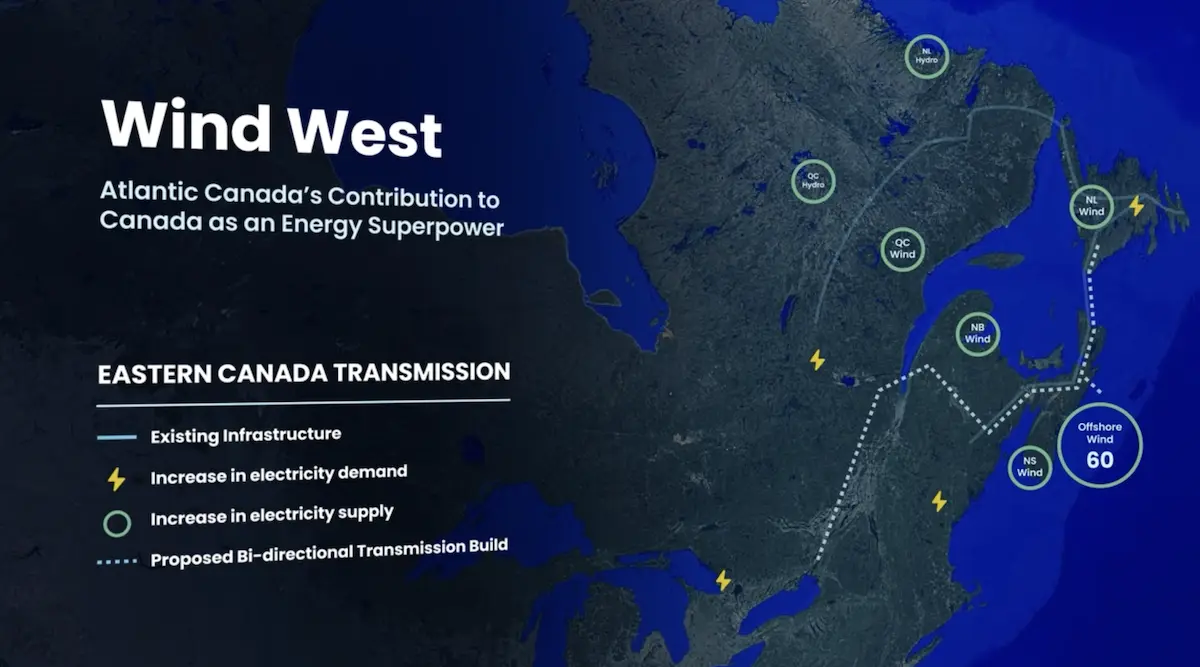
The Canadian province of Nova Scotia is moving forward with ambitious plans to exploit its copious offshore wind resources. This development comes at a time when energy-hungry coastal states in the United States are actively seeking reliable, localized power generation to meet their climate goals and energy demands, particularly as federal policies under US President Donald Trump seek to stall domestic wind energy development.
Canada & The US Offshore Wind Connection
The political and regulatory landscape for renewable energy in the United States has faced severe headwinds. Last year, the federal administration attempted to halt construction on US offshore wind projects that were already in motion along the Atlantic Coast. In addition, the administration ordered the Department of Defense to review and delay onshore wind farms currently in the pipeline.
While the courts have ruled that these actions against offshore wind projects are unlawful, and similar legal challenges have targeted onshore reviews, many domestic projects remain on hold as developers navigate bureaucratic hurdles and administrative delays. Furthermore, the administration has continued its opposition to offshore wind by offering financial leaseout options and incentives to encourage offshore leaseholders to abandon their development plans.
With domestic options heavily constrained, energy-hungry coastal states are looking outward for solutions. The thirst for reliable, localized power generation is particularly acute among Northeastern states. Massachusetts has already begun exploring a strategic offshore wind partnership with Canada, leveraging the ambitious "Wind West" project in Nova Scotia.
Earlier this year, Massachusetts Governor Maura Healey and Nova Scotia Premier Tim Houston signed a new Memorandum of Understanding, pledging to collaborate on cross-border offshore wind projects in the North Atlantic that offer mutual benefits for both the United States and Canada. Premier Houston emphasized the regional economic benefits in a press statement, noting that sharing clean energy with Massachusetts will power economic opportunities for the New England region while creating thousands of jobs and billions of dollars in investment within Nova Scotia.
More Offshore Wind From Canada
The centerpiece of Nova Scotia’s offshore wind strategy is the Wind West initiative. The project was prominently featured among 20 major investment opportunities showcased by the Government of Nova Scotia at the inaugural Canada Investment Summit in Toronto.

If all goes according to plan, Wind West will add offshore wind to Nova Scotia’s existing roster of conventional offshore energy resources. According to provincial data, the region boasts annual average offshore wind speeds topping 9 to 11 meters per second, positioning it among the strongest wind resource areas in North America.
Government assessments indicate that Nova Scotia possesses the offshore wind potential to power roughly a quarter of Canada’s total electricity needs, representing an estimated capacity exceeding 60 gigawatts. The initial phase of the plan calls for a 5-gigawatt tranche of offshore wind turbines, which is projected to produce 24 terawatt-hours of electricity annually. This output is approximately twice the current peak electricity demand in Nova Scotia.
Provincial officials emphasize that Wind West will serve as Canada’s first major offshore wind development, establishing the scale, direction, and trajectory for future industry growth. The identified offshore sites are capable of hosting up to 62 gigawatts of capacity, with projected wind power capacity factors reaching up to 60 percent.
Capacity factor measures the ratio of an electrical power plant’s actual output over a given period to its potential output if operated at full nameplate capacity. For comparison, conventional fossil-fueled generation sources in the United States, such as coal and high-efficiency combined cycle gas plants, typically record capacity factors ranging from the mid-30s to the low-60s depending on the season, while other forms of fossil-fueled generation often score significantly lower.
Offshore Wind Is Just For Starters
Offshore wind is only the beginning of a broader regional strategy. Under the framework of Canada’s new Eastern Energy Partnership, Nova Scotia and neighboring eastern provinces are eyeing expansive regional markets for clean power, positioning offshore wind as the cornerstone of a larger energy transition.
The Wind West strategic plan highlights that offshore wind from Nova Scotia can provide enormous quantities of clean energy at stable prices while diversifying supply and boosting grid reliability for customers. Beyond offshore wind, the Atlantic Provinces offer substantial resources in new and expanded hydroelectric generation, new nuclear power, onshore wind, geothermal energy, and tidal power.
The Eastern Energy Partnership is designed to establish new transmission infrastructure between Quebec and the Atlantic Canadian provinces of New Brunswick, Newfoundland and Labrador, Nova Scotia, and Prince Edward Island. This initiative adds a robust east-west energy corridor to Canada’s longstanding export links with US markets to the south.

Expanded energy production and increased electricity-sharing among Canadian provinces are expected to create positive spillover effects for the United States, whether through new cross-border transmission infrastructure, regional supply chain manufacturing, or direct power purchases.
Cross-border clean energy collaboration is already translating into operational infrastructure. Despite various logistical hitches, the newly completed 1.25-gigawatt Champlain Hudson Power Express transmission line officially commenced operations, capable of supplying up to 20 percent of electricity demand in New York City using hydroelectric power imported from Quebec.
An Offshore Wind Turbine By Any Other Name
Meanwhile, within the United States, federal agencies have navigated political restrictions on renewable energy terminology. Reports indicate that the US Department of Energy has adapted its programs to sustain wind power initiatives despite ongoing political opposition, utilizing the term "aeromechanical energy systems" in place of traditional nomenclature.
In tandem with this terminology shift, the agency restructured its former Solar Energy Technologies and Wind Energy Technologies offices into the new Integrated Energy Systems Office. Official documentation from the office clarifies that references to "aeromechanical" systems pertain directly to wind energy technology and the recycling of end-of-life components, rather than unrelated mechanical equipment. However, industry observers note that translating administrative reorganization into direct federal funding for new wind projects remains a significant hurdle.
At the state level, coastal jurisdictions are actively challenging federal actions that restrict offshore development. Attorneys General representing New York, Connecticut, Maine, Massachusetts, New Jersey, and Rhode Island have filed a lawsuit against the US Department of the Interior over a high-profile financial settlement involving offshore leaseholders. Similarly, in California, Attorney General Rob Bonta and the California Energy Commission have initiated legal action against the federal administration to contest the buyout of the Golden State Wind lease.
As legal battles continue to unfold across the country, state leaders maintain that restrictions on offshore development have temporarily constrained access to an abundant and economical energy resource, complicating regional planning efforts as conventional fuel costs remain volatile.