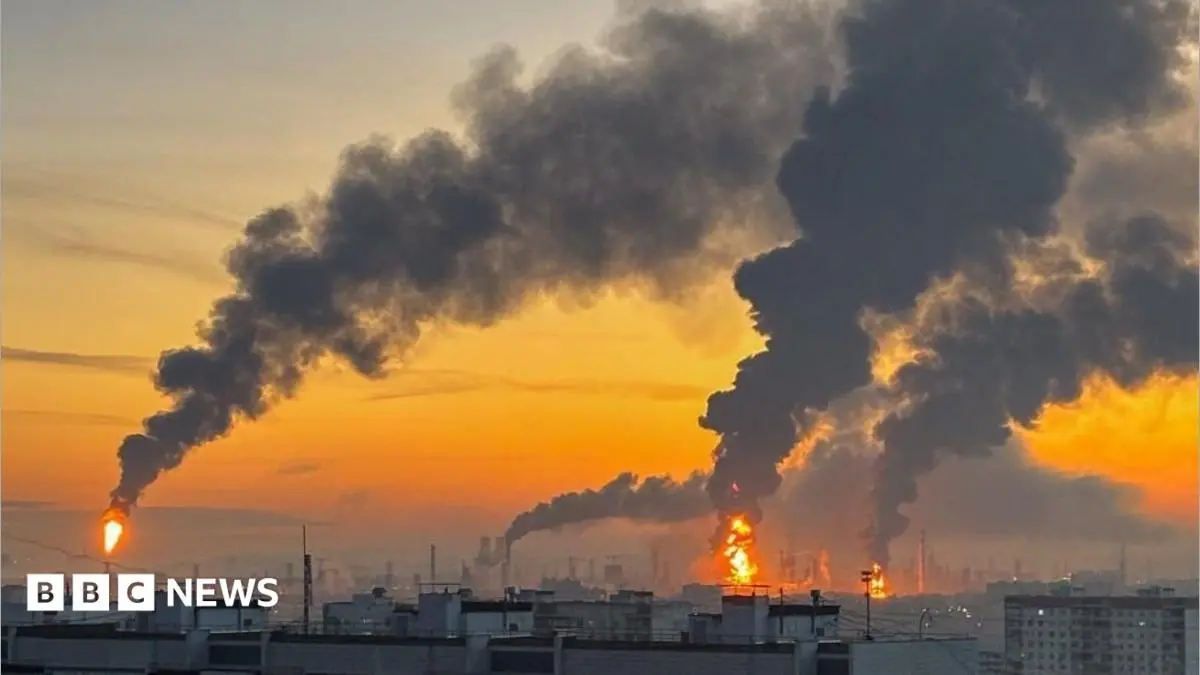
At least two people have been confirmed dead and six others injured following a "massive" overnight Ukrainian drone assault on the Moscow region, according to regional Governor Andrei Vorobyev. The attack, which authorities have described as unprecedented in its scale, triggered widespread air defense operations, residential fires, and significant disruptions to the Russian capital’s aviation infrastructure.
Governor Vorobyev reported that Russian air defenses successfully intercepted 249 drones throughout the night. Despite the high interception rate, debris and direct impacts resulted in fires erupting across several residential buildings and a local warehouse. In Moscow city proper, Mayor Sergei Sobyanin confirmed that a drone struck a structure near one of the capital’s central boulevards, while a facility at an oil refinery sustained damage. In a post on social media, Sobyanin stated that 450 drones were intercepted in total while en route to Moscow, characterizing the event as an "unprecedented attack" on the region.
The human toll of the overnight strikes has been confirmed by regional officials. In the village of Sofyino, a 44-year-old woman lost her life after a drone impacted a three-storey residential building. Governor Vorobyev further noted that five other individuals, including two children, were injured in the same incident. In a separate tragedy within the Orekhovo-Zuevo district, an elderly man died after his private home was struck by a drone.
The scale of the attack prompted immediate security measures at Moscow’s primary aviation hubs. Sheremetyevo International Airport, the busiest in the region, issued warnings to passengers regarding temporary operational restrictions. Simultaneously, all arrivals and departures at Vnukovo airport were halted as a precautionary measure. While authorities announced that restrictions were lifted by Sunday morning, both airports cautioned that lingering delays remained likely as operations slowly returned to normal.
Social media platforms were flooded with unverified footage purportedly showing the night sky over the Moscow region illuminated by explosions, alongside clips showing a large warehouse engulfed in flames. While these videos align with official reports of the strikes, they have not been independently verified by news agencies.
This surge in violence directed at the heart of Russia follows a similarly grim day of hostilities in Ukraine. On Saturday, Russian forces launched a series of strikes targeting the Kyiv and Sumy regions, resulting in the deaths of seven people, including two children.
In the city of Fastiv, located in the Kyiv region, regional head Tymur Tkachenko reported that a mother and her two small children—a boy and a girl—were killed when their home was struck. The attack also caused significant damage to several private residences in the area. In the north-eastern Sumy region, local official Oleh Hryhorov confirmed that four people were killed after a Russian drone struck the vehicle in which they were traveling.
The recent exchange of fire marks a sharp intensification in a conflict that has persisted since President Vladimir Putin launched a full-scale invasion of Ukraine in February 2022. For months, both nations have increasingly prioritized the targeting of critical infrastructure. Energy-generating facilities, major logistics hubs, and transport networks have become primary strategic targets as both sides attempt to degrade the other’s capacity to sustain the war effort.
This escalation persists despite recent claims made by US President Donald Trump, who asserted on social media that both Russia and Ukraine had reached an informal agreement to refrain from striking energy infrastructure. The reality on the ground suggests that such diplomatic optimism has had little impact on the strategic calculations of military commanders in either Moscow or Kyiv.
The targeting of energy infrastructure represents a significant escalation in the tactical nature of the war. For Ukraine, striking facilities near the Russian capital serves as a method of bringing the realities of the conflict home to a population that has, for the most part, remained physically removed from the front lines. For Russia, the focus on Ukrainian energy grids and transport nodes is aimed at crippling the logistical support necessary for the Ukrainian military to continue its resistance, while simultaneously exerting pressure on the civilian population during the winter months.
As the smoke clears from the Moscow region and recovery operations begin in the impacted residential areas, the incident underscores the vulnerability of Russian interior regions to long-range drone technology. The sheer number of drones reported—hundreds in a single night—highlights a shift toward saturation tactics. By launching large swarms of inexpensive unmanned aerial vehicles, Ukraine seeks to overwhelm Russian air defense batteries, forcing them to expend high-value interceptor missiles on low-cost drones while increasing the probability that at least some craft reach their intended targets.
The damage sustained by the oil refinery in Moscow is particularly notable. Energy exports remain a vital component of the Russian economy, and the targeting of refineries is a strategic move intended to disrupt domestic fuel supplies and economic output. Russian authorities have maintained a posture of resilience, with state media emphasizing the efficacy of air defense systems, yet the frequency of these attacks on the capital is increasingly difficult to downplay.
In Ukraine, the loss of life in Fastiv and the Sumy region has served as a painful reminder of the persistent threat posed by Russian aerial bombardments. The death of civilians in their homes and while commuting highlights the indiscriminate nature of modern warfare, where infrastructure and residential areas often lie within the impact radius of military strikes.
As the conflict approaches its third year, the cycle of retaliation shows no sign of abating. Both Moscow and Kyiv remain locked in a war of attrition, with each side convinced that its industrial and logistical targets are essential to securing a favorable position in the conflict. The reports from the Moscow region and the Kyiv and Sumy areas are merely the latest data points in a broader, grinding struggle that continues to exact a heavy toll on infrastructure and human life alike.
International observers remain concerned that this intensification of strikes against sensitive infrastructure could lead to further humanitarian crises. With winter setting in, the destruction of energy-generating capacity threatens the stability of heating and electricity for millions of civilians, potentially leading to increased migration and further straining the resources of regional governments.
For now, residents in the affected areas of Moscow are left to contend with the aftermath of the most significant aerial assault on the capital in recent memory, while families in Ukraine continue to mourn the loss of loved ones amidst the ongoing Russian bombardment. The situation remains fluid, with both governments signaling that they intend to continue their current military strategies despite the mounting costs to civilian life and domestic stability. As the sound of sirens and the reports of explosions continue to punctuate the lives of citizens on both sides of the border, the prospects for a de-escalation appear increasingly distant, replaced by a grim determination to endure the ongoing strategic assault.