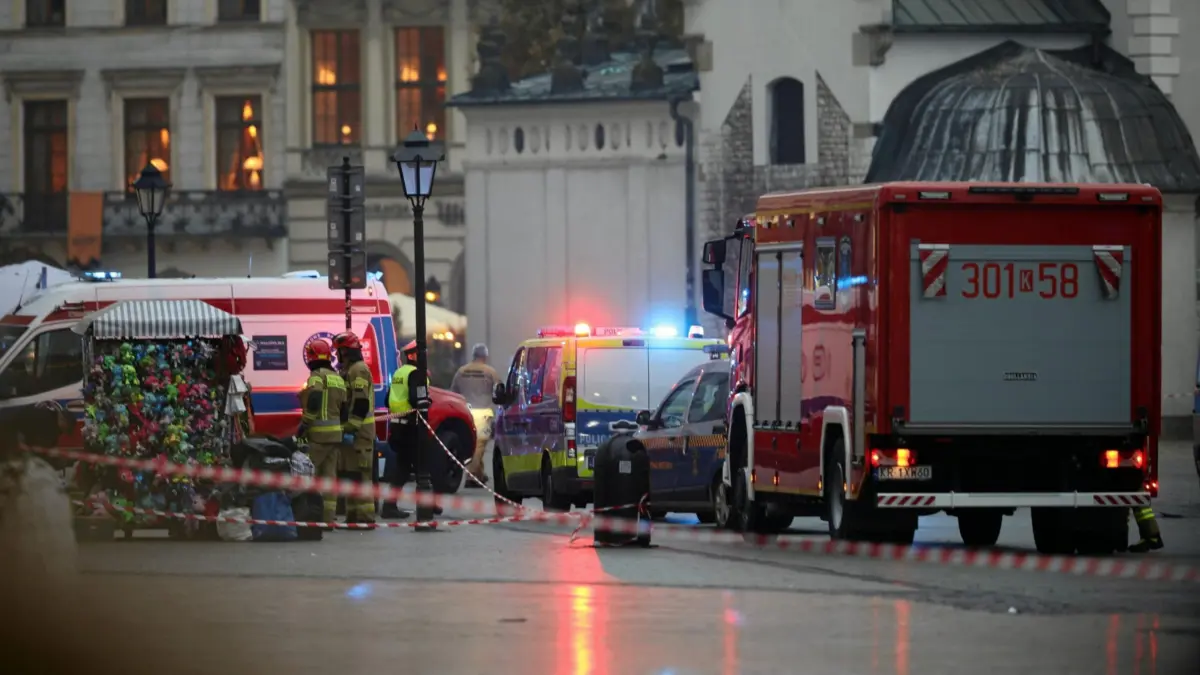
Krakow, Poland’s historic cultural capital and a premier destination for tourists from around the globe, remains in a state of profound shock following a harrowing gun attack that has left at least six people dead and scores of others injured. The incident, which unfolded in the heart of the city’s Main Market Square, has prompted a massive security operation and an investigation into the suspected far-right motivations behind the violence.
The tragedy began shortly before 15:00 local time (14:00 GMT), transforming one of Europe’s most bustling and picturesque medieval squares into a scene of carnage and confusion. Eyewitnesses described a sudden eruption of gunfire that sent hundreds of locals and tourists fleeing for safety. Authorities have confirmed that the suspect, a 25-year-old Polish man, drove into the square in a vehicle before opening fire on unsuspecting pedestrians.
The immediate aftermath saw a rapid and decisive response from law enforcement. Within three minutes of the first shots being fired, armed police officers engaged the suspect in a gunfight. The attacker was neutralized—shot and subsequently arrested—a move that officials credit with preventing an even greater loss of life. While the gunman survived the confrontation, he remains in custody, and his actions have ignited a national conversation regarding security and the threat posed by extremist ideologies.
The Scale of the Tragedy
The human toll of this attack is substantial. Six individuals—four women and two men—have been confirmed dead. Among the deceased is a British national, a detail that has added an international dimension to the mourning process. Three of the victims are Polish, while the identities of the final two individuals have yet to be publicly disclosed by authorities.
Beyond the fatalities, sixteen people were transported to local hospitals with varying degrees of injury. This group includes five foreign nationals from diverse backgrounds, including Austria, Russia, Germany, and Portugal, underscoring the cosmopolitan nature of the square at the time of the attack.
Two Polish police officers, Senior Constable Jakub Kulik and Senior Constable Artur Morawski, were among those injured during the desperate effort to subdue the gunman. Prime Minister Donald Tusk has personally acknowledged their bravery, confirming that they were shot while attempting to disarm the attacker. One of the officers is currently in a "very critical condition" and remains in surgery, according to government spokespeople.

The horror of the event extended beyond the public square. Following the arrest, counter-terrorism police conducted a search of the suspect’s residence. There, they discovered three additional bodies—two women and one man—leading investigators to believe that the suspect’s path of violence may have begun earlier than the incident in the city center.
The Investigation into Motive and Means
As the investigation continues, police and intelligence services are working to piece together the background of the 25-year-old perpetrator. While his name has not been released, authorities have described him as an individual with clear links to radical, far-right ideologies. A government official characterized the suspect as an "ultra-nationalist," noting that preliminary evidence suggests the attack was ideologically motivated.
The perpetrator was observed wearing military-style clothing and was armed with a military-grade weapon, though authorities have confirmed that he is not a member of the armed forces. A search of his vehicle yielded a significant cache of weapons and ammunition, raising urgent questions about how he acquired such equipment. Initial reports from Polish media indicate that the suspect held a valid firearms permit and may have accessed weapons stored at his family home.
The suspect’s vehicle, found abandoned at the busy intersection of Dietla and Stradomska streets, was treated as a potential site for explosive devices. While no explosives were ultimately discovered, the discovery necessitated the evacuation of nearby residential buildings as a precautionary measure, reflecting the high level of caution and tactical precision currently being employed by Polish authorities.
Witness Accounts of the Terror
For the thousands of people present in Krakow’s Main Market Square, the afternoon turned into a struggle for survival. The square, known for its expansive architecture and proximity to landmarks like St Mary’s Basilica, offers few places to hide, leading to chaotic scenes as people sought shelter behind stone walls and inside nearby shops.
Jonathan Balshaw, a visitor from Ipswich, England, was in the vicinity of the Basilica with his partner, Dominika, when the first shots rang out. "We ran down the side of the church and through the side door and hid with several other people until the gunfire died down," he recounted. Balshaw noted the terrifying intensity of the attack, describing the sound of more than 20 shots, which he believed originated from multiple different firearms, suggesting a coordinated or sustained level of aggression.

For others, the realization of the danger came via secondary warnings. Caitlin Shasby, a visitor from Newcastle, was inside her hotel room when she heard the distinct sound of gunfire. It was only after a direct call from hotel staff, instructing her and her companion to remain locked in their rooms, that the gravity of the situation became clear. Across the city, shop windows still bear the scars of the attack, with bullet holes and scattered glass serving as a grim reminder of the violence that occurred.
National and International Response
The attack has been met with universal condemnation, with Polish leadership emphasizing the rarity and severity of the violence. Prime Minister Donald Tusk, who traveled to Krakow to oversee the government’s response, did not mince words regarding the nature of the crime. "Until now in Poland we haven’t had such drastic cases of terrorism," he stated. "That’s what we have to call this—a cruel attack on people’s lives."
In a sign of the city’s collective grief, the Mayor of Krakow, Łukasz Gibała, has signed an official order declaring a period of mourning, which is set to last until November 11. This period will see flags flown at half-mast and the suspension of various celebratory events, reflecting the somber mood currently blanketing the city.
International reactions have been swift. The United States Ambassador to Poland, Tom Rose, issued a statement describing the event as a "savage and murderous attack," while Kaja Kallas, the European Union’s top diplomat, expressed deep condolences, noting that the tragedy is one that will be felt far beyond the borders of Poland.
As the city begins the long process of healing, the focus remains on the medical recovery of the injured and the ongoing police investigation. The events of this day have left an indelible mark on Krakow, a city now forced to grapple with the reality of an attack that struck at the very heart of its public life. Authorities continue to urge residents and tourists to exercise caution and avoid the immediate area of the incident as the painstaking work of forensics and evidence collection continues in the days ahead.