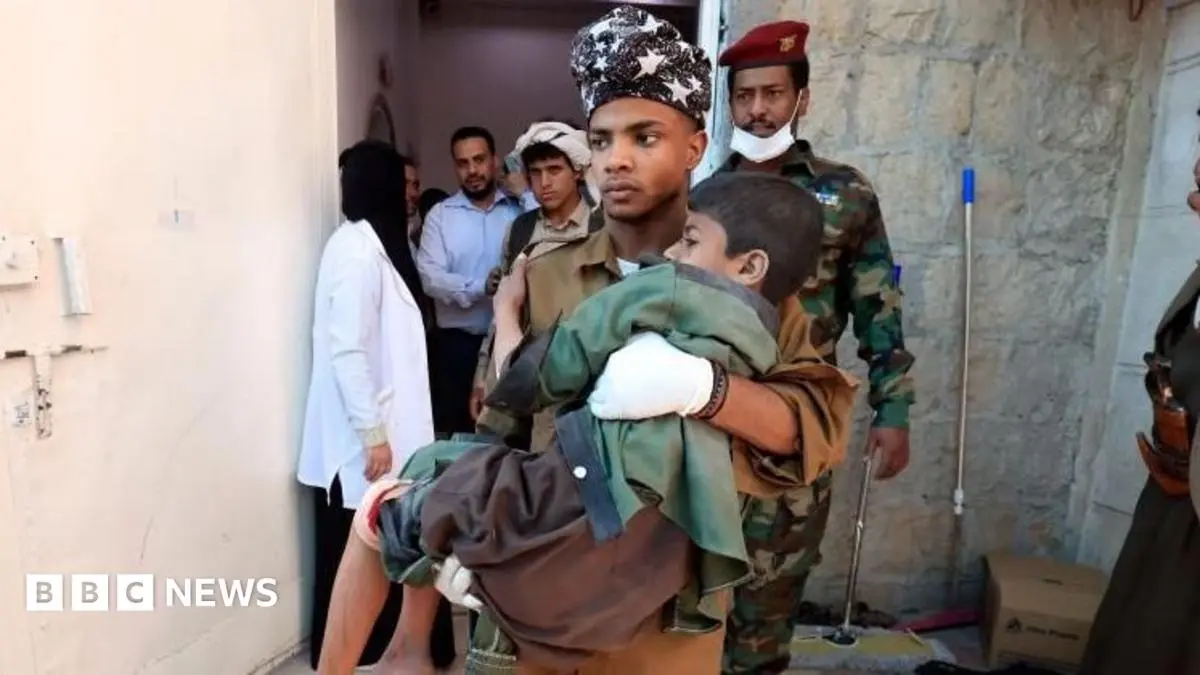
Media outlets affiliated with the Houthi movement in Yemen have reported that at least 33 people, including a significant number of women and children, were killed during a series of airstrikes conducted by the Saudi-led coalition on Saturday. The incident, which took place in the town of al-Shariyah, located to the east of the Yemeni capital, Sanaa, has sparked immediate outrage and renewed concerns over the intensifying conflict in the region.
As of Saturday evening, there has been no official comment or acknowledgement from the Saudi-led coalition, which has been engaged in a long-standing military campaign to support Yemen’s internationally recognized government against the Houthi rebels.
The immediate aftermath of the strike was broadcast via live video footage on Al Masirah, a television station operated by the Houthis. The harrowing images depicted rescue workers frantically digging through the mangled wreckage of several residential buildings in al-Shariyah. Among the most distressing scenes captured by the cameras were the bodies of young children being recovered from the debris, highlighting the devastating human toll of the strike. In addition to the fatalities, the network aired footage of numerous injured survivors being rushed to nearby medical facilities on stretchers, many appearing to be in critical condition.
The Saba news agency, also under Houthi control, corroborated the reports, confirming that the attack occurred on Saturday. According to the agency’s assessment, the death toll stands at 33, with an additional 39 individuals reported as injured. The lack of an independent verification mechanism in the area makes these figures difficult to confirm, but the reports align with a broader pattern of escalation that has characterized the conflict in recent weeks.
The Saudi-led coalition has been engaged in a fierce struggle against the Houthi movement for more than a decade. The coalition’s primary objective has been the restoration of the internationally recognized government, which was ousted from power by the Iran-backed Houthi insurgents. While the war had experienced periods of relative dormancy, the regional tensions—exacerbated by the ongoing conflict involving Iran—have served as a catalyst for a violent resurgence.
The fragile stability that had characterized the region for a time began to unravel following a series of strategic provocations. The situation reached a critical breaking point when the Saudi-led coalition conducted an airstrike on the airport in Sanaa, which remains under Houthi control. The coalition stated that the strike was intended to prevent an Iranian aircraft from landing at the facility. In retaliation, the Tehran-backed Houthis launched a series of offensives, most notably targeting Abha airport in Saudi Arabia.
Beyond targeting airports, the conflict has expanded into the maritime domain. Houthi forces have increasingly targeted Saudi ships navigating the Red Sea off the coast of Yemen. These vessels are essential to the Saudi economy, as the Red Sea has served as a vital alternative oil export route to the Strait of Hormuz. The disruption of this maritime corridor has significantly escalated the economic stakes of the conflict, prompting major fighting to resume between Houthi rebels and forces loyal to the Saudi-backed Yemeni government.
The civilian population continues to bear the brunt of this renewed warfare. On Friday, just one day prior to the al-Shariyah incident, a separate attack on a marketplace in the province of Taiz resulted in the reported deaths of 30 people. Taiz has emerged as a central theater of recent combat, with both sides trading accusations regarding the marketplace massacre. The Houthis have leveled direct charges against the Saudi coalition for the strike, while government forces have countered that the casualties were the result of a Houthi-fired missile aimed at the site.
The humanitarian impact of this renewed cycle of violence is staggering. The United Nations has reported that since the fighting intensified, more than 1,600 people have been killed, and over 300,000 civilians have been forced to flee their homes. The displacement crisis, combined with the destruction of infrastructure, has pushed millions of Yemenis to the brink of starvation and disease, according to various aid organizations operating in the region.
The military strategies employed by both sides have contributed significantly to the mounting death toll. The Saudi-led coalition has relied heavily on its superior air power, conducting regular sorties against identified Houthi positions. In turn, the Houthi movement has demonstrated an increasing capacity to strike deep into Saudi territory, launching multiple missiles at key strategic targets, including airports and critical oil infrastructure.
The timing of the strike on al-Shariyah appears to be linked to a broader, ongoing exchange of fire. Hours before the buildings in al-Shariyah were struck, the Saudi-led coalition issued a statement claiming they had successfully intercepted a missile that was trajectory-bound for the Saudi capital, Riyadh. This interception, while preventing potential casualties within Saudi borders, seems to have set the stage for the subsequent retaliatory air campaign that resulted in the tragedy in al-Shariyah.
The situation remains volatile, with little sign of de-escalation on the horizon. Following the news of the 33 deaths, Mahdi al-Mashat, a prominent Houthi leader, issued a stark warning, vowing that the group would take decisive revenge for the attacks. As international observers watch with growing concern, the cycle of strike and counter-strike continues to threaten the stability of the entire region, leaving civilians trapped in the middle of a war that shows no sign of yielding to diplomatic resolution. The lack of communication from the Saudi-led coalition regarding the specific incident at al-Shariyah leaves many questions unanswered, but the images coming out of the town serve as a grim reminder of the high cost of the ongoing hostilities.