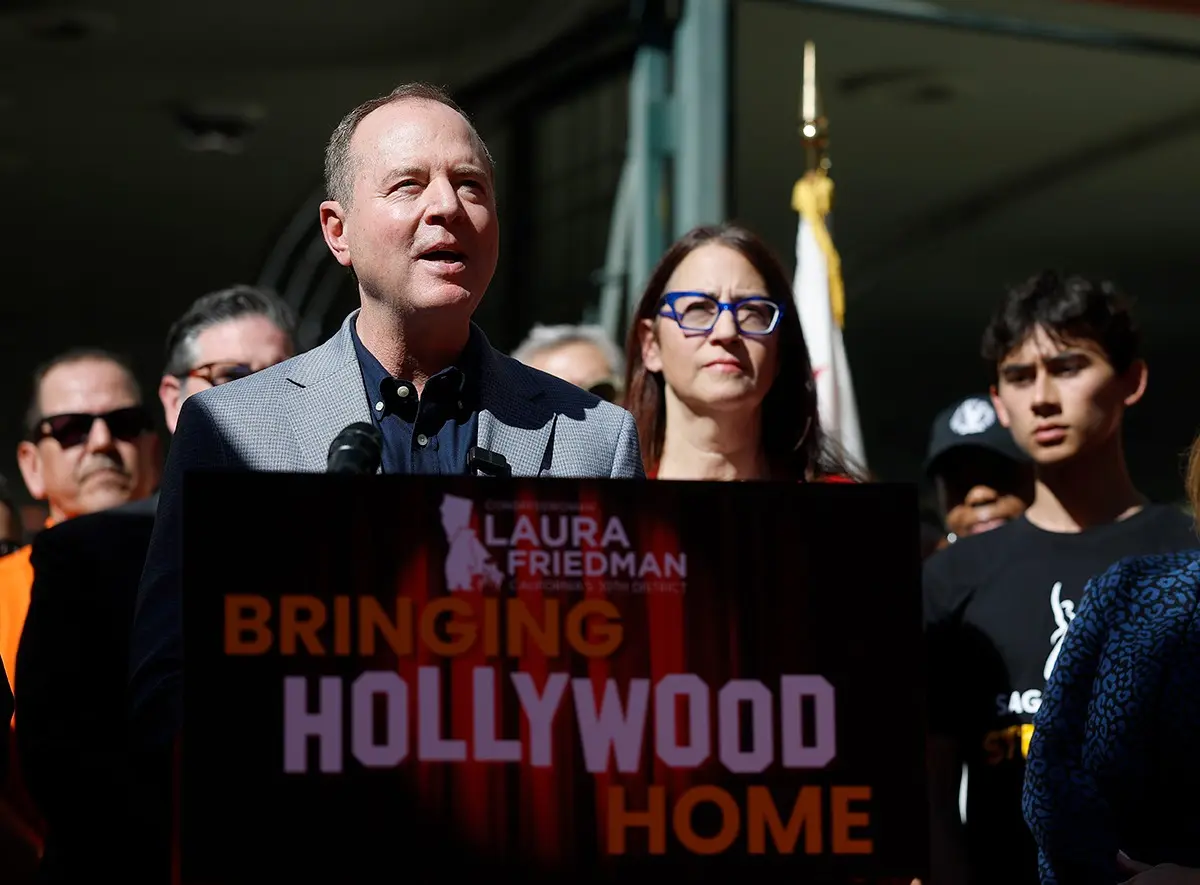
A coalition of California Democrats and influential labor union leaders gathered in Glendale on Tuesday, intensifying their efforts to secure a federal film incentive program before the current Congress concludes. The push comes as lawmakers aim to capitalize on a brief window of legislative opportunity during the upcoming lame-duck session to address the long-standing issue of “runaway production,” where American film and television projects are increasingly filmed in foreign countries to take advantage of more aggressive tax subsidies.
Senator Adam Schiff, joined by eight Democratic representatives from Southern California, stood outside the historic Alex Theatre to make a compelling case for the legislation. Despite the sweltering 100-degree heat, the group remained focused on the urgency of the moment. Schiff, a key architect of the push, did not mince words regarding the necessity of the measure, describing it as "job No. 1."
"We are so close to getting this done," Schiff told the gathered crowd and press. "Whatever we can do to get this done, that is the priority. It just can’t wait. It’s too important. The losses so far have been too extraordinary."
The legislative proposal, introduced just last month, seeks to create a transferable tax credit ranging from 20% to 30% for U.S. labor costs associated with film and television production. Proponents argue that such a measure is essential to level the playing field against 65 other nations that currently offer their own robust incentive programs designed to lure American studio investment away from domestic soil. According to Schiff’s office, the bill has managed to bridge the partisan divide, currently boasting the support of 12 senators—split evenly between six Democrats and six Republicans. Among the most recent additions to the list of cosponsors are Sens. Thom Tillis, a Republican from North Carolina, and Chris Coons, a Democrat from Delaware, signaling a level of bipartisan interest that supporters hope will be sufficient to push the bill over the finish line.
The legislative window is narrow. Lawmakers will have approximately five weeks during the post-election lame-duck session to shepherd the bill through both chambers of Congress. Representative Laura Friedman, whose office took the lead in organizing the Tuesday press conference, expressed a cautious but hopeful outlook regarding the timeline.
"I am cautiously, guardedly optimistic," Friedman said in a subsequent interview. "We need to have this on the president’s desk by mid-December, as far as I’m concerned." Friedman noted that she and her colleagues are pushing for the bill to be integrated into a larger tax package, a strategy she believes offers the best chance of passage in its current form. "This has been almost two years of constant work. It hasn’t just come together in the last few weeks. It’s been a snowball effect. It started out as this idea, and then we just kept building and building and building. So I feel like we have a great momentum."
The structure of the proposed tax credit is multifaceted. Beyond the baseline 20% to 30% credit, the bill includes a 5% bonus for productions filming in designated disaster areas. Under the current language of the bill, this would apply to the entirety of Los Angeles County through January 2030, a provision responding to the significant impact of last year’s wildfires. Additional bonuses are included for independent films and for productions that choose to film in rural opportunity zones. When layered on top of existing state-level incentives—such as those offered by California and New York—the total tax credit for a production could reach 50% or more, creating a financial landscape that would make domestic production highly competitive against foreign alternatives.
The economic argument for the bill is underscored by a stark reality: the erosion of the U.S. share of the global entertainment market. A report released on Monday by a coalition of major industry unions documented a significant shift in production geography over the past quarter-century. The data shows that the U.S. share of global spending has dropped from 74% to 42% for film and from 94% to 64% for television. While the absolute volume of production has grown globally, the U.S. has seen its relative dominance wane.
Duncan Crabtree-Ireland, the executive director of SAG-AFTRA, emphasized that other countries are not merely competing; they are effectively capitalizing on the U.S. industry’s failure to provide competitive domestic support. "It is fair to say that these other countries recognize the quality of these jobs—that’s why they put these measures in place," Crabtree-Ireland said. "That’s why they are eating not only our lunch, but our breakfast and our dinner as well. And we have to change that. This is our opportunity to do it."
The political landscape for such a bill is unique, with interest crossing traditional ideological lines. In a notable development in August, President Donald Trump publicly urged Congress to "immediately" pass a federal film incentive, famously labeling the state of the industry as a "Complete and Total Disaster." This presidential interest has added a layer of political complexity and potential urgency to the legislative process, as both parties weigh the economic implications of preserving the domestic film industry.
The Motion Picture Association (MPA), which represents the major film studios, has been a central player in advocating for the industry’s health. The organization has worked to frame the legislation as a nationwide benefit, rather than one limited to traditional production hubs like Los Angeles or New York, noting that the bill could impact all 50 states. However, the MPA has maintained a more measured tone regarding the timeline. While acknowledging the importance of quick action, the association has emphasized that it is equally important to "get this right," ensuring the policy is robust enough to achieve its stated goals without unintended consequences.
For the workers represented by the unions, however, the academic debate over legislative perfection is secondary to the immediate financial hardship caused by dwindling production. Union leaders at the press conference were clear that their members are facing an existential crisis and cannot afford further delays.
Mike Miller, vice president of IATSE, the union representing a vast array of behind-the-scenes craftspeople, warned that the stakes for the upcoming year are high. "When this passes in this lame-duck session, it will immediately impact production in 2027," Miller said. "And there are hundreds of thousands of entertainment industry workers that are counting on it."
As the legislative session heads toward its conclusion, the coalition of Democrats and union supporters remains focused on the finish line. Whether they can successfully navigate the complexities of a lame-duck session and secure the support needed to turn the proposal into law remains to be seen, but the pressure to act before the mid-December deadline is mounting. For those on the ground in Glendale, the message was clear: the time for waiting has passed, and the health of the American entertainment industry depends on immediate federal intervention.