By Azadeh Moshiri
South Asia Correspondent
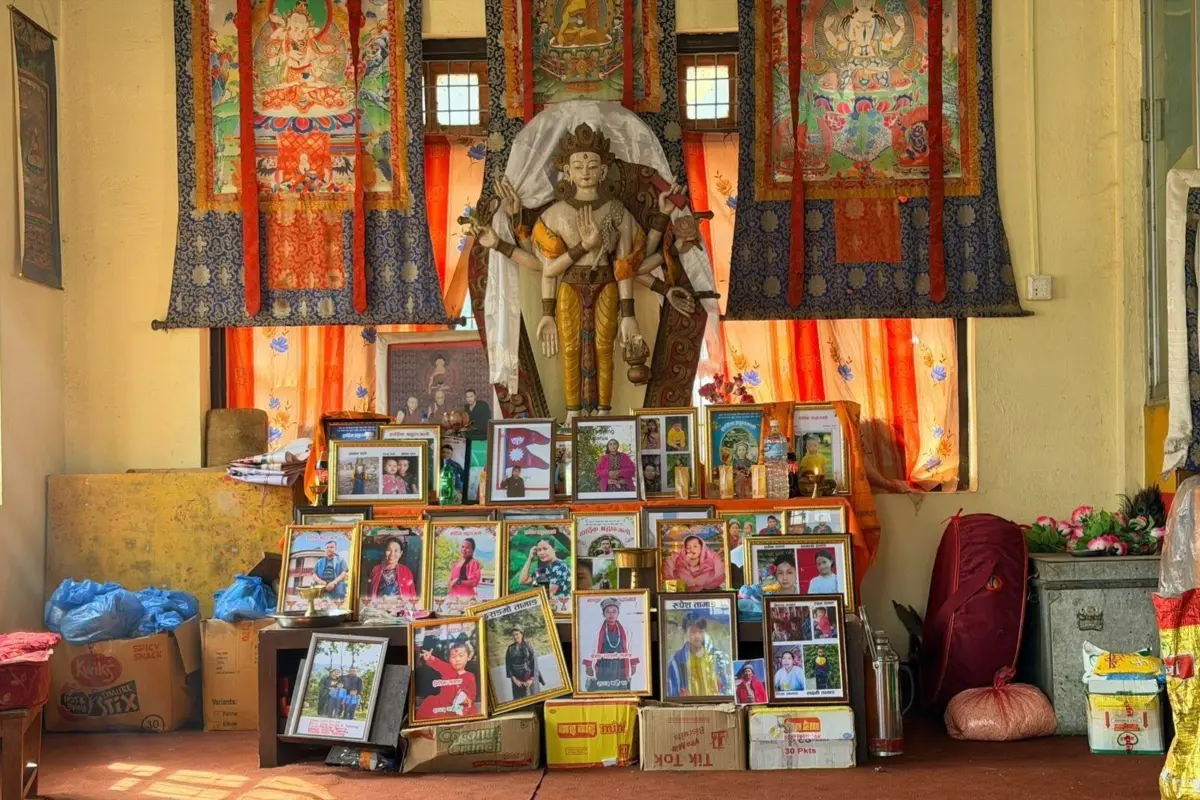
At the historic Pashupatinath temple, situated along the sacred banks of the Bagmati River in Kathmandu, the atmosphere is heavy with a grief that refuses to find closure. Among the mourners is Madan Lal Lawat, who has joined other families in performing final, heartbreaking rites for loved ones lost to the catastrophic flooding that decimated the China-Nepal border region last month.
In accordance with long-standing Hindu tradition, when a body cannot be recovered from the wreckage of a disaster, a symbolic effigy is crafted from sacred "kusha" grass. This ritual acts as a conduit for the spirits of the departed, allowing grieving relatives to carry out the funeral rites that are essential for the soul’s final journey. For Lawat and thousands like him, this ritual is the only form of closure they may ever receive. With official search and rescue operations now concluded and more than 5,000 people still unaccounted for, the reality has set in: the bodies of their loved ones are likely gone forever, claimed by the same torrents of mud and water that leveled their homes.

Lawat’s personal story is a harrowing testament to the speed of the disaster. He survived only because he was driving his bus outside his village of Betrawati when the floodwaters surged. According to the last reports he received from survivors, his brother, Mangal, spent his final moments going door-to-door, desperately urging his neighbors to flee the oncoming wall of water. "I don’t know how to start over," Lawat says, his voice strained by the weight of uncertainty. "Police say they’re still searching for the bodies, but I’m not sure they’ll ever be found."
While the emotional toll is absolute, the legal reality is proving to be a far more complex, and often cruel, secondary disaster. In Nepal, the legal framework regarding missing persons is rigid and archaic. Under current laws, a missing person is only legally presumed dead after a period of 12 years. This statute, intended for individuals who have vanished abroad or disappeared under different circumstances, is woefully ill-equipped to handle the immediate, mass-casualty aftermath of a climate-induced catastrophe.
A Legislative Deadlock
The implications of this legal impasse are profound. For survivors like Lawat, the lack of an official death certificate is not merely a bureaucratic hurdle; it is a wall preventing access to the most basic forms of relief. Without proof of death, families cannot process inheritance, transfer property titles, or access the government-mandated flood compensation packages intended to help them rebuild their lives.

The compensation structure, while modest, is a lifeline for those who have lost everything. The government has pledged up to 25,000 rupees (£122; $162) for immediate funeral costs, alongside bereavement compensation of approximately 200,000 rupees (£981; $1,302) for the first deceased relative, with an additional 100,000 rupees (£491; $651) for every subsequent death. However, these funds are strictly contingent upon the production of a death certificate. As families struggle to clear the mud from their ruined homes and secure food and shelter, they are simultaneously caught in a paralyzing administrative nightmare.
"In view of the current disaster, the law is outdated," explains constitutional law expert Bipin Adhikari. He points out that the 12-year provision was designed for an era when communication was sparse and individuals could truly vanish without a trace. "But technology has advanced now; it isn’t as difficult to send or receive information," he argues. The law, he suggests, is failing the very people it was intended to protect during times of crisis.
When Lawat attempted to secure a death certificate at his local municipality office last week, he was met with the same wall of bureaucracy that has stymied so many others. "They said they’re still discussing the death certificate issue. We aren’t sure what to do now. There’s so much uncertainty," he says.

The Scale of Destruction
The difficulty in confirming deaths is exacerbated by the logistical nightmare of recovering and identifying victims. Even when bodies are found, the process is agonizingly slow. More than 1,400 bodies have been recovered to date, but the national authorities lack the infrastructure and experience to conduct DNA processing on such a massive scale. In some instances, overwhelmed officials have taken DNA samples and buried the bodies in marked graves, hoping that families might eventually be able to claim them once identification protocols are established.
The scale of the destruction is staggering. Recent assessments indicate that 7,570 private buildings have been destroyed or damaged, affecting nearly 33,000 people. The village of Betrawati, where the BBC witnessed the aftermath firsthand, serves as a grim example of the devastation. Once the roads to the Rasuwa district were cleared—after days of isolation from Kathmandu—the true extent of the damage became clear. The village, which once boasted a bustling market and the now-ruined Uttargaya School, had been swallowed by hardened silt and mud in a matter of minutes.
Betrawati straddles the districts of Rasuwa and Nuwakot and falls under the jurisdiction of the Bidur municipality, which reports the highest number of destroyed buildings in the country—over 3,000. For Mayor Rajan Shrestha, the situation is dire. "Everything is on hold," he told the BBC, noting that his office is currently unable to issue the necessary documentation. "We understand the emotional pain for families who have already performed funeral rituals, but officials must work within legal boundaries to avoid future liabilities."

A Call for Urgent Reform
The government, for its part, has acknowledged the severity of the crisis. In an official statement, the prime minister’s office admitted to being "aware of the difficulties" the current laws pose for families during exceptional disasters. The home ministry has signaled a willingness to amend the legislation if necessary, but for those living in temporary shelters, the pace of government action is too slow.
The pressure on the state is immense. Nepal faces an estimated reconstruction bill of up to £3.6 billion ($4.8 billion)—a figure that represents more than 10% of the nation’s gross domestic product. At the UN General Assembly in New York, leaders highlighted the vulnerability of Nepal, a country that contributes minimally to global greenhouse gas emissions yet suffers disproportionately from the consequences of global climate change. Prime Minister Balen Shah has been vocal in calling for grant-based international support, warning that saddling a poor nation with further debt through "mega-loans" is an unsustainable and unjust response to a climate-driven tragedy.
For individuals like Tisum Ghale, the macro-economic debates are far removed from his daily struggle for survival. Ghale’s story is a tragic cycle of loss; he and his family were displaced by the 2015 earthquake, only to rebuild their lives in Betrawati, which was subsequently destroyed by last month’s floods. He lost 19 relatives in the disaster, including five of his sisters, and now finds himself caring for eight children left behind. Like Lawat, he is living in one of the 37 holding centers across northern Nepal, his home gone, his family shattered, and his access to compensation blocked by the absence of a piece of paper.

As the government continues to debate the legalities of death confirmation, the people of the flood-ravaged regions are left in a state of suspended animation. They have held their funerals with grass effigies, they have mourned their dead, and they have begun the long, arduous process of attempting to rebuild. What they require now is a government that recognizes the reality of their loss not through the lens of an outdated legal code, but with the urgency that the tragedy demands. Until then, the families of the missing remain stuck between the grief of their loss and the cold, bureaucratic indifference of the law.