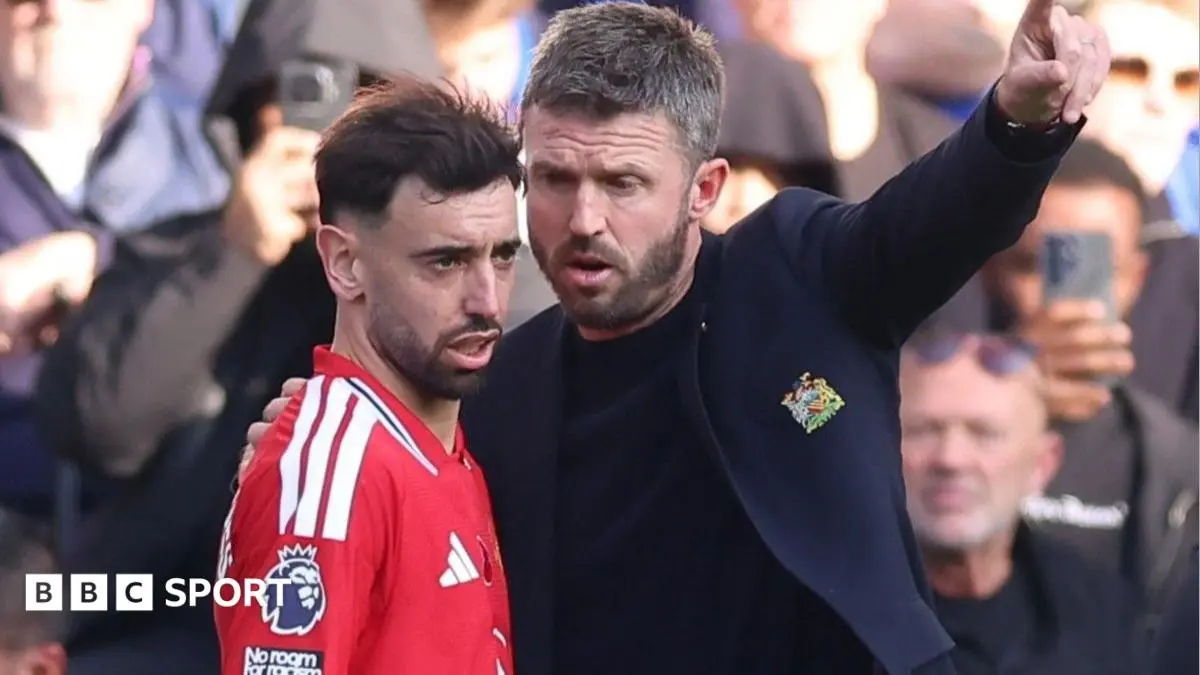
As Manchester United prepares for a pivotal encounter against Aston Villa at Old Trafford this Sunday, the atmosphere at Carrington remains defined by a blend of introspection and a desperate search for consistency. Interim manager Michael Carrick finds himself at the helm during one of the most testing periods in the club’s recent history, tasked with steadying a ship that has drifted dangerously close to the relegation zone.
Following the stinging disappointment of the recent loss to Bournemouth, questions regarding the morale and internal dynamics of the squad have intensified. Central to the discourse has been the role and reaction of Bruno Fernandes, a player whose influence has been debated amid the team’s collective struggles. Carrick, however, has moved to shield his star playmaker, refusing to divulge the specifics of private conversations held behind closed doors.
For Carrick, the dialogue between coaching staff and players is not an extraordinary event reserved for crises, but rather the heartbeat of daily operations at the club’s training ground. "There are always conversations, and bits going on," Carrick noted when pressed on his recent interactions with Fernandes. "It’s acknowledging when things are going well and what we need to improve on. Sometimes it’s individually, sometimes it’s a group. What’s actually said in that discussion, I’ll keep that to myself, but it’s pretty clear we’ve moved in a good direction."
Carrick’s defense of Fernandes is rooted in a firm belief in the Portuguese international’s dedication to the cause. Despite the external noise and the team’s erratic form, the interim manager remains convinced that the midfielder’s professional standards have not wavered. "Bruno’s commitment is undoubted for me in terms of what he brings to this team and this club," Carrick asserted, hoping to dampen speculation that a breakdown in relationships might be exacerbating United’s on-field woes.
The broader context of United’s situation is undeniably grim. With only one victory in nine Premier League matches—a solitary win against Ipswich back in August—the club is enduring a drought that has left supporters and pundits alike searching for answers. The current state of affairs has created an environment of heightened pressure, with the expectation that United’s hierarchy will conduct a comprehensive assessment of the managerial situation immediately following the Sunday fixture.
Carrick, a figure who understands the demands and expectations of the club better than most, maintains a pragmatic outlook regarding his own uncertain tenure. He acknowledges that the current trajectory is insufficient for a club of Manchester United’s stature. While he is acutely aware of the precarious nature of his position, his focus remains steadfastly on the immediate task: extracting a performance from his squad that can provide a foundation for the remainder of the season.
The recent victory over Roma in European competition has been touted by some as a potential turning point, a flicker of light in an otherwise dark campaign. Carrick is eager to capitalize on that result, framing it as the necessary catalyst for a wider recovery. However, he is equally wary of allowing the win to mask deeper, systemic issues that continue to plague the team.
In his notes for the official matchday programme, Carrick struck a tone of cautious optimism tempered by a demand for greater excellence. "While we can be really pleased with elements of the performance on Tuesday night, we must absolutely know there is so much more to come from our team," he wrote. The message to the players is clear: the victory in Rome cannot be an outlier, but must instead serve as the standard by which all subsequent performances are measured.
"We must be ready to show that we can back up Tuesday’s victory and begin to create the momentum to give ourselves something to build on after the international break," he added. The upcoming hiatus from club football is often viewed as a chance to reset, but for United, the opportunity to enter that break with a sense of positivity is contingent entirely on the result at Old Trafford this weekend.
The stakes of the match against Aston Villa have been amplified by external results that have only tightened the pressure on United. The reality of their current predicament was laid bare by Nottingham Forest’s impressive 3-1 victory over Manchester City, a result that sent shockwaves through the league table and served as a stark reminder of how quickly the landscape can change.
Because of that result, the math is unforgiving: should Manchester United fail to secure three points against Aston Villa, they are destined to spend the entirety of the international break languishing in the Premier League relegation zone. For a club that has historically occupied the upper echelons of the table, the prospect of an international hiatus spent in the bottom three represents a sobering reality check.
The weight of the situation is not lost on the players or the staff. Old Trafford, often a fortress, has become a place where anxiety is as palpable as expectation. The fans, while frustrated by the lack of returns on the pitch, remain a critical factor in how the team navigates these turbulent waters. A win on Sunday would provide more than just three points; it would offer a vital psychological reprieve for a group of players currently struggling to find their identity under the bright lights of the Premier League.
Carrick’s challenge is as much about mental fortitude as it is about tactical discipline. He must convince a squad that has tasted victory only once in two months that they possess the quality to compete with the likes of Villa, a team that will arrive at Old Trafford looking to exploit the home side’s vulnerabilities. The interim manager’s reliance on clear, consistent communication—whether with individual leaders like Fernandes or with the squad as a whole—suggests a belief that the answers lie within the current group.
As the countdown to Sunday’s kickoff begins, the narrative surrounding Manchester United remains one of transition and uncertainty. The club’s powerbrokers are watching closely, and the result against Aston Villa will likely dictate the tenor of the discussions held in the boardroom next week. Whether Carrick remains the man to lead the charge forward or is merely a caretaker managing a necessary decline remains to be seen. For now, however, the focus is entirely on the ninety minutes at Old Trafford.
The resilience required to turn the season around will be tested against a Villa side that will be well aware of United’s fragility. Carrick knows that words—whether spoken in the dressing room or written in the programme—carry little weight unless backed by a dominant display. The transition from the high of the Roma victory to the intensity of the domestic league is the defining challenge for a United team currently fighting for its pride, its position, and its future.
Should they falter, the impending international break will be dominated by agonizing analysis of how a giant fell into the relegation scrap. Should they triumph, it may provide the first tangible signs that the club has finally begun to navigate the darkest chapter of its recent history. The margin for error has effectively vanished, leaving Carrick and his players with a single directive: perform, win, and silence the gathering storm.