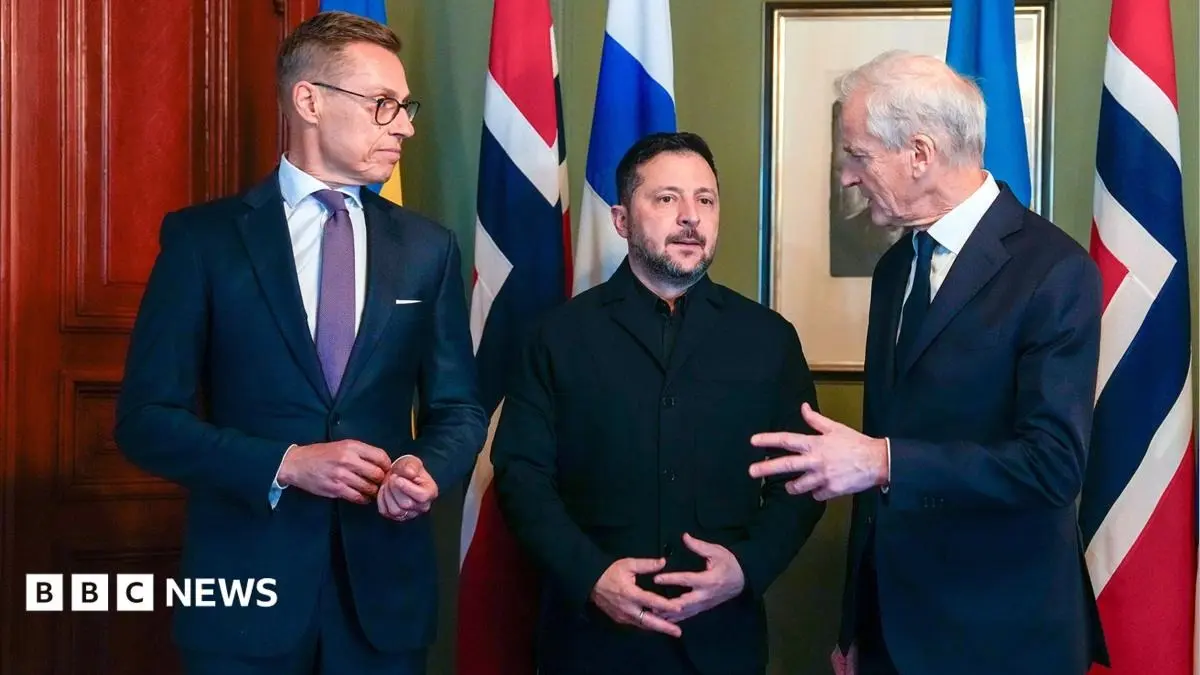
In a move aimed at stabilizing a rapidly deteriorating diplomatic relationship, Ukrainian President Volodymyr Zelensky is scheduled to meet with US Special Envoy Steve Witkoff in Oslo. The meeting, which comes at a pivotal juncture for the Ukrainian war effort, occurs against the backdrop of increasingly strained ties between the Ukrainian leadership and the administration of US President Donald Trump.
The gathering, facilitated by Norwegian Prime Minister Jonas Gahr Støre and Finnish President Alexander Stubb, is viewed as a critical attempt to bridge the deepening chasm between Kyiv and Washington. Prime Minister Støre confirmed that the initiative for the meeting originated with President Zelensky, who sought to convene with US and European allies during what he described as "a critical time for Ukraine."
The diplomatic tension has been exacerbated by growing friction regarding the efficacy and consistency of US support. Recently, Ukrainian military technical adviser Serhii "Flash" Beskrestnov told the BBC that the inconsistency of US intelligence sharing was having a tangible, lethal impact on the battlefield. "This looks very strange," Beskrestnov remarked, noting that the erratic delivery of intelligence warnings often left Ukrainian forces vulnerable. "Sometimes we receive this information before the attack, another time we do not."
These allegations prompted a sharp rebuke from US Secretary of State Marco Rubio, who dismissed the claims as "scandalous" and "outrageous." Speaking while on a diplomatic mission in India, Rubio sought to address concerns regarding the alleged withholding of critical military aid, including Patriot interceptor missiles. While the Secretary of State acknowledged that the delivery of additional Patriot systems might indeed be delayed, he emphatically denied that the US was intentionally depriving Kyiv of the resources necessary to defend its territory.
The fragility of the current relationship is underscored by President Trump’s recent public commentary. The US President has grown increasingly vocal about his dissatisfaction with the current Ukrainian leadership, explicitly stating that it is time for the nation to elect a new president and, more recently, suggesting that it is time "for somebody else to negotiate on behalf of Ukraine."
Ahead of the in-person summit with Witkoff—which will also include the remote participation of Jared Kushner via video link—President Zelensky held preparatory discussions with the Norwegian and Finnish leadership. Prime Minister Støre emphasized that the overarching objective of the Oslo summit is to steer the US-Ukraine relationship toward a "more constructive path." Speaking to reporters at the Norwegian parliament, Støre stressed the collective goal of ensuring that the conflict concludes through diplomatic channels, resulting in a peace that is both lasting and just.
For his part, President Zelensky characterized his recent dialogue with Secretary Rubio as "constructive." The Ukrainian leader highlighted the urgent necessity for robust early-warning systems, advanced missile interceptors, and the continued stability of SpaceX’s Starlink internet network, which has become a vital lifeline for Ukrainian communications. The importance of this infrastructure was underscored last week when a bipartisan group of US senators called for an urgent investigation into recent disruptions to the Starlink network within Ukraine.
As the talks in Oslo proceed, the broader geopolitical landscape remains fraught with uncertainty. According to officials in the Norwegian government, while President Zelensky is expected to participate in a post-talks press conference alongside his Nordic counterparts, Special Envoy Witkoff is not slated to join them. This exclusion has fueled speculation regarding the envoy’s subsequent movements, with reports circulating that he may travel to Russia following his stop in Oslo.
The Kremlin has signaled an openness to such engagement. Dmitry Peskov, the Kremlin spokesman, stated that Russia "greatly appreciates the mediation efforts of the American negotiators" and expressed a hope that a meeting with President Trump’s envoy could be organized in the near future. This potential for direct US-Russia engagement follows a recent telephone conversation between President Vladimir Putin and Donald Trump. In the wake of that call, the White House announced a significant shift in policy: Moscow would immediately supply over 300,000 tons of diesel to the United States and other markets, effectively signaling the end of American sanctions on Russian diesel exports.
The timing of this agreement, which coincided with a meeting in Miami between Witkoff, Kushner, and Ukrainian officials, drew a stinging response from President Zelensky, who described the deal as "a happy birthday present for Putin."
The domestic political climate in the United States is also exerting significant pressure on foreign policy decisions. With US midterm elections approaching next month, the Trump administration has been increasingly vocal about fuel prices, which have climbed to record highs since the onset of the US-led war on Iran. The President has directly blamed Ukraine’s strikes on Russian oil refineries for the inflationary pressure at American gas pumps, creating a clear point of contention between the two nations.
This divergence of interests has caused considerable alarm among European leaders, who fear that a fractured US-Ukraine alliance could jeopardize the entire security architecture of the continent. German Chancellor Friedrich Merz expressed his concern on Monday regarding what he termed "mixed pictures and messages" emanating from Washington. Merz stated that he is actively working to convince the American government that the resolution of the war is a joint responsibility that cannot be shouldered by one party alone.
Chancellor Merz further highlighted the economic burden currently being carried by Europe, noting that the United States has not contributed to the direct defense funding of Ukraine since the start of 2025. "It’s really a big effort for our budgets, it’s really a big thing for the European Union, but we are doing that and we are trying to keep on doing that until this terrible war ends," the German leader told Bloomberg TV.
The shift in the US stance has been articulated most clearly by Vice President JD Vance. In a recent television interview, Vance questioned the fundamental nature of the relationship, stating that while Ukraine is "certainly a partner in some ways," the two nations possess "divergent interests from time to time." Vance specifically cited Ukraine’s attacks on Russian energy infrastructure as a point of disagreement. "We don’t have a formal alliance as far as I know with Ukraine," Vance said. "They’re not in NATO, I don’t think they should be in NATO… we’re gonna work together on some things, but also we’re going to be opposite on some things too."
As the diplomatic delegations gather in Oslo, the primary challenge remains whether these disparate interests can be reconciled. The outcome of these discussions will likely determine not only the future of US military and intelligence support for Kyiv but also the trajectory of the war itself as it enters this complex new phase of international maneuvering. With the weight of European stability, domestic US politics, and the existential survival of the Ukrainian state all hanging in the balance, the meeting in Norway represents a high-stakes attempt to recalibrate a partnership that appears to be drifting toward an uncertain and potentially transformative crossroads.