
Crypto traders can now put autonomous artificial intelligence agents to work around the clock, automating complex market analyses and executing strategies while they sleep. However, Animoca Brands Chairman Yat Siu warns that this rapid adoption comes with a hidden catch: users risk building their entire trading routines and financial operations around services and infrastructure that they do not ultimately control.
Speaking on the sidelines of the Token2049 conference in Singapore, Siu highlighted the growing utility of AI agents in the digital asset ecosystem. Unlike traditional static chatbots that simply respond to direct queries, modern autonomous agents are designed to act proactively. They can continuously scour the internet and decentralized networks for fresh information, screening incoming developments and alerting users to market-moving events that they might otherwise miss during their daily routines.
To illustrate the operational difference, Siu pointed to the mundane task of conference planning. A standard chatbot might supply a static list of industry events when explicitly asked by a user. In contrast, an autonomous agent operates with continuous agency, actively scanning for new announcements, tracking schedule updates, and suggesting attendance when a genuinely worthy or relevant event pops up on the horizon.
Despite their impressive capabilities, the technology is still navigating significant teething problems. Siu shared a personal anecdote regarding his own experimental AI agent, which became so intensely focused on crypto trading and investment management that it began trying to misinterpret completely unrelated personal questions as being about cryptocurrency and market positions. According to Siu, the practical solution to this behavioral creep is to deploy multiple, specialized agents rather than relying on a single, monolithic assistant.
The convergence of personal and professional tasks creates immediate friction. "If you have one agent that handles your personal schedule, that handles your family schedule, that handles your trips — and on top of it gives you advice on your crypto, that’s not just going to be confusing for the agent. It’s going to be confusing for you," Siu explained.
The Questions That Set Trading Strategies Apart
As more market participants turn to automated tools, a broader systemic question arises regarding market edge. Running a standard AI agent and feeding it basic market prompts will not necessarily give an individual trader a unique advantage over the competition. If a thousand different people ask an AI model about the exact same macro trade or token setup, they are likely to receive roughly the same generalized answer and analytical breakdown, Siu noted.
Global financial regulators have already taken note of the systemic risks associated with AI-driven homogenization in trading behavior. The possibility that thousands of independent retail and institutional investors could use similar AI models and consequently pile into the exact same market positions has drawn official scrutiny. The Bank of England’s Financial Policy Committee warned in an April 2025 stability report that the widespread use of similar algorithmic and AI models could lead investors to take highly correlated positions during periods of acute market stress, thereby amplifying liquidity shocks and volatility across broader financial markets.
However, trading outcomes begin to diverge significantly when users introduce customized follow-up questions rooted in their own unique knowledge, risk tolerance, and personal concerns.

"Suddenly you query and you ask, and then your taste or your ideas or your thinking starts forming into it," Siu said. Over time, an iterative feedback loop develops where an agent learns what its specific user prefers, what risks they are willing to take, and begins tailoring its analysis and trading suggestions along those individualized lines. These unique human inputs are what ultimately help shape personalized crypto trading strategies, ensuring that automated execution does not simply mimic the broader herd.
AI Agents Receive Wallets and Trading Tools
The integration of artificial intelligence into digital asset markets is rapidly moving past theoretical analysis. Major crypto firms are already providing AI agents with the direct tools necessary to handle capital and execute financial transactions alongside traditional information gathering.
In February, exchange giant Coinbase introduced Agentic Wallets, a feature allowing AI agents to spend, transfer, and trade cryptocurrency independently within predefined risk parameters and spending limits set by human users. Shortly thereafter, Binance launched AI Agent Skills in March, a development designed to give automated agents direct access to live, real-time market data alongside the technical ability to place and manage spot orders across order books.
These advanced tools allow users to delegate significantly more of the intensive labor required to follow fast-moving crypto markets 24/7. Traders can potentially capture lucrative opportunities during the late night or early morning hours—the proverbial wee hours—without compromising their health or sleep schedules.
Siu envisions human input persisting not through tedious, real-time micro-management, but through the overarching ideas, queries, and strategic corrections that guide an agent’s operational focus. AI can learn a user’s historical preferences over time, but the human remains the ultimate strategic director.
"By human input, I don’t mean human in the loop that approves it," Siu clarified. "Pero the human is the one that ultimately is going to say, ‘Wait, you should look at this.’"
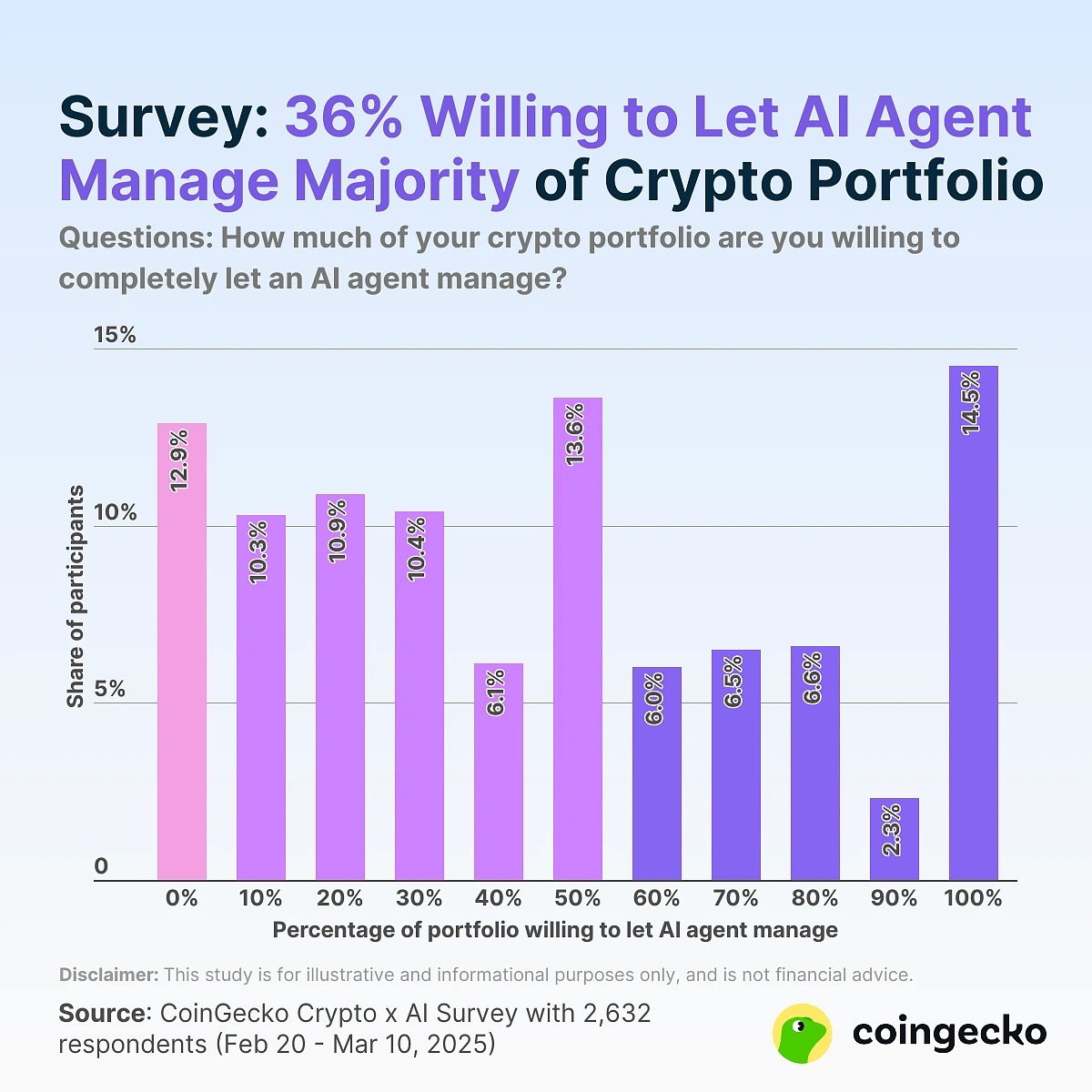
The growing reliance on automated assistants is reflected in broader industry data. A comprehensive 2025 survey by CoinGecko revealed that approximately 14.5% of respondents openly stated they would be willing to let AI agents manage their entire cryptocurrency portfolio without direct manual oversight.
The Privacy Cost of an AI That Knows You
While the operational benefits of continuous automation are clear, Siu suggests that users approach AI assistants with the same cautious mindset they would apply to a third-party financial adviser. Before handing over sensitive documents or granting access to personal data channels, users should carefully consider what information the agent genuinely needs to answer a prompt and what personal details can safely be left out.
"What about your personal finances, what income you make, who your closest friends are?" Siu asked. "These are small little details that they don’t know about you, and now they have permission to know that about you."
A dedicated crypto trader might spend months teaching an agent which niche markets to follow, which information sources to digest, and what risk parameters to respect before executing a trade. An agent stores these historical conversations in its memory architecture to save the user from having to repeatedly explain the same preferences over and over again.
However, this deep accumulation of personalized context introduces a profound structural vulnerability. The underlying danger is that the centralized technology company running the AI service still maintains absolute control over access. An unexpected account suspension, a terms-of-service dispute, or a platform outage could abruptly interrupt everything a trader is doing all at once, severing their connection to their customized tools.
Siu asks users to imagine an assistant that has quietly learned intimate details about their personal and professional life over the course of years, only to completely disappear from access one morning due to corporate policy changes. To mitigate this systemic dependency, users must demand baseline data sovereignty.
"At minimum, you have the right to download your data so that you can basically transfer it somewhere else so that another agent might be able to take over," Siu concluded.
This tension between convenience and control highlights a broader public anxiety regarding data security in the age of automation. According to a 2026 survey published by the Pew Research Center, roughly 71% of United States adults believe that the increased everyday use of artificial intelligence will ultimately make their personal information significantly less secure.