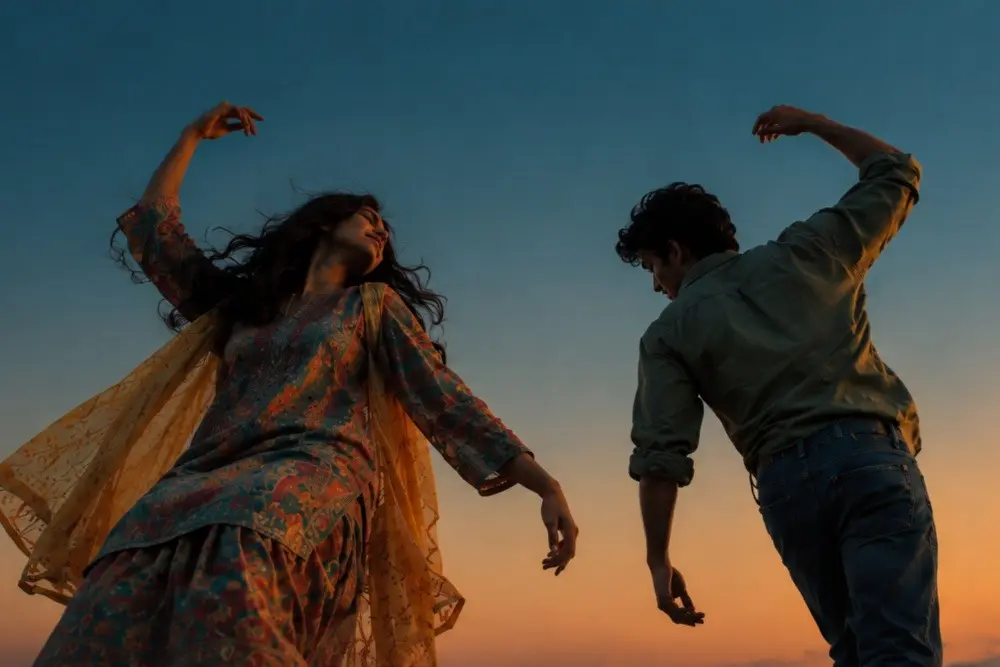
The complex, often painful tug-of-war between the desire to emigrate and the profound pull of one’s ancestral roots serves as the emotional engine of "Dancers," a new coming-of-age drama from writer-director Eshah Shakeel. Set in a Punjab town situated in the shadow of Lahore, the film follows two young protagonists whose lives intersect through a series of secret, clandestine dance lessons. As the film prepares for its high-profile appearance at the Asian Project Market (APM), held during the Busan International Film Festival’s Asian Contents & Film Market, it is already garnering attention for its poignant exploration of the modern Pakistani experience.
The narrative focuses on two distinct journeys. Paras is a young person defined by a singular, burning ambition: to leave Pakistan behind for a future abroad. Conversely, Ramza is navigating a more existential crossroads, struggling to define her own identity while facing the constraints of a childhood-arranged marriage. Their personal struggles are mirrored by the physical transformation of their hometown, where the construction of a new road acts as a metaphor for a community fracturing between those who embrace the promise of modernization and those who view the encroachment of change as an assault on their cultural heritage and traditional way of life.
For Shakeel, the project is deeply personal. The director acknowledges that she began both dancing and acting in secret, defying family prohibitions against such pursuits. This history of secrecy and rebellion has informed the development of her characters. "When they faced their own crossroads, they charted their own paths, which I don’t even necessarily agree with but which make sense for Paras and Ramza," Shakeel explains. "Their lives continue even when the film ends."
The genesis of the project lies in Shakeel’s observations of her own peer group. In recent years, she has witnessed a significant exodus of friends and relatives moving abroad in search of opportunity. Yet, whenever she has considered following suit, she finds herself anchored by the stories she feels compelled to tell. This internal conflict is what she has sought to capture in the screenplay. "It’s a complicated limbo of the necessity of leaving and having an emotional bond with your roots," she says. "I wanted to explore this internal dynamic of Pakistani youth by splitting it into two characters: one who dreams of leaving and the other who feels a pull to home."
Central to the film’s visual language is the act of movement itself. Shakeel, who is trained in contemporary dance, intends to fuse that discipline with traditional Punjabi dance forms. Through this hybrid choreography, the protagonists will be able to express the emotions, desires, and frustrations that they are forced to keep hidden in their daily lives. By externalizing their internal turmoil through dance, the film seeks to transcend the limitations of dialogue, using the body as a vessel for narrative progression.
The development of "Dancers" has been marked by significant professional milestones. The script was honed through Film Independent’s prestigious Global Media Makers program, where it was selected from a competitive pool of 600 applications to be one of just 20 scripts invited to participate. This endorsement provided the project with a robust framework for development, moving it from a raw concept to a polished, industry-ready production.
Producer Haris Khan, who co-founded the Pakistani production company Last Shot alongside Shakeel, notes that the project has reached a critical stage of maturity. The final draft of the script is complete, and the production budget—estimated at approximately $443,000—is now fully locked. Furthermore, the U.K.-based Pink Llama Films has committed to the project’s financing, providing a firm foundation for the upcoming production. With the core crew already in place and the initial round of auditions for the two lead roles concluded, the team is entering the Busan International Film Festival with a clear sense of purpose.
"I would like to think that we are arriving in Busan with genuine momentum along with a team that has really pushed forward," says Khan.
The production team boasts an impressive roster of talent. Joining the project as a producer is Iram Parveen Bilal, a filmmaker whose previous work includes acclaimed titles such as "Josh," "I’ll Meet You There," and "Wakhri." Waseem Mahmood, a veteran of the BBC and co-founder of Pink Llama, serves as executive producer and has been involved with the project since the earliest stages of its development, pre-dating the Film Independent fellowship. The creative team is rounded out by cinematographer Haider Bhatti, sound recordist Ashar Khalid (known for his work on "In Flames"), and stylist and choreographer Gulshan Majeed, whose work on the internationally celebrated "Joyland" brought significant acclaim to the Pakistani independent film scene.
At the Asian Project Market in Busan, the team is aiming to expand their network by seeking new investors, exploring potential co-production opportunities, and engaging with festival programmers and sales agents. Bilal notes that the financial strategy is multifaceted, incorporating a blend of grants, equity, and in-kind support. The goal is to build a collaborative financing structure that brings together both hard and soft money. "Our focus at Busan is to onboard co-producers who can open up not just the production possibilities of the project but also access to new markets for distribution," she explains.
For Last Shot, "Dancers" represents more than just a single film; it is a manifestation of the company’s broader mission. Having previously produced the web series "Dheet Haddi" and the short film "Explicit," both of which were written and directed by Shakeel, the company is committed to curating a slate of stories centered on the experiences of women. "We are not trying to make only one good film; we’re trying to build a company that can consistently put female-centric, socially urgent South Asian stories in front of the world," says Khan.
The reception of recent Pakistani cinema, particularly the international success of films like "Joyland" and "In Flames," has brought an unprecedented level of global scrutiny to the region’s independent film sector. According to Bilal, this has led to increased interest from festival programmers, press, and grant-making bodies. However, she remains pragmatic about the realities of the film industry. "I do not think the conversation with financiers and sales companies has changed," she observes. "They are and always will be inherently risk-averse in their approach. Those who were willing to bet on independent cinema bet on it even when the world wasn’t paying attention to Pakistan."
As the team prepares to present "Dancers" in Busan, the focus remains on the integrity of the story. By grounding their film in the specific, localized tensions of a changing Punjab, Shakeel and her team hope to articulate a universal sentiment: the haunting, beautiful difficulty of choosing between the horizon and the home. For the protagonists of "Dancers," and perhaps for the filmmakers themselves, the dance is only just beginning.