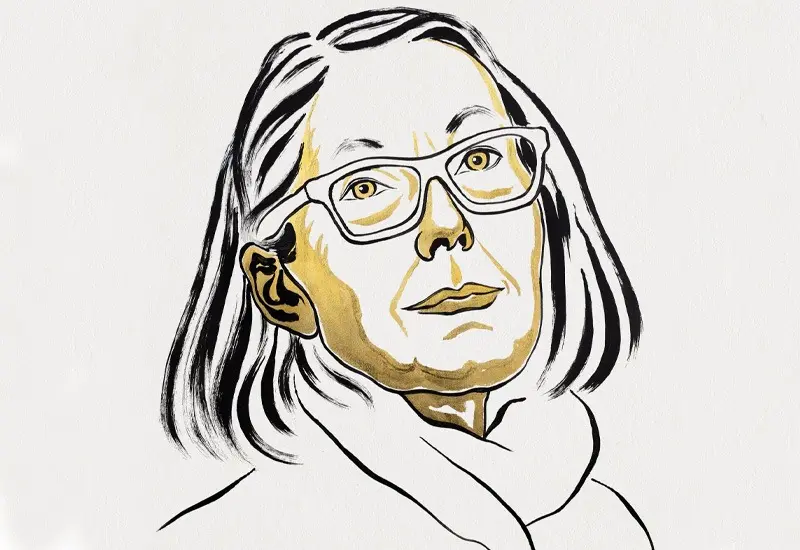
Today, the Swedish Academy announced that the prestigious 2026 Nobel Prize in Literature has been awarded to the celebrated Canadian author, poet, translator, and classicist Anne Carson. According to the official citation, the honor recognizes her "bold and inventive oeuvre that in playful dialogue with the classical tradition has created new forms for contemporary literature."
The announcement marks another monumental milestone for one of the most distinctive and fiercely original voices in modern letters. True to her inimitable character and the quiet, contemplative nature of her life’s work, the news reached Carson while she was traveling in Iceland. When the permanent secretary of the Swedish Academy placed the traditional call to inform her of the win, Carson was reportedly outside, simply listening to the wind—a reaction that literary peers and devoted readers alike have hailed as perfectly characteristic of the reclusive and deeply observant writer.
Trained rigorously as a classicist, Carson has long balanced her academic pursuits with her literary output. In biographical notes, she famously and simply summarizes her professional life with the declaration that she "teaches ancient Greek for a living." That foundational grounding in antiquity has not remained a static academic exercise in her hands; rather, it has served as the fertile soil from which modern, genre-shattering works of poetry, translation, and criticism have grown. Over a decades-long career, she has published a vast and varied array of books that consistently defy easy categorization, blending poetry, essayistic prose, dramatic narrative, and visual art.
Among her most celebrated works is Wrong Norma, published by New Directions in 2024, which earned widespread critical acclaim as a finalist for the National Book Award and went on to capture the National Book Critics Circle Award. Her extensive bibliography with Alfred A. Knopf includes Float from 2016; Red Doc> from 2013; The Beauty of the Husband: A Fictional Essay in 29 Tangos from 2001, which was honored with the prestigious T. S. Eliot Prize for Poetry; and her breakthrough masterpiece, Autobiography of Red, published in 1998.
Beyond her original poetry and essay collections, Carson has made profound contributions to the translation of classical texts, bringing the voices of antiquity into striking, modern focus. Her translation work includes If Not, Winter: Fragments of Sappho, published by Knopf in 2002, which remains a landmark rendering of the archaic Greek lyric poet’s surviving fragments. Her critical acumen is equally evident in foundational long-form essays such as Eros the Bittersweet, published by Princeton University Press in 1986, which explores the dynamics of desire and absence through the lens of ancient Greek literature.
Throughout her career, Carson’s works have been characterized by a distinct blend of playfulness and irony, propelled by a relentless experimental spirit. She is renowned not merely for bending literary genres, but for actively bending the physical and visual form of books themselves. A prime example of this radical approach to publishing is Nox, released by New Directions in 2010. Conceived as a deeply personal monument, Nox is housed inside a box and consists of a single, long sheet of paper folded accordion-style. It serves as an intricate, mournful, and visually striking elegy dedicated to her estranged brother following his death, combining photography, collage, translation, and handwritten notes.
For readers seeking an entry point into Carson’s formidable and expansive body of work, literary critics frequently recommend beginning with her novel in verse, Autobiography of Red. Initially published in 1998, the book reimagines the surviving fragments of a lost poem by Stesichorus about the monster Geryon and his defeat by Herakles, transposing the mythological figures into a contemporary setting. Far from being a dry academic exercise, the work is celebrated for its narrative drive, profound emotional resonance, and an unexpected, wry sense of humor that catches many first-time readers by surprise.
The Swedish Academy’s decision to award the 2026 Nobel Prize in Literature to Anne Carson cements her legacy as a towering figure who has permanently expanded the boundaries of how literature can be constructed, experienced, and understood. By breathing new life into the classical tradition and continuously inventing fresh forms for contemporary writing, Carson stands as a truly singular voice on the global literary stage.