A bipartisan group of lawmakers is issuing a stark warning that badly needed home repairs are blocking housing from reaching the families who need it most, revealing a hidden crisis running parallel to the nation’s broader real estate crunch.
In a Sept. 30 letter urging the Department of Housing and Urban Development to fully implement a new federal home-repair program, Sens. John Fetterman, a Democrat from Pennsylvania, and Cynthia Lummis, a Republican from Wyoming, alongside Rep. Nikema Williams, a Democrat from Georgia, pointed directly to seniors who might otherwise downsize but simply cannot afford to update their aging homes before putting them on the market.
"This is an issue that disproportionately affects America’s seniors, many of whom would like to downsize but do not want to sell the home at a steep discount due to the updates required," the lawmakers wrote to HUD officials.
While the lawmakers’ focus highlights the immediate hurdles faced by older Americans looking to transition out of larger properties, their warning points to a much larger systemic supply problem facing the entire country. The United States is already losing an estimated 350,000 to 400,000 housing units every year to deterioration, demolition, and severe weather, according to data from the Center for Community Progress.
If housing losses continue at roughly that pace over the next decade, between 3.5 million and 4 million units will completely disappear from the market. That staggering figure is nearly as many homes as the country is currently estimated to be short overall.
This dynamic creates a dangerous second front in America’s ongoing housing affordability crunch. At the very same time the nation desperately needs to build millions of new homes to keep up with demand, it also faces the immense challenge of preserving the housing stock it already has.
And a coming generational shift threatens to raise the stakes even higher. An estimated 13.9 million homes currently occupied by baby boomers and the Silent Generation will leave older owner-occupancy through 2036, according to the Generational Housing Succession report from Realtor.com.
Whether that massive handoff helps ease the crippling inventory shortage will depend heavily on the physical condition those homes are in when the next household attempts to move in.
Homes Survive Because Someone Keeps Investing in Them
Residential properties rarely become unusable all at once. Instead, critical components such as roofs, plumbing networks, electrical systems, and foundations gradually deteriorate over time until keeping a property habitable requires more money than an owner can—or is simply willing to—spend. Eventually, properties that reach this tipping point are abandoned, heavily stripped, demolished, or otherwise removed from the active housing stock entirely.
Researchers at the Urban Institute estimate that about 0.21% of one- to four-family homes become obsolete each year. That obsolescence rate ticks up to roughly 0.25% among older homes built before the year 2000.
Those rates have remained relatively low, in part, because property owners continually pour money back into the real estate they already inhabit. Homeowners across the country spent about $825 billion on home improvements from 2021 through 2023, according to Urban Institute calculations, which amounts to roughly 1% of the total aggregate value of owner-occupied residential real estate each year.
However, as homes age, a much larger share of that financial investment goes entirely toward basic upkeep and keeping them functional rather than upgrading finishes or expanding square footage. Maintenance and replacement projects accounted for 61% of all remodeling and repair spending on homes built before 1960 in 2023, according to research from Harvard University’s Joint Center for Housing Studies.
Existing housing is not a permanent, self-sustaining reservoir of supply. Keeping those units viable requires a steady, continuous stream of private and public investment. Yet the financial opportunity to make those crucial investments is not shared equally among all homeowners.
‘We Are Fixing the Wrong House’
The financial divide in home maintenance is stark. Among owners of homes built before 1960, households in the highest income quintile spent an average of $12,700 on improvements and repairs in 2023, according to Harvard’s research. Meanwhile, households in the lowest income quintile spent an average of just $3,400 during the same period.
This investment gap is deeply problematic because lower-income households depend much more heavily on older, more affordable housing stock. About 1 in 4 American homeowners lived in a home built before 1960 in 2023. Among homeowners in the lowest income bracket, that share spiked to 29%.
"Because older homes tend to have lower values, they make up a disproportionate share of the housing options available to lower-income households," writes Sophia Wedeen, a research associate at Harvard.
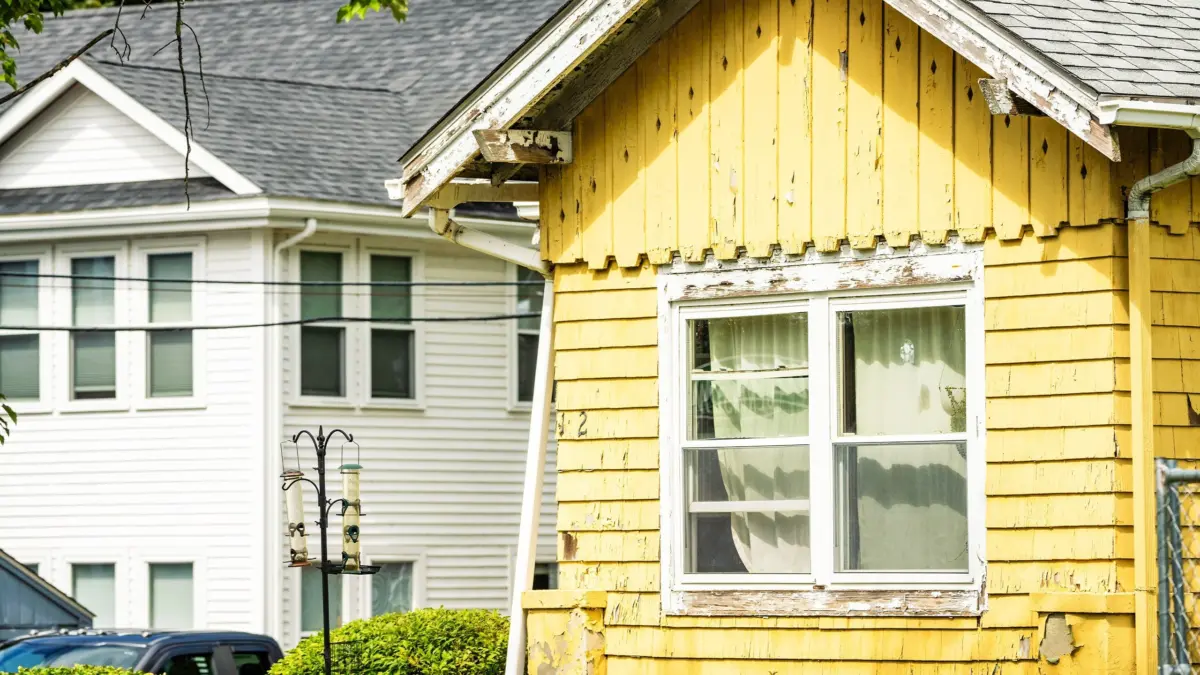
The physical condition of these properties directly reflects the widening investment gap. More than 22% of owner-occupied homes built before 1960 suffered from at least one major structural deficiency in 2023, which is more than twice the deficiency rate recorded among homes built since the year 2000.
Across the entire occupied U.S. housing stock, the Federal Reserve Bank of Philadelphia estimates that eliminating outstanding repair deficiencies would carry a staggering price tag of $198.4 billion. Lower-income households account for a disproportionately large share of that urgent need.
These accumulating structural deficiencies are arriving precisely at a time when cheaper homes have become exceptionally difficult to find. The number of homes listed for sale that were genuinely affordable to households earning $75,000 or less was 60% lower in March 2026 than it was in March 2019, according to data compiled by Harvard.
"We are fixing the wrong house," Harvard researchers write in a recent working paper. "The costs of inaction, spread across millions of households, represent an enormous and largely invisible drain on household finances, community wealth, and national health trajectories."
Losing a Cheaper Home Can Be Harder to Undo
The compounding crisis of deteriorating affordable housing is precisely what federal lawmakers are now hoping to address through legislative action.
The 21st Century Road to Housing Act, which was signed into law in July, authorized a federal pilot program running through 2031 to distribute funding for essential home repairs to eligible owner-occupants and landlords. In their recent letter backing the initiative, Fetterman, Lummis, and Williams emphasized that almost 7 million Americans currently live in homes that are in desperate need of significant repairs.
The stakes for the housing market are arguably highest at the lowest-cost end of the spectrum, where losses are felt most acutely.
Data from the Department of Housing and Urban Development tracking the same rental units from 2015 to 2017 found that rental units priced below $500 a month were roughly four times as likely to be permanently lost from the housing stock compared to units renting for $1,500 or more a month.
While those specific figures cover the rental market rather than owner-occupied single-family homes, they illustrate a broader principle: housing losses disproportionately strip away the affordable options serving households who have the fewest alternative places to go.
Furthermore, once a lower-cost home evaporates from the market due to neglect or abandonment, simply building brand-new units does not necessarily replace what was lost. The share of active residential home listings priced below $200,000 fell precipitously from 39% in 2016 to just 13% by 2025, according to the Urban Institute.
Real estate researchers note that soaring land, labor, construction, and financing costs have made it economically unfeasible for residential builders to profitably produce smaller, less-expensive entry-level homes. Homes priced below $300,000 accounted for a mere 23% of all new-home sales in June 2026, according to the National Association of Home Builders, which noted that reaching that modest price point requires exceptionally low development and construction costs.
This reality highlights one of the fundamental limitations of measuring the national housing shortage as a single, monolithic number. If the homes the country loses to deterioration are predominantly lower-priced units, building enough new homes to hit headline targets may still leave prospective buyers and renters desperately short on affordable options.