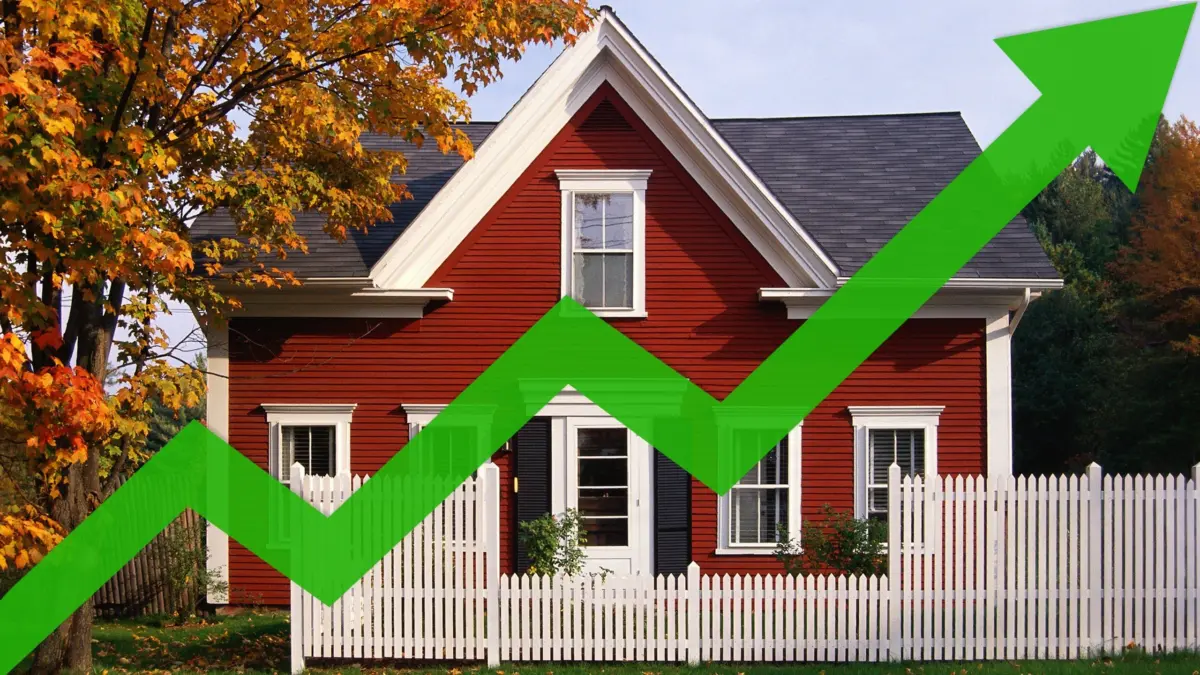
Mortgage rates continued their sharp and relentless climb this week, pushing borrowing costs even higher and further tightening housing affordability for prospective fall home shoppers across the United States. According to the latest data released by Freddie Mac, the average rate on the popular 30-year fixed home loan reached 7.40% for the week ending Oct. 8. This represents a notable 12-basis-point jump from the previous week’s average of 7.28%, signaling ongoing turbulence in the broader financial markets and mortgage sector.
This latest upward movement marks another substantial increase in the cost of borrowing, adding immediate financial pressure to individuals and families attempting to navigate the autumn housing market. To fully understand the broader context of this ongoing trend, market observers need only look back a year: during the exact same period in 2025, 30-year fixed mortgage rates hovered at a significantly more manageable average of 6.30%. The stark year-over-year difference highlights just how much macroeconomic shifts and Federal Reserve policy adjustments have fundamentally altered the financial landscape for everyday American consumers.
So what does this sustained rate environment actually mean for the average homebuyer trying to secure a property in today’s challenging market? By examining the math through the official Realtor.com mortgage calculator, financial analysts can break down exactly how these elevated rates translate into real-world monthly expenditures for a typical household. For the purposes of these standard financial calculations, all examples assume a traditional 30-year fixed-rate mortgage and account exclusively for principal and interest payments. These figures deliberately exclude additional homeownership expenses such as local property taxes, hazard or homeowners insurance, and private mortgage insurance, which vary significantly by geographic location.
Monthly mortgage payment today with a 20% down payment
For a prospective homebuyer eyeing the current median single-family house price in the United States, which currently sits at $430,000, coming up with a substantial 20% down payment results in a starting loan amount of $344,000.
At today’s prevailing 7.40% interest rate, the resulting monthly principal and interest payment comes out to approximately $2,382. This figure reflects an immediate $28 monthly increase from the previous week’s baseline payment of $2,354, illustrating how quickly even minor weekly basis-point bumps can erode a buyer’s monthly purchasing power.
The contrast becomes even more striking when viewed against the backdrop of last year’s housing market. Compared to the 6.30% average recorded during October 2025—which required a monthly payment of $2,129 for a home at the exact same $430,000 price point—today’s buyers are forced to absorb an extra $253 every single month just to finance the same property. Over the course of a single year, that translates to thousands of dollars in added housing expenses that directly compete with other household essentials and savings goals.
Monthly mortgage payment today with a 3.5% down payment
The financial strain is not isolated to conventional buyers with large down payments; monthly costs have also risen markedly for entry-level and repeat buyers utilizing Federal Housing Administration, or FHA, loans that allow for a lower down payment of just 3.5%.
On a median-priced home valued at $430,000, an FHA borrower utilizing the minimum down payment requirement would need to finance roughly $414,950 after accounting for upfront mortgage insurance considerations and the smaller initial cash investment.
At today’s average 7.40% mortgage rate, the monthly principal and interest payment for an FHA borrower comes to approximately $2,873. This represents a $34 increase from the previous week’s monthly cost of $2,839, compounding the weekly financial pressure on lower- and middle-income families striving to achieve homeownership.
When measured against the more favorable lending environment of October 2025, where the average 6.30% rate yielded a monthly payment of $2,568 for that same loan amount, today’s FHA borrowers are paying an extra $305 in interest charges every month. Over the course of twelve months, that amounts to an additional $3,660 flowing purely toward financing costs rather than building localized wealth or property equity.
Despite this heavy burden, a historical look at the broader interest rate cycle provides a modicum of perspective. When looking back at the severe market peak in October 2023, when 30-year fixed rates briefly surged to 7.79% and drove the monthly payment for a median-priced home to $2,984, today’s monthly payment still offers $111 in relative relief for consumers who might otherwise fear we have returned to the absolute worst of the recent rate cycle.
Long-term savings over 30 decades
While the immediate monthly sting is often the first thing buyers notice, the long-term financial picture illustrates how this continued upward movement dramatically expands total lifetime borrowing costs over the full course of a 30-year repayment term.
A traditional homebuyer who puts down 20% and secures a mortgage at today’s 7.40% rate will ultimately pay a staggering total of $857,443 exclusively in principal and interest over the life of the mortgage. This means the total cost of acquiring the home far exceeds the original purchase price due to the compounding weight of high interest charges.
While recent rate hikes have significantly eaten into long-term household savings and strained family budgets, this total remains distinct from the historical peaks of late 2023. During the October 2023 peak of 7.79%, the cumulative lifetime cost for that same $344,000 loan would have reached an even higher $890,630. By managing to secure a mortgage at today’s slightly lower rate rather than locking in at that severe market peak, a disciplined homebuyer effectively avoids $33,187 in cumulative interest charges over the 30-year life of the loan.
FHA borrowers navigating the current market see a strikingly similar trajectory when examining long-term figures. Financing the current median-priced home at today’s 7.40% rate results in a lifetime payment of $1,034,291 for principal and interest combined. If that exact same FHA loan had instead been locked in at the 7.79% rate peak observed in late 2023, the total lifetime cost would have climbed to $1,074,323. This difference represents a total long-term savings of $40,032 for FHA buyers compared to the absolute worst-case scenario of two years prior, offering a small silver lining for lower-down-payment consumers who remain determined to buy a home despite prevailing macroeconomic headwinds.