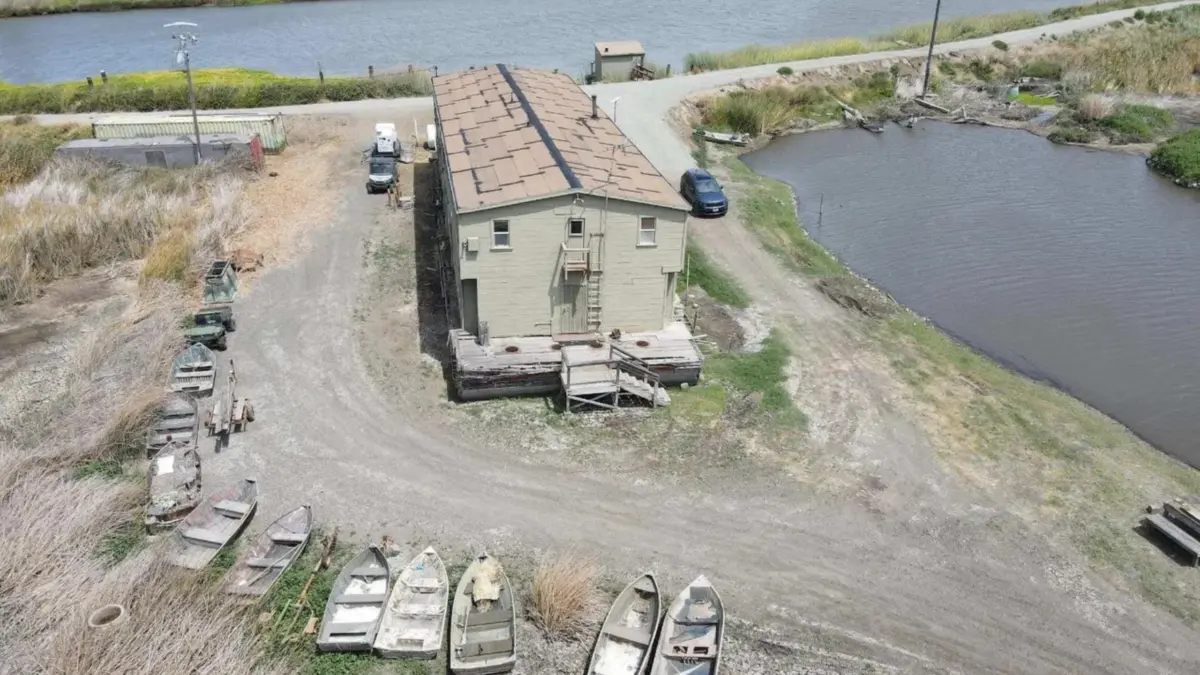
A sprawling 400-acre marsh property in Northern California that has served as a haven for waterfowl hunters for more than a century has officially hit the real estate market with an asking price of $1.5 million.
The offering, known as the Concord Farms Duck Club, is situated in Suisun City, California, on Van Sickle Island on the southern edge of the ecologically rich Grizzly Island Wildlife Area. Located roughly an hour and a half from San Francisco and about 19 miles from Suisun City proper, the property offers a rare combination of vast wilderness, rich local history, and a traditional sporting lifestyle that has endured for generations.
At the heart of the marshland estate is a unique, historic clubhouse featuring 16 bedrooms and three bathrooms. According to John Ward, the listing agent with California Outdoor Properties, the property’s roots run deep within the local hunting community, which has utilized the tidal marshes and waterways of the region for well over a hundred years.
"It’s just a place where these guys can go out and shoot ducks. It’s been going on for like 100 years plus," Ward explains.
The traditional routine at the club involves members taking small boats out into the marshland to reach secluded duck blinds where they wait for migrating waterfowl. "You have your duck call and your shotgun, and you start blowing your whistle or your duck call, and hopefully some birds come in," Ward says.
The Suisun Marsh area is home to approximately 160 distinct duck clubs, many of which share a similar century-old heritage. Membership in these clubs has traditionally been passed down or shared among dedicated enthusiasts of the sport. However, shifting demographics are beginning to reshape the landscape of these historic institutions.
"There’s just kind of a changing of the guard a little bit now with some of the older guys just getting older," Ward notes, describing the decision process that led to the current listing. "With this particular club, the members took a vote and decided whether they were going to make an effort to try to get new blood into the club, or if they were all kind of ready to hand the torch to the next group. So, they just decided to sell the property."
The clubhouse itself is a structure steeped in regional history. Rather than a conventionally built rural home, the primary building is constructed from an old barge repurposed a century ago.
"It’s basically an old barge. They had crews that came in 100 years ago to help build the levees and do a lot of the work out there," Ward explains. "So some of these barges turned into duck club houses because they built the levees around them. The men back 100 years ago used those barges for their quarters to sleep at night."
Today, that same historical barge-turned-clubhouse serves as the primary gathering space where hunters return after a successful morning in the field—typically after reaching their legal limit of seven ducks per hunter.
"They’ll take their boat back to the club and then make a breakfast or a brunch or whatever, and then usually the guys just kind of hang out in the club, and watch college football, watch the NFL, or whatever they want to watch, and it’s usually just kind of a hang out place," Ward says.
The interior of the building features a basic kitchen and rustic, utilitarian gathering spaces designed strictly for practicality rather than luxury.
"There’s nothing super special. There’s just a bed and some hooks and stuff and a small closet to hang up your jackets and your hunting gear," he notes. "They’re just pretty basic. There’s nothing glamorous."
While the clubhouse could benefit from some routine care and deferred maintenance, future buyers face strict limitations regarding what can be altered on the exterior or the surrounding land. The marsh property is heavily protected under existing environmental regulations and is situated within a conservation easement.
"The marsh is protected and it’s definitely in a conservation easement. You can build right where that clubhouse is. You could totally redo the house, but you have to keep that footprint of the house," Ward explains, adding that all of the historical duck clubs in the area are grandfathered into current zoning and environmental regulations.
Because of its prime location within the Grizzly Island Wildlife Area—a celebrated wetland ecosystem known for supporting big and small game, numerous bird species, fishing, and hiking opportunities—Ward points out that the potential buyer pool extends well beyond traditional waterfowl hunters.
"There could just be somebody that wants to buy it and is a bird watcher. You don’t have to be a duck hunter," Ward says. "You can do whatever you want. You could buy and have the intention of bird watching and fishing, or to ride your ATVs and your quads around. But this particular property has been used for 100 years as a duck club."
Given real estate valuations in nearby metropolitan centers, Ward believes the $1.5 million price tag represents a distinct value proposition for buyers seeking wide-open spaces within a reasonable driving distance from the San Francisco Bay Area.
"$-1.5 million in San Francisco gets you a condo. $1.5 million out here gets you 400 acres with 16 bedrooms and lots of elbow room and a place to exhale," he says. "[The buyer] could be an individual or it could be just a group of guys. It could be four or five guys that like to shoot, and they buy it and have the opportunity to sell a couple more memberships or something like that."
Beyond recreational use, Ward emphasizes the broader ecological significance that private duck clubs have historically played in preserving the integrity of the Suisun Marsh. Addressing critics of hunting, he argues that the private sporting community has been instrumental in safeguarding the wetlands from commercial and residential encroachment.
"Private duck clubs have been an integral part of the Suisun Marsh, helping preserve its open space and character and protect thousands of acres of wetlands from development," he explains. "What the anti-hunter community doesn’t realize is that the reason the marsh is still there and natural and doesn’t have a city over it is because of the duck hunters. The hunting community saved the marsh from being developed."