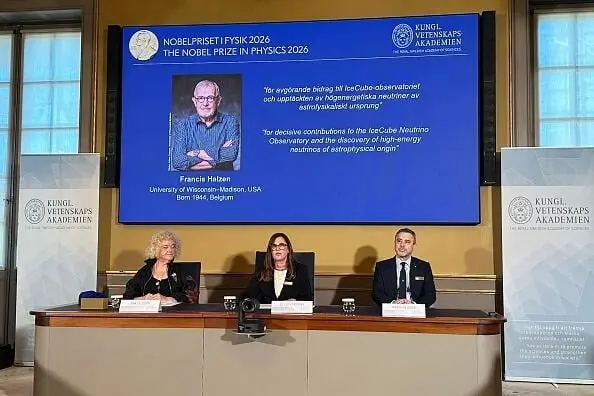
Francis Halzen, a Belgium-born physicist at the University of Wisconsin-Madison, has been awarded the Nobel Prize in Physics for his visionary work utilizing vast sheets of glacial ice at the South Pole to capture elusive subatomic particles known as neutrinos. As the driving force behind the establishment and realization of the IceCube Neutrino Observatory, Halzen has fundamentally transformed humanity’s capacity to observe the cosmos. The massive telescope buried deep within the Antarctic ice has enabled researchers around the globe to explore the origins and behaviors of some of the most mysterious and energetic particles traveling from the far reaches of outer space.
Halzen, who serves as the Vilas Research Professor and the Gregory Breit Professor at the University of Wisconsin-Madison, often describes his professional identity with characteristic modesty as "a theoretician studying problems at the interface of particle physics, astrophysics, and cosmology." Despite his theoretical foundations, his career has been defined by a monumental, decades-long experimental endeavor. He has been working relentlessly on the IceCube project since 1987, a commitment that has required him to routinely travel to the harsh, remote environment of the South Pole, enduring the slightly milder conditions of the Antarctic summer months between November and February to advance the construction and operation of the observatory.
The prestigious Nobel Prize, which comes with a monetary award of roughly $1.2 million, was formally bestowed upon Halzen "for decisive contributions to the IceCube Neutrino Observatory and the discovery of high-energy neutrinos of astrophysical origin." This recognition marks a watershed moment not only for Halzen and his home institution but for the broader international scientific community, validating decades of painstaking research, engineering innovation, and theoretical perseverance in one of the most hostile environments on Earth.
The impact of Halzen’s scientific leadership was highlighted by the leadership of the prize committees. Mark Pearce, chair of the Nobel Committee for Physics, commended the physicist for his unprecedented contributions to the field. "Francis Halzen has led an international team of researchers and engineers who have provided us with a fantastic instrument. His tenacity and scientific vision have paved the way for a new kind of astronomy," Pearce said. This new domain, known as neutrino astronomy, allows scientists to look past traditional electromagnetic radiation—such as visible light, radio waves, and X-rays—to observe the universe through particles that pass uninterrupted through stars, planets, and galaxies.
The journey toward this monumental achievement spans nearly four decades of dedication. When Halzen first conceived of using natural ice formations as a particle detector, the scientific community faced immense technical and logistical hurdles. Neutrinos are notoriously difficult to detect because they possess virtually no mass and carry no electrical charge, allowing them to traverse the universe interacting rarely with ordinary matter. To catch even a fraction of these ghostly messengers, scientists needed a massive detector volume. By repurposing the ultra-clear, ancient ice beneath the Amundsen-Scott South Pole Station, Halzen and his collaborators found a way to turn a cubic kilometer of glacier into a sprawling particle detector.
The resulting IceCube Neutrino Observatory operates by melting holes deep into the ice using high-pressure hot water drills, then lowering strings of thousands of digital optical modules down into the boreholes. When a high-energy neutrino occasionally collides with an atomic nucleus within the ice, it produces a faint flash of blue light known as Cherenkov radiation. The sensors embedded in the ice capture these faint light signatures, allowing scientists to reconstruct the trajectory and energy of the incoming particle with remarkable precision. This intricate network transforms the polar ice cap into a massive, vigilant eye pointed toward the cosmos.
Throughout the decades-long development of the project, Halzen maintained a steadfast presence, balancing his theoretical work in Madison with hands-on involvement in the Antarctic deployments. The collaborative nature of the project grew over the years, eventually encompassing hundreds of physicists, engineers, and technicians from institutions around the world, all coordinated through the vision that Halzen championed from its earliest conceptual stages.
The realization of neutrino astronomy has opened entirely new windows onto cosmic phenomena that remain hidden from conventional telescopes. Because neutrinos are not deflected by interstellar magnetic fields and are rarely absorbed by cosmic dust, they point directly back to their violent sources, such as active galactic nuclei, gamma-ray bursts, and other cataclysmic events in the distant universe. The data gathered by the IceCube Observatory has already led to landmark discoveries, including the identification of high-energy cosmic neutrino sources outside our solar system, fundamentally altering our comprehension of cosmic accelerators.
For the University of Wisconsin-Madison and the international physics community, the award serves as a profound validation of long-term scientific investment and collaborative exploration. As researchers continue to analyze the streams of data flowing continuously from the South Pole, the foundations laid by Francis Halzen ensure that neutrino astronomy will remain at the forefront of astrophysical discovery for generations to come.