For most students at Polk County High School—situated in a rural county hugging Tennessee’s border with Georgia—the idea of attending a four-year university feels like a distant dream. Principal Rachel Lowe notes that her students rarely picture themselves on a traditional university campus. For years, the school’s leadership has spearheaded a multiyear campaign to expand horizons, working hard to help students understand their postsecondary options, including educating them about the Tennessee Promise, the state’s pioneering free community college program.
Yet, for many rural students and their families, a four-year degree remains synonymous with unaffordability. This perception is especially strong regarding the state’s flagship institution, the University of Tennessee at Knoxville. Even Lowe admitted she once believed the university was not the most financially responsible choice for local families.
That perspective shifted dramatically when University of Tennessee system president Randy Boyd visited the 400-student high school. Boyd has maintained a tradition of touring high schools across Tennessee at the start of every academic year since taking the helm at UT eight years ago. However, his tour across the final two weeks of September marked a significant departure from previous years: it was the first time his annual tour focused exclusively on rural schools.
"While we have some great programs that make college affordable, and we have great reasons why you should go to college, the message just isn’t getting to the students in rural communities," Boyd said in an interview with Inside Higher Ed.
Boyd pointed to entrenched cultural barriers that have persisted for generations. "Unfortunately, you have a culture that believes that people in this particular community aren’t supposed to go to college. We’ve actually, literally had superintendents of different districts in the past say, ‘Oh, in our district, people don’t go to college. That’s not what we do.’ And so we had to help them change the mindset by having this outreach."
This grassroots approach aligns with a broader national trend. Colleges and universities across the United States are increasingly engaging with students from rural communities, which higher education experts say have historically suffered from deep underrepresentation in traditional college recruitment and enrollment pipelines. According to the National Student Clearinghouse’s most recent High School Benchmarks report, just 53 percent of rural students transition directly to college right after graduating from high school. Ironically, this disparity persists even though rural students graduate from high school at higher rates than their urban and suburban peers.
Historically, higher education recruitment strategies have heavily favored urban areas. Colleges send the vast majority of their admissions officers and recruiters to major metropolitan centers, largely because it represents a more efficient use of limited staff and institutional resources. A single recruiter embedded in a major city can reach thousands more students in a fraction of the time than one traveling across vast rural expanses.
That calculus, however, is gradually changing. In 2023, a collaborative coalition of selective private and public colleges—known as the Small Town and Rural Students College Network—joined forces to make a formal commitment to visiting and actively recruiting from rural high schools. That network has since grown to include 32 participating institutions.
Intensified outreach to rural students addresses two pressing challenges facing American higher education simultaneously: equitable college access and nationwide enrollment declines. Rural students frequently do not see higher education as a viable path for themselves, viewing it as prohibitively expensive or worrying they will struggle to fit into an unfamiliar campus culture—misconceptions that colleges are now actively trying to dispel. Concurrently, as institutions across the United States contend with a shrinking pipeline of high school graduates, expanding recruitment into rural sectors offers a strategic opportunity to offset those demographic declines. Tennessee stands out as an exception among states, projected to avoid a major drop-off in high schoolers, but universities are nonetheless racing to secure talent from every corner.

Meeting Students Where They Are
Research highlights the profound impact that physical proximity and direct campus engagement can have on rural students. Elise Swanson, director of research initiatives for college and career success at Harvard University’s Center for Education Policy Research, emphasizes the value of intentional outreach.
"There are strong theoretical considerations for why these visits would be helpful for students in terms of developing a sense of belonging on campus, just sort of understanding how the campus works, building up some specific knowledge of what they need to do [to get there] and just a better sense of their own self-advocacy for being able to be successful in those spaces," Swanson explained. "There’s some empirical evidence to support that."
While formal research tracking the specific outcomes of college recruiters visiting rural high schools remains limited—and empirical data on visits from top system administrators like Boyd is virtually nonexistent—Swanson believes these high-level appearances send a powerful, unmistakable message. At the very least, they signal to rural students that their presence and potential are genuinely desired on major university campuses.
For Principal Lowe, Boyd’s personal visit to Polk County High School carried far more weight than a traditional field trip to the UT Knoxville campus ever could. Logistical hurdles often restrict campus tours to a small cohort of 30 or 40 students, and trips must adhere to strict schedules to ensure buses return in time for afternoon dismissal. When Boyd visited Polk County, however, the university achieved something remarkable: it reached the school’s entire 400-student body in the span of a single afternoon.
"[Boyd] was like, ‘Just keep that in mind, as you’re evaluating your list: I came here to personally invite you to attend one of our UT schools,’ and that was really neat," Lowe recalled. "He was very personable with the students, and his message was very much on point for our students and the needs of our students."
Other higher education leaders echo the sentiment that direct, localized engagement is essential for sparking interest in higher learning. For community colleges, visiting local high schools has long been a foundational recruitment strategy. These two-year institutions traditionally enjoy higher favorability among rural students, a trend validated by the High School Benchmarks reports. While the share of rural high school graduates enrolling in four-year colleges lags behind urban and suburban peers by 5.6 and 10.9 percentage points respectively, rural enrollment rates in community colleges match urban counterparts and slightly edge out suburban graduates.
The Louisiana Community & Technical College System, a sprawling network encompassing 65 two-year campuses, participates in more than 120 events at state high schools—the vast majority of which are rural—over the course of a single recruitment cycle. These visits are carefully customized so that local teenagers can learn specifically about whichever LCTC campus sits closest to their hometown.
Queena Grant, executive director of strategic enrollment management for the system, noted that LCTC is sometimes the solitary higher education institution to visit a given rural high school. The core message delivered to those students is that a community college education is a robust, valuable pathway, never a consolation prize.
"Louisiana State University is king here, right? And everybody wants their kid to go to LSU. However, reality is everyone may not be able to meet the requirements for LSU," Grant said. "Our colleges do a very good job of explaining in the recruitment process that… you’re not choosing the consolation prize."

Effective Outreach
Beyond standard high school visits, institutions are pioneering innovative methods to connect with rural youth. The admissions office at North Dakota State University recently forged a strategic partnership with the state’s 4-H program, administered by NDSU Extension. This initiative integrates college and career readiness programming directly into local 4-H clubs and after-school activities, according to NDSU President Marshall Stewart.
Stewart emphasized that embedding higher education into the fabric of students’ everyday lives is critical in a predominantly rural state like North Dakota, where physical isolation can make traveling to a campus or connecting with a broader college community uniquely challenging.
However, Stewart cautioned that simply showing up in a rural community is insufficient.
"Outreach must be relevant. Students want to understand how education connects to their goals. Programs are most effective when they help students see a clear connection between what they are learning today and the opportunities available to them tomorrow," Stewart wrote. "Effective rural outreach starts with listening. Communities want partnerships, not transactions. Students and families are far more likely to engage when universities demonstrate a long-term commitment to their schools and communities and take the time to understand local needs and priorities."
Throughout Boyd’s rural tour across Tennessee, affordability remained the central pillar of his presentations. He noted that a primary objective was reassuring rural students that they are not required to relocate to major urban hubs like Knoxville or Chattanooga to access a UT education; instead, they can pursue degrees at regional campuses situated closer to their hometowns if paying for room and board at a flagship campus proves prohibitive.
For Principal Lowe, one of the most eye-opening disclosures was a specific data point shared by Boyd: fewer than 50 percent of University of Tennessee graduates leave higher education burdened by student debt.
"That’s a huge number. That they’re committed to finding ways to financially provide a way for students to come to one of the UT schools—that’s huge," Lowe said.
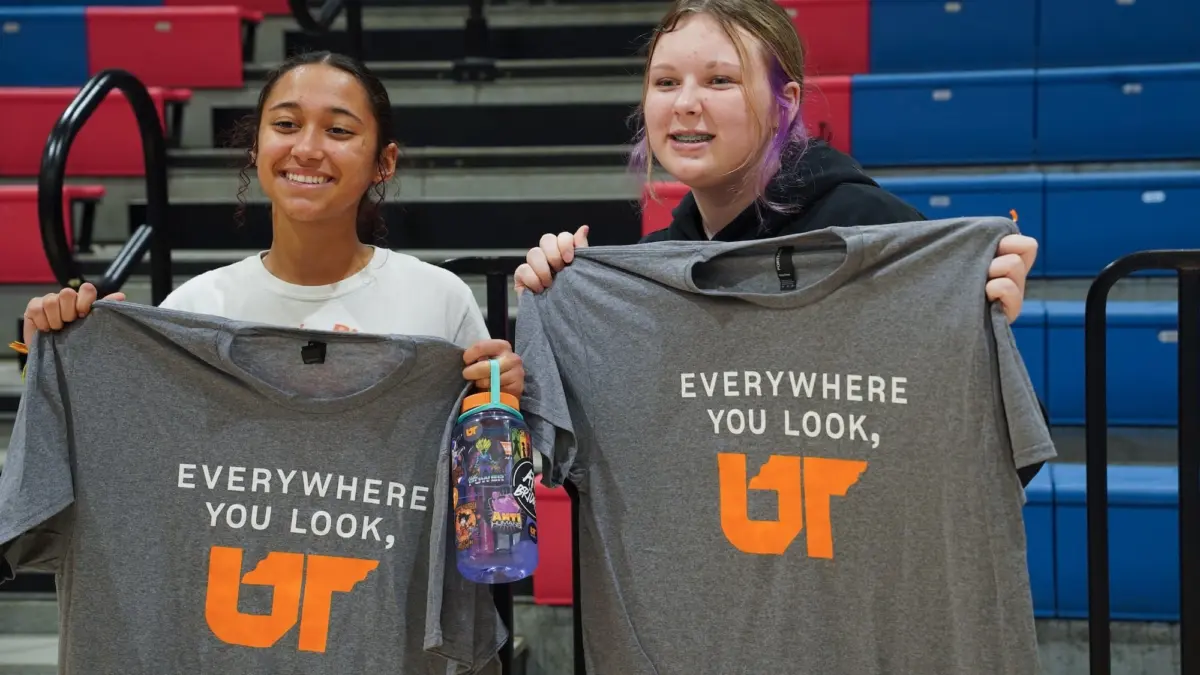
Boyd’s high-energy visits functioned similarly to pep rallies. They featured local alumni who had successfully transitioned from Polk County or neighboring high schools to a UT institution, alongside the chancellor representing the UT campus geographically closest to the school. True to form, the visits concluded with distribution of university apparel—including gray shirts emblazoned with the slogan "everywhere you look, UT"—which Lowe noted some students proudly slipped on before the final school bell even rang.