In the high-stakes world of automotive promotion and endurance racing, few figures loom as large or as uniquely as Mickey Thompson. Part speed demon, part hot rodder, professional racer, astute salesman, tireless promoter, and serial entrepreneur, Thompson was a man built from entirely different stuff. His vibrant personality and relentless drive earned him widespread respect across the industry, including a close, influential relationship with Detroit legend Bunkie Knudsen. When Knudsen assumed the presidency of the Ford Motor Company in 1968, that powerful alliance quickly opened doors for ambitious factory-backed projects.
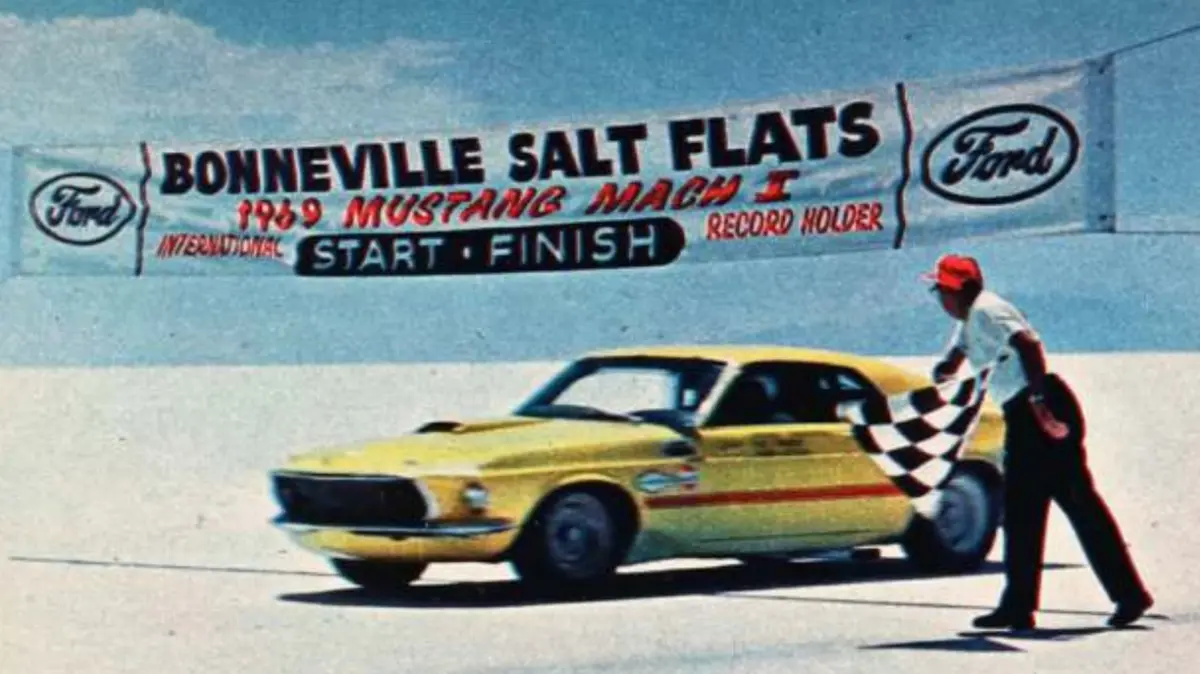
Ford was preparing to launch its heavily redesigned Mustang for the 1969 model year and needed a marketing splash that would resonate far beyond the showroom floor. To cement the car’s performance credentials on a global scale, the manufacturer turned to Thompson, tasking him with capturing a slew of international speed records at the legendary Bonneville Salt Flats using a specially prepared trio of Mustang Mach 1s. Thompson was no stranger to the unforgiving white expanse of Bonneville or the pursuit of motorsport history, and he jumped at the opportunity without hesitation. When the dust, salt, and exhaust finally settled over the Utah desert, Thompson and his crew had successfully secured an astonishing 295 new speed records for the Blue Oval.
To tackle the grueling endurance challenge, Thompson brought along his trusted friend and teammate Danny "On The Gas" Ongais, with whom he would split the lion’s share of the demanding driving duties. True to his lifelong nature as an aggressive promoter and media-savvy operator, Thompson also extended invitations to prominent industry journalists. He invited Hot Rod Magazine publisher Ray Brock and Sports Illustrated writer Bob Ottum to step out from behind their typewriters, take a turn behind the steering wheel, and chronicle the historic undertaking firsthand from the cockpit. The grand plan was simple yet punishing: drive for as long and as fast as necessary to shatter every single Fédération Internationale de l’Automobile (FIA) endurance and speed record within their sights. While the elements and mechanical hurdles ultimately forced adjustments to their initial timeline, the four men still walked away with an unprecedented haul of new FIA record entries.
Operating on the remote salt flats near the Utah-Nevada border, Thompson and his crew meticulously laid out a massive 10-mile oval course in July of 1968. Nature, however, had other ideas. Heavy rain had swept across the region just a day prior, leaving the fragile salt crust in exceptionally rough shape as it struggled to absorb the standing water. Maintaining speeds exceeding 160 miles per hour on a damp, unpredictable surface is a daunting task, and standing puddles are the absolute last thing any racing team wants when pushing machinery to the absolute limit. Contemporary reports from Ford detailing the grueling event noted that Ongais and Thompson were frequently driving "in a continual four-wheel drift, with the back end of the car ‘hung out’ like a dachshund turning a corner," showcasing incredible car control amid treacherous conditions.
The cars
Pinpointing the exact birth date of these three iconic 1969 Mustang Mach 1s can be a challenge for automotive historians, but archival evidence suggests they may have been assembled as early as 1967. Ford selected three early preproduction units and shipped them directly to the legendary racing and fabrication shop Holman Moody. There, the cars underwent a rigorous transformation, receiving the exact same level of advanced chassis preparation as the team’s NASCAR Baby Grand touring car series entries. Upgrades included aerodynamic covers for the headlights and cleanly cut-down roof drip rails to slice more efficiently through the desert air. Heavy-duty NASCAR Torino-style suspension systems were installed, featuring a sophisticated quad-shock A-arm front setup, robust heavy-duty rear leaf springs, and specialized weight jacks designed specifically to dial the cars in for high-speed circle track driving.
The bright yellow car was deliberately engineered and built to compete in the FIA Class C category. The stringent rulebook for Class C mandated an engine displacement falling strictly between 183 and 305 cubic inches. To meet these parameters, Ford equipped the vehicle with a high-revving 302 Tunnel Port V8 engine, an aggressive powerplant originally developed for the Sports Car Club of America (SCCA) Trans Am racing series. These advanced, high-flow engines were reportedly putting out somewhere in the neighborhood of 420 horsepower in full race trim. While they lacked the low-end torque required to compete head-to-head against Roger Penske’s dominant Camaros on twisty road courses in Trans Am, a sustained 10-mile oval course required a completely different discipline. With no need for aggressive low-end punch out of slow corners, the tunnel port proved to be the absolute ideal foundation for a high-speed sustained record run.
The red car, meanwhile, was packing significantly more brute force under its hood. During the initial media photo shoot for the Bonneville record runs, both the red and blue cars were spotted sporting thunderous NASCAR 427 Tunnel Port engines. However, their intended purposes were distinct: the red car was optimized for the rigorous oval course, while the blue car was constructed primarily for straight-line performance. Interestingly, official record books do not reflect that the blue car ever successfully laid down any competitive times, and the red car’s initial attempts were abruptly scrapped due to deteriorating weather. When that same red car eventually returned months later for another shot at history, it had completely abandoned its traditional carburetor setup, instead running bespoke fuel injection alongside a massive supercharger protruding proudly right up through the center of the hood.
The attempt
The initial strategy laid out by the team was for the quartet of drivers to secure a formidable 24-hour speed record utilizing the yellow Class C car. However, contemporary reports from the salt flats indicate that a punishing combination of rain-induced poor salt conditions, a handful of terrifying high-speed spinouts, and minor component failures ultimately forced the team to halt their primary effort at the 500-mile mark. Even with the shortened run, the results were staggering; they had maintained an average speed of 159 miles per hour for the entirety of the distance. It was an undeniable success, resulting in an incredible 42 broken Class C records on that single day alone.
While pop singer Wilson Pickett may have spent his time begging a fictional Sally to slow her Mustang down, Mickey Thompson knew inherently that there was vastly more speed and a multitude of additional records waiting to be claimed. Bonneville remained frustratingly damp for much of the summer that year, only beginning to dry out properly by August when the crew returned to the desert. True to the unpredictable nature of the salt flats, the heavens opened up yet again, dumping sheets of heavy rain onto the crust and forcing the entire project to be scrapped for a second time. By September, however, conditions finally shifted for the better. Bonneville was far more pleasant, and the salt was in vastly superior condition—drier, flatter, and considerably safer to navigate at extreme velocity. It was game on once more.
With the public unveiling of the completely redesigned 1969 Mustang slated to take place just two weeks away, both Thompson and his corporate backers at Ford were eager to have the record books settled before the car made its official global debut. Thompson eased himself and the rest of the driving team back into a rhythm with blistering runs behind the wheel of the red Class B car, swiftly capturing an astonishing 174 additional records within 500 miles while maintaining an average speed exceeding 175 miles per hour throughout the grueling test. After breaking briefly for a late dinner, the team shifted their focus back to the agile yellow Class C car, and the coveted 24-hour endurance record was placed firmly on the table. That little 302 cubic-inch engine proceeded to obliterate the longstanding 24-hour record, chewing through 3,783 grueling miles. In the process, an incredible 101 Class C records fell, successfully re-breaking several milestones that had been established earlier that same summer. Decades later, Mickey Thompson and his dedicated crew still hold 12 of these remarkable endurance records, standing as a testament to engineering prowess and human grit 57 years later.