SEOUL, South Korea — Long before SsangYong Motor became a participant in the electric-vehicle transition that is currently reshaping South Korea’s automotive industry, the company engineered an electric sports car that looked as though it had arrived from a distant future.
The SsangYong CCR-1, an acronym standing for Clean Car 1, made its official debut in 1995 as a lightweight, mid-engined electric sports coupe outfitted with striking gull-wing doors. Unlike many concept vehicles of that era which existed purely as static styling exercises or clay models for auto show floors, the CCR-1 was an entirely functional, running prototype capable of real-world test drives. This engineering feat provided SsangYong with a valuable opportunity to explore electric propulsion, lightweight construction methodologies, and advanced aerodynamic efficiency at a time when battery-powered vehicles remained largely experimental novelties.
California is the Trigger
The project officially began in April 1993, unfolding against a rapidly evolving regulatory backdrop defined by California’s landmark 1990 Zero Emission Vehicle mandates. That strict environmental framework compelled global automakers to seriously investigate electric propulsion as a potential pathway to future regulatory compliance. Simultaneously, manufacturers across Europe and Asia were beginning to examine viable alternatives to conventional internal-combustion powertrains as environmental consciousness slowly entered the mainstream automotive consciousness.
For SsangYong, entering this experimental space represented a significant departure from its established corporate identity. At the time, the South Korean manufacturer was best known for producing rugged utility vehicles, diesel-powered sport utility vehicles, and heavy-duty commercial vehicles. The CCR-1 project offered a rare platform to demonstrate that the company’s internal engineering organization possessed the technical capability to develop an advanced, forward-thinking passenger vehicle. Furthermore, it allowed the firm to explore cutting-edge technologies that could eventually trickle down and be applied far beyond its traditional product range.
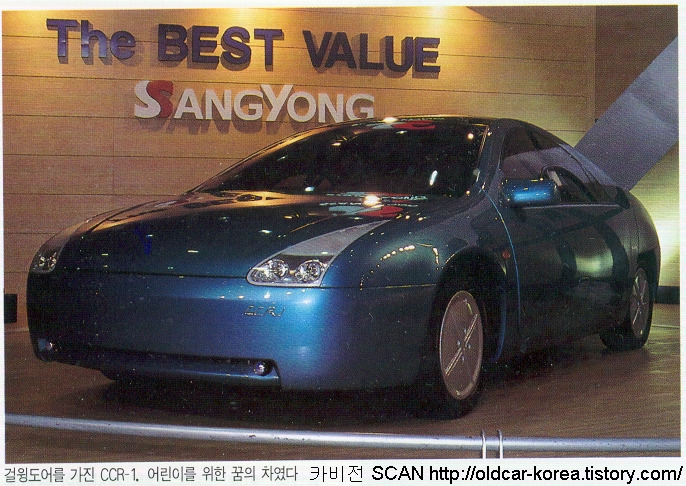
The project’s name reflected its underlying purpose. Clean Car 1 was conceived around the ambitious vision of zero-emission urban transportation. However, its designers deliberately avoided the conventional industry approach of simply converting an existing, mass-market sedan into a makeshift electric vehicle. Instead, the engineering team sketched and built a low-slung, two-seat coupe specifically intended to merge high aerodynamic efficiency with the emotional visual appeal of a true sports car.
Team Manager Lee Myung-hak, who spearheaded the intensive engineering effort, frequently pointed out that one of the most daunting challenges of the project was defining what an electric car ought to be during an era when there was no established formula or industry standard for building one from the ground up.
A Rolling Lab
Functioning as a true rolling laboratory, the CCR-1 showcased an innovative approach to vehicle architecture. Its chassis utilized an extruded aluminum space-frame structure explicitly engineered to minimize vehicle weight. To complement this lightweight foundation, the exterior body panels were manufactured from high-rigidity fiber-reinforced plastic. This dual strategy was designed to tackle one of the most fundamental physical hurdles confronting early electric vehicle development: the immense, burdensome weight of contemporary batteries.
The electric powertrain itself was positioned strategically behind the two-seat cabin in a classic mid-engine, rear-wheel-drive configuration. Powering the wheels was a multi-face bipolar brushless DC motor that generated approximately 37 kilowatts of power—roughly translating to 50 horsepower—accompanied by a peak torque output of 196 Newton-meters.
Energy storage was handled by a high-performance lead-acid battery pack, supplied by Korea Battery Co., Ltd. While this battery chemistry appears primitive by modern lithium-ion standards, the CCR-1 brilliantly illustrated how meticulous attention to vehicle weight reduction, aerodynamic profiling, and rolling resistance could partially compensate for the inherent limitations in early battery energy density. SsangYong claimed the prototype could achieve a top speed of 120 kilometers per hour alongside a maximum test range of approximately 200 kilometers on a single charge when driven at a steady, efficient speed. While those metrics would be considered modest by contemporary electric vehicle standards, they were remarkably significant for a lead-acid-powered prototype engineered in the mid-1990s.
An EV Tire
Recognizing that efficiency must be engineered into every single component of the vehicle rather than just the motor and battery pack, the engineering team collaborated closely with Hankook Tire to develop specialized, low-rolling-resistance tires. The resulting 195/65VR15 tires were engineered specifically to reduce rolling resistance by roughly 7 percent compared to conventional tires available during that period. This collaboration underscored how deeply the project valued a holistic, system-wide approach to automotive efficiency.
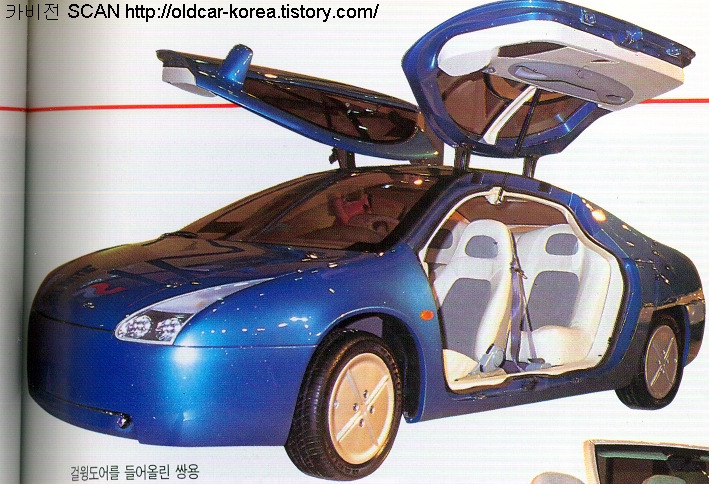
Visually, the vehicle’s most striking statement came from its gull-wing doors. Hydraulically assisted and designed to swing gracefully upward from the body structure, these doors beautifully complemented the CCR-1’s low roofline, sharp angles, and teardrop-shaped aerodynamic profile.
The concept vehicle made its grand world debut at the inaugural Seoul Motor Show in May 1995, held at the Korea General Exhibition Center, which is now widely known as COEX. SsangYong proudly displayed the CCR-1 alongside the CRS, another experimental vehicle from its stables, as the automaker aggressively sought to project a more technologically ambitious and forward-looking corporate image to the domestic public.
Following its successful domestic premiere, the electric coupe traveled to Europe for its international debut at the prestigious Frankfurt Motor Show in September 1995. Its appearance on the European stage placed a pioneering South Korean electric sports-car concept squarely before a critical international automotive audience during a period when battery-powered performance cars were still viewed as automotive curiosities.
Despite the technical triumphs of the prototype, the CCR-1 never transitioned into commercial production. The project fell victim to profoundly unfavorable macroeconomic timing. Within just two years of its international debut, South Korea and the broader Asian region were engulfed by the devastating Asian financial crisis. This sudden and severe economic shock placed crushing financial pressure on the country’s major industrial conglomerates, forcing businesses to drastically redirect their capital toward projects that promised clearer and much more immediate commercial returns.

Why It Didn’t Happen
SsangYong Motor was already navigating delicate financial waters prior to the economic downturn. In 1998, the company was officially acquired by Daewoo Motors. Amidst corporate restructuring and financial instability, expensive experimental vehicle programs could no longer command priority. As the business refocused its resources entirely on its established, profitable lines of SUVs and commercial vehicles, the CCR-1 remained a fascinating one-off prototype rather than evolving into a limited-production electric sports car.
Nevertheless, the historical significance of the CCR-1 extends far beyond its status as an unproduced concept car. The development process provided SsangYong’s engineers with invaluable, hands-on experience in aluminum space-frame construction, composite bodywork fabrication, electric propulsion integration, battery management, aerodynamic optimization, and low-resistance tire engineering at a time when the global electric vehicle industry was still in its absolute infancy.
Over the ensuing decades, the original prototype found a permanent home in SsangYong’s institutional history archives. The company itself weathered several subsequent ownership transitions before eventually emerging under the banner of KG Mobility.
Decades after the pioneering work done on the CCR-1, KG Mobility returned to the forefront of battery-electric vehicle development with modern production models such as the Korando e-Motion and the Torres EVX. Those contemporary vehicles belong to an entirely different technological epoch, utilizing advanced lithium-ion chemistry, sophisticated power electronics, and high-speed charging infrastructure that would have seemed like science fiction back when the gull-wing CCR-1 first rolled onto the showroom floor in Seoul.